


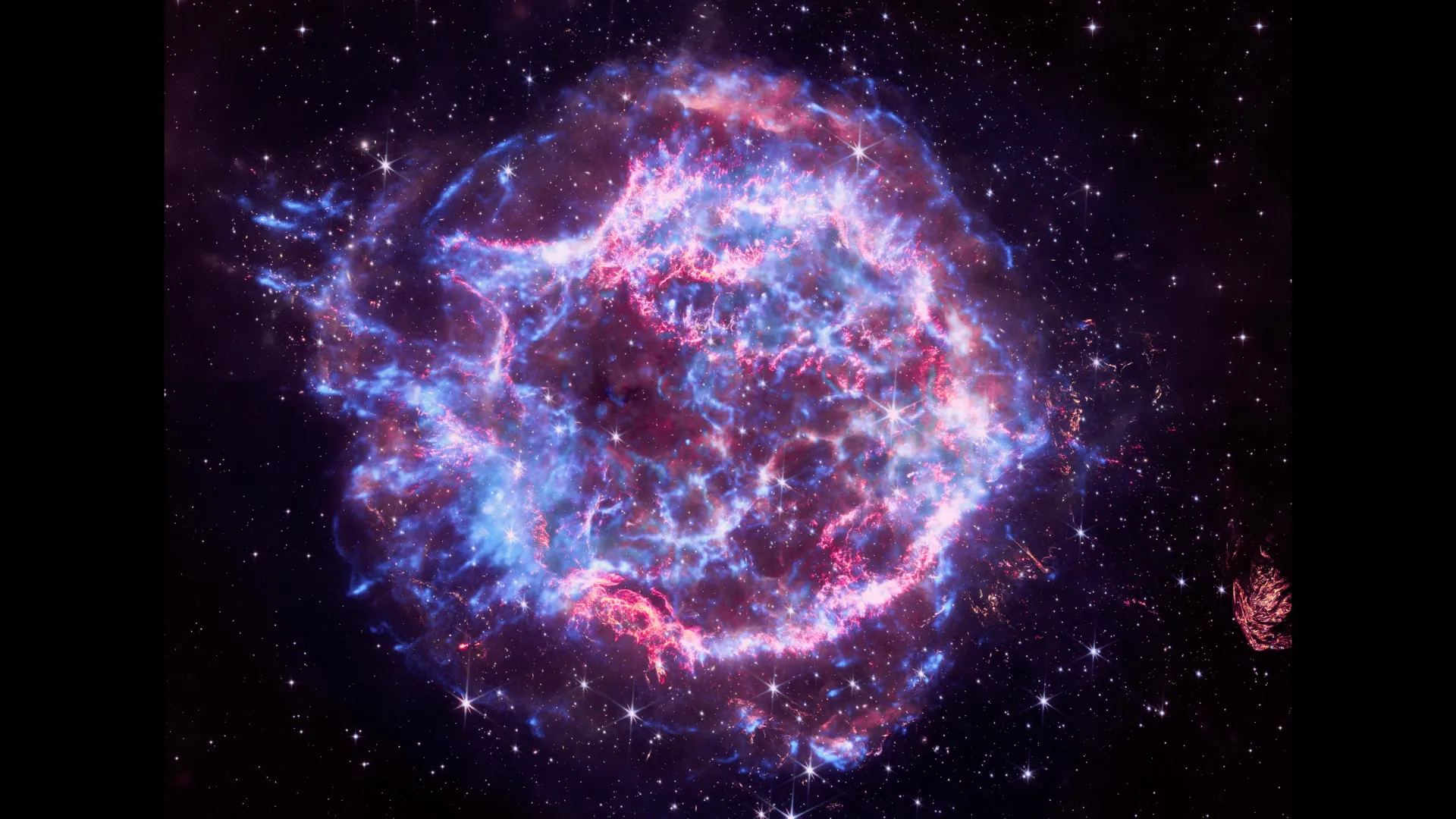
To commemorate the United States’ 250th anniversary, NASA has released four spectacular images of deep space from the Chandra X-ray Observatory. Each image is rendered in patriotic shades of red, white, and blue. In addition to images, the station also announced three new sonifications that convert stargazing into sound, offering another way to experience the universe.
This collection combines data from Chandra with observations from other telescopes to showcase some of the universe’s most remarkable objects, from the remains of exploding stars to distant galaxy clusters filled with evidence of dark matter.
Cassiopeia A reveals the aftermath of a stellar explosion
The first image (above) shows Cassiopeia A, one of the Milky Way’s best-known supernova remnants. It combines X-ray observations from NASA’s Chandra X-ray Observatory (shown in blue and purple) with infrared data from NASA’s James Webb Space Telescope (shown in red and white).
Chandra’s X-ray observations highlighted the powerful blast wave from the star’s explosion and revealed elements such as iron, calcium, and oxygen scattered throughout the debris. Webb’s infrared images capture an expanding shell of material left behind by the explosion and a cloud of cosmic dust spread across the debris.
NGC 3603 presents a wonderful nursery school
The following image highlights NGC 3603, a nebula in the Milky Way that contains a huge population of young stars.
In this composite view, Chandra’s X-ray data (red and white) reveals diffuse X-ray emission near the center and many bright dot-like X-ray sources scattered throughout the image. Observations collected by NASA’s Hubble Space Telescope in optical, infrared, and ultraviolet wavelengths (red-orange, green, blue, and yellow) show that stars are concentrated near the center, while dust and gas are spread out in the lower part of the nebula.
Combining these layers creates an image dominated by red, white, and blue, and the X-ray data highlights the shimmering glow of young stars forming within the nebula.
Messier 94 highlights star-forming rings
Another image provides a fresh view of spiral galaxy NGC 4736, known as Messier 94.
This photo combines Chandra X-ray observations at multiple energies (red, orange, and blue) with visible-light images (red, green, and blue) taken by an astrophotographer using a ground-based telescope. At the center of the galaxy is a bright inner ring known as the starburst ring, where new stars are actively forming. Scientists believe this burst of star formation may have been fueled by gas flowing inward through the galaxy’s characteristic elliptical structure.
Galaxy cluster provides evidence of dark matter
The final image in the Patriotic collection shows ZwCl 0024+1652, a distant galaxy cluster that has helped astronomers study dark matter.
Specially processed Hubble observations (blue) reveal evidence of dark matter, and another Hubble image shows the cluster’s individual galaxies in yellow and white. Chandra’s X-ray observations added a glowing red cloud of superheated gas filling the cluster. This huge reservoir of hot gas contains much more mass than all the galaxies in the cluster combined.
Together, the four images celebrate America’s 250th anniversary and highlight the unusual objects and phenomena that NASA continues to explore throughout the universe.
