


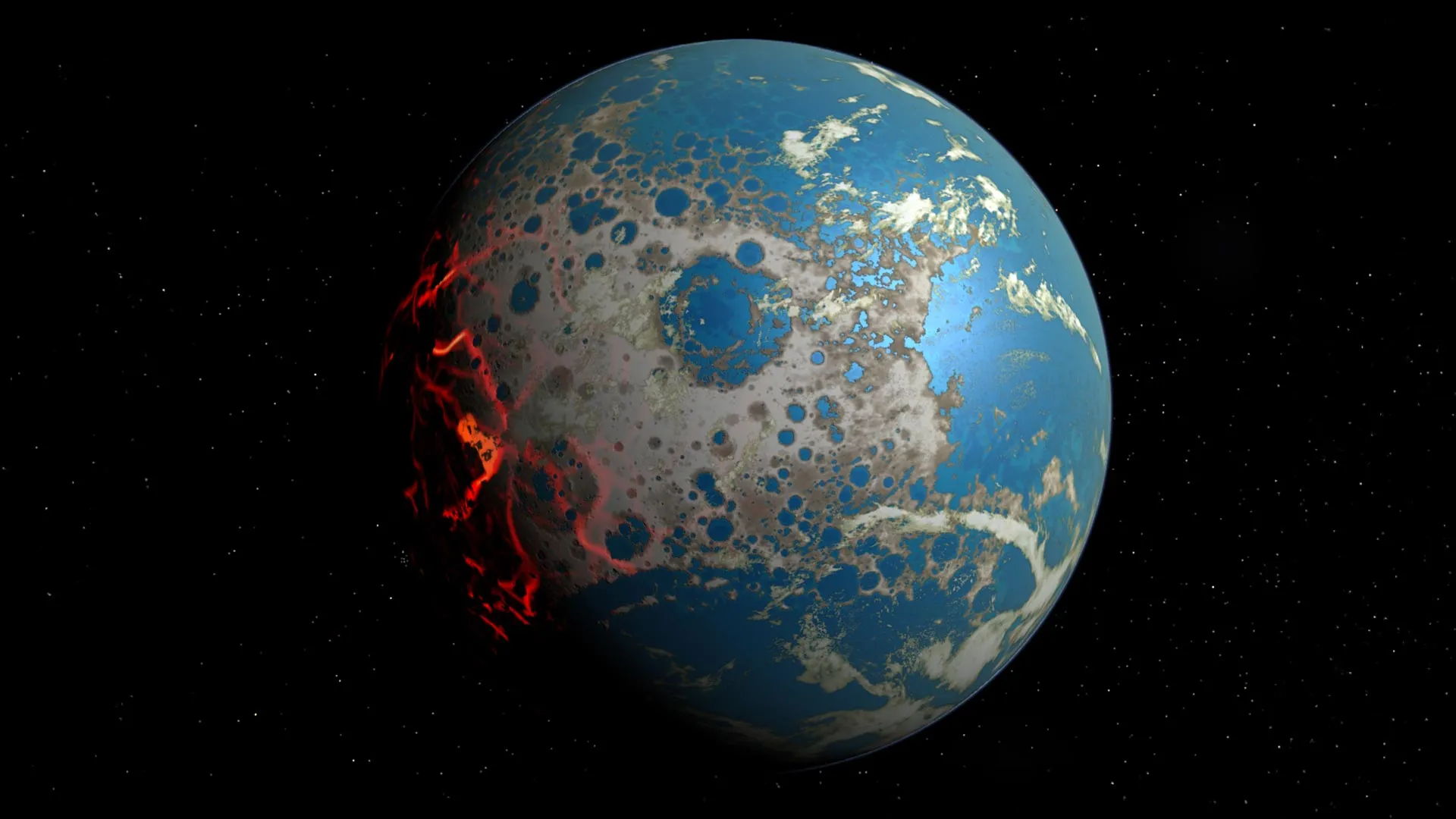
Scientists at the Southwest Research Institute (SwRI) have taken a new look at Earth’s violent beginnings and found that ancient asteroid impacts may have played a key role in making Earth habitable. Their computer models suggest that repeated impacts did more than just reshape the young Earth’s surface. They also created large hydrothermal systems, hydrothermal environments that may have provided the right conditions for life to emerge.
To reach these conclusions, the researchers modeled the early history of asteroid impacts on Earth. Their simulations showed that these powerful impacts disrupted the planet’s crust, creating porous underground channels that allowed water to circulate through the upper layers of the crust.
The research team used a sophisticated impact physics code that simulates how high-velocity impacts disrupt solid rock and create permeable regions. This is the first comprehensive study to measure how asteroids affect production permeability, a key property that allows fluids to move through the early Earth’s crust.
“This modeling is both novel and critical to understanding the earliest environments in which life could have originated,” said SwRI’s Amanda Alexander, lead author of the paper. AGU progress Article explaining the research. “Although often considered catastrophic in the context of dinosaur extinction, impact shocks were also likely important in creating an environment for prebiotic chemistry.”
How asteroids reshaped the early Earth
Earth formed about 4.5 billion years ago and soon entered an era of violent asteroid impacts. These high-velocity impacts shattered vast amounts of rock beneath the Earth’s surface, vaporizing material and dispersing molten rock across the Earth’s surface.
The enormous heat generated by each impact, combined with the Earth’s natural geothermal heat, may have forced hot water into the newly cracked crust. The resulting hydrothermal system is comparable to the network of geysers around Yellowstone National Park and may have created a favorable environment for the origin and early evolution of life.
To better understand this process, the researchers simulated asteroid impacts across a range of sizes and velocities. They also tested various crustal compositions and temperature conditions before calculating how many cracks would form with each impact, producing a permeable crust.
Simulations suggest that this early, single, large impact could have generated 100 times as much hydrothermal activity as is seen across the Yellowstone region today.
“Because life may have originated or evolved in hydrothermal environments, it is important to understand and quantify the production of these systems through early Earth impacts,” Alexander said, noting that additional research is needed to better define the characteristics of these ancient hydrothermal systems.
Long-term effects on the Earth’s crust
The model shows that the amount of broken, permeable rock produced by an impact depends primarily on the energy of the impact, which is controlled by the asteroid’s size and speed. At the same time, the degree of permeability within these fractured regions was influenced by the Earth’s geothermal gradient and crustal composition. The researchers also included estimates of how often these effects occurred.
“Using bombardment history models to estimate the cumulative effects of repeated impacts, we estimate that the upper 5 miles (8 kilometers) of the Earth’s crust were likely highly permeable 4.3 billion years ago, and that a significant portion of this volume may have remained permeable until 3.5 billion years ago,” Alexander said. “These results show that impacts helped induce hydrothermal changes in the early Earth’s crust, with important consequences for the geochemical evolution of the near-surface environment.”
