


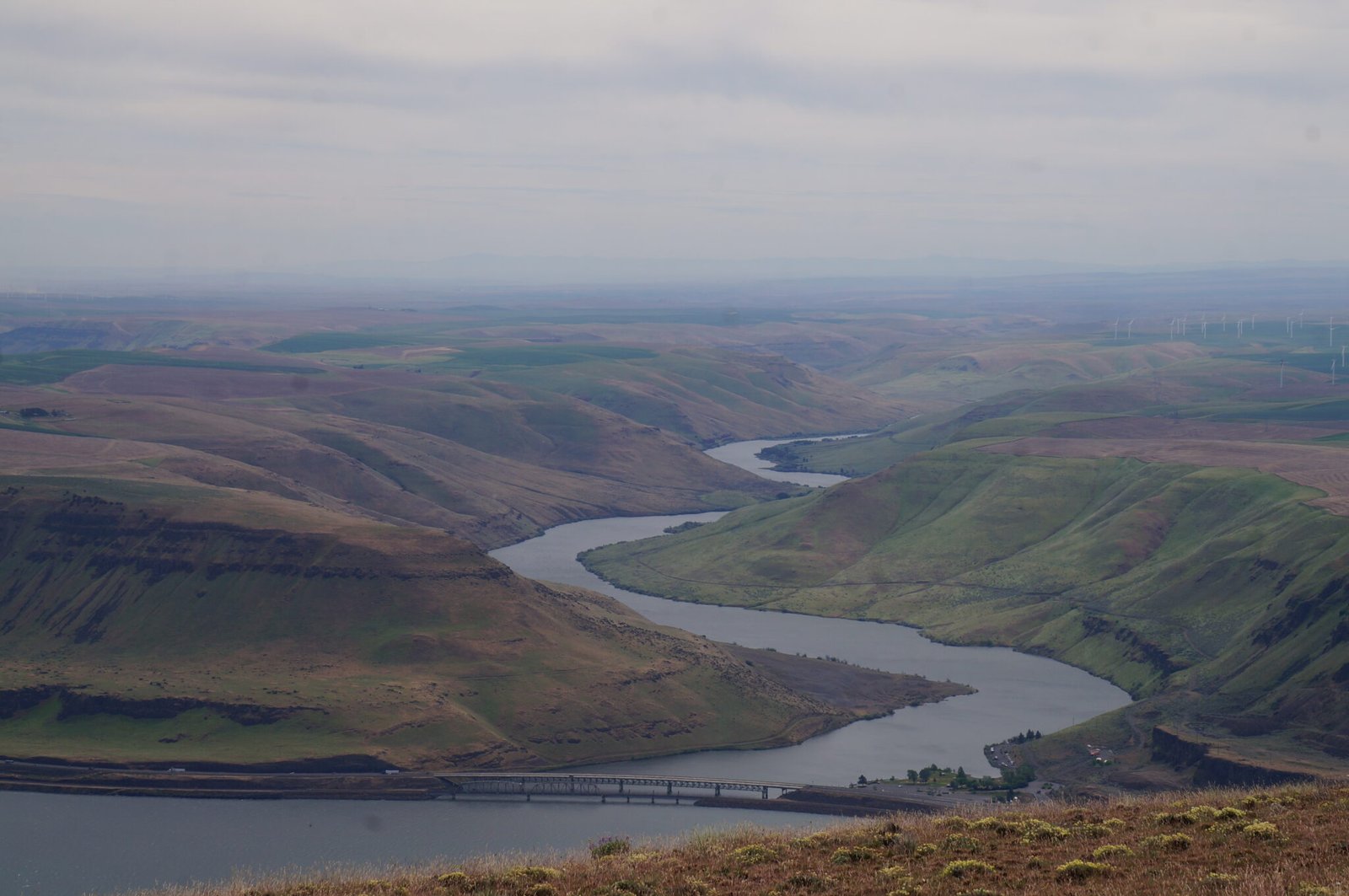
GOLDENDALE, Wash. – Members of the Yakama Nation gathered on high ground on the Washington side of the Columbia River near the John Day Hydroelectric Dam to protest a proposed clean energy storage project on the tribe’s sacred land.
Supporters of the Goldendale pumped storage energy storage project say it will help meet the region’s growing energy needs, with project developers touting its potential to one day power up to 500,000 homes without emitting harmful greenhouse gases into the atmosphere. But there is growing evidence that large data center campuses may be one of the main beneficiaries of that power.
At an event earlier this month, Yakama leaders and a handful of nonprofits fighting the project in federal court, including Hood River-based Columbia Riverkeeper, called on Washington Gov. Bob Ferguson to intervene after state and federal agencies issued key permits to the project developer, a process that has been in the works for a decade. This was despite a state study finding that it would have a “significant and unavoidable adverse impact” on Yakama’s historic sites and culturally significant plants.
The 700-acre hydropower storage project will be built on the contaminated site of an abandoned aluminum smelter once owned by Lockheed Martin, and more broadly on land that has long encroached on the sacred Yakama grounds known as Pushpum, meaning “mother of all roots.”
It is home to Yakama ruins and dozens of seeds, roots, flowers, and shrubs, some of which are unique to the region, that are harvested and protected by the tribe.
“We know it’s time for renewable energy, but why is it in our roots? Why is it in a critical migratory corridor for hawks, grouse and deer?” asked Elaine Harvey, watershed manager for the Columbia River Intertribal Fish Commission and member of the Kamiupa Band of Yakama.
“And I say this: Who are we building for? We’re going green now when it comes to data centers,” she said. “We’re not going green because of Washington and Oregon mandates. We’re going green because of our data centers.”
 Elaine Harvey, a member of the Yakama Tribe and watershed manager for the Columbia River Intertribal Fish Commission, speaks at an event near Pushpum, a sacred site for the Columbia River Tribe near Goldendale, Washington, on Friday, May 8, 2026. (Photo by Alex Baumhardt/Oregon Capital Chronicle)
The project’s owner, Danish investment firm Copenhagen Infrastructure Partners, has not provided details about who will buy the energy.
Paul Kopleman, the company’s communications manager, did not respond to multiple questions from the Capital Chronicle about who specifically the company would sell power to, but instead said in an email that the project is aimed at meeting the growing demand for power in the Northwest and, when fully operational, will provide “enough on-demand renewable electricity to power approximately 500,000 homes.”
He added that the permitting process required consultation with Yakama and a lengthy public comment period.
“We remain committed to working with affected tribes to complete a historic property management plan that protects their cultural and historic resources,” he said.
Recent reports from Street Roots, Northwest Public Radio, and local utility district permitting documents and energy usage data reviewed by the Capital Chronicle reveal that Denver-based data center company Stack Infrastructure is certain to be among the power buyers.
STACK did not respond to a request for comment, but a spokesperson for the Washington State Department of Ecology told Street Roots that the data center is in negotiations to purchase land next to an energy storage project in Goldendale. Additionally, Street Roots reported that Scott Tillman, manager of the LLC that currently owns the land where the energy storage project will be built, also notes on his LinkedIn page that he is “working with STACK and Blue Owl Digital Infrastructure to develop the world’s greenest IGW and hyperscale data center.”
 People gather near Pushpum, a sacred site for the Columbia River Tribe near Goldendale, Washington, on Friday, May 8, 2026. Yakama tribal leaders and nonprofit environmental groups want to halt development of the pumped-storage energy project, arguing it threatens the site, the seeds and roots that tribal members harvest from it, as well as wetlands, groundwater and wildlife. (Photo by Alex Baumhardt/Oregon Capital Chronicle)
Power for whom?
Once built, the multibillion-dollar pumped-storage project will function as a type of gravity storage battery.
When the wind and sun aren’t producing enough electricity, billions of gallons of water from reservoirs built above the river are released through large tunnels to turbines below to generate electricity, which then collects in the reservoir below. The next time there is plentiful wind and sun, the excess energy is used to push water back into the upper reservoir, waiting to be released to recharge the turbines on another dark or windless day.
There is no indication that this project is needed to provide more power to meet Klickitat County’s growing local energy needs.
The local government’s latest forecast for 2024 estimates that industrial and commercial energy demand will increase by only 3% over the next 10 years. Additionally, data from the U.S. Energy Information Administration shows that electricity demand for Klickitat Utility District users is about the same today as it was for commercial and industrial customers a decade ago. Although there are no data centers in the county at this time, only a planned STACK data center, the area serves the needs of a stable residential customer base.
However, in a 2020 letter to the Federal Energy Regulatory Commission, district officials wrote that they had “recently held discussions with parties interested in pursuing the development of a data center facility” adjacent to the proposed energy storage site in Goldendale. The district has agreed to provide water for the Goldendale Energy Project and, if approved, will provide water to the data center, but said it will not be able to power the data center unless it purchases power from sources like the Goldendale Energy Project.
That’s because the district currently purchases all of its power from the Bonneville Power Administration, and under the Northwest Power Act, it is not allowed to use that power to supply new single loads with a capacity greater than 10 megawatts, such as a “hyperscale data center.”
A power company owned by a private investor will likely need to power the data center. In 2022, Puget Sound Energy submitted an interconnection application to the BPA for a 958-megawatt stacked data center to be built on what appears to be the Goldendale site, listing it as “under consideration,” according to Columbia Riverkeeper researchers. If built at that scale, the data center facility could require as much as 80 percent of the 1,200 megawatts of energy that the Goldendale Pumped Storage Project could generate at full capacity.
Meg Bomarito, an environmental planner with the Washington State Department of Ecology, said application documents for the Goldendale project show a new aerial transmission line is needed across the Columbia River to connect to the Bonneville Power Administration’s John Day substation. This means that Bommarito may also be planning to sell power directly to BPA, but Bommarito had no information on who it would connect to or who would buy it. The Department of Ecology and the Klickitat Utility District directed all questions regarding who will buy back the energy to Copenhagen Infrastructure Partners.
For Yakama, the projects, processes and opaque power purchasers represent a new multigenerational displacement caused by new industrial energy consumption.
 Yakama youth perform the Swan Dance near Pushpum, a sacred site for the Columbia River Tribe near Goldendale, Washington, on Friday, May 8, 2026. (Photo by Alex Baumhardt/Oregon Capital Chronicle)
For more than a century, governments, businesses, and individuals have designed, harnessed, and harnessed the power of water, wind, and sparse landscapes in the Columbia River Basin for energy, at great cost to indigenous peoples and the natural world. In the early 20th century, hydroelectric dams provided power for the expansion of irrigated farmland, towns and cities, and during World War II they were also used to manufacture vast amounts of aluminum used in airplanes and artillery.
Today, wind and solar farms dot the landscape to meet the non-fossil energy needs of homes as well as increasingly industrialized electricity, much needed after 150 years of pumping catastrophic levels of carbon dioxide into the atmosphere to meet endless demand.
“We’re feeling the pressure of data centers and that pressure and the need for water and energy,” Harvey said. “It feels like things are moving too fast, just like when the dams were built and the people were pushed aside.”
Get your morning headlines.
Subscribe
