


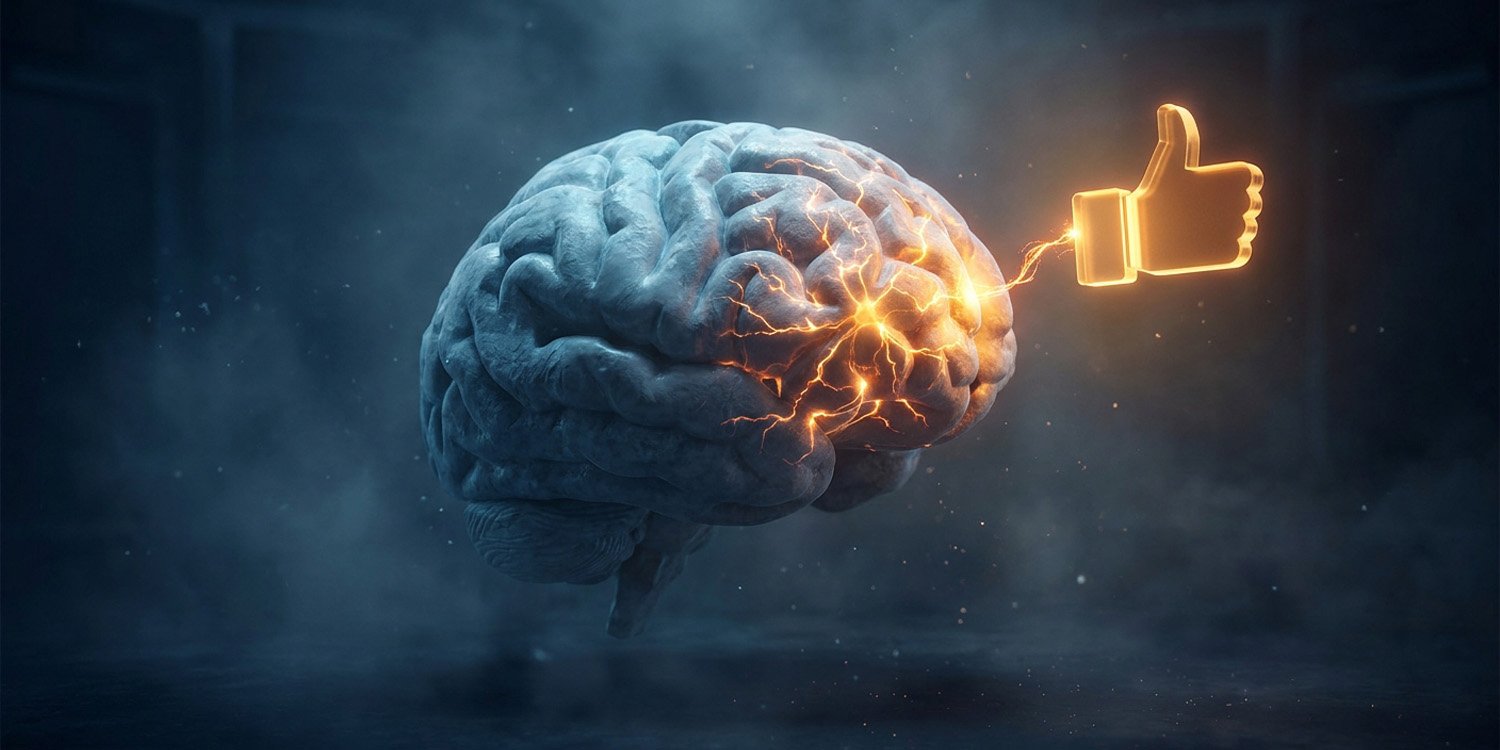
People who experience high levels of anxiety about missing out on social events exhibit specific patterns of brain activity when receiving digital approval. A recent experiment found that people with a strong fear of missing out have increased neural sensitivity to positive social feedback in the form of a digital thumbs up icon. This study Journal of Affective Disorders.
Fear of missing out (often abbreviated as FoMO) is the pervasive feeling of anxiety that others will be enjoying a rewarding experience without you. Psychologists link this particular anxiety to a basic human need known as the need to belong. When people feel isolated and unsupported in their physical lives, they often turn to their smartphones to monitor the social activities of their peers. This pursuit of digital connectivity acts as a coping mechanism to reduce feelings of isolation.
Social media platforms are systematically built to exploit these basic psychological needs. It provides instant social rewards, such as likes and positive comments, and provides a temporary sense of belonging. Over time, repeated exposure to these digital validations can train the brain to anticipate rewards. According to behavioral psychology models, this intermittent reinforcement can make digital-like expectations highly motivating and form habitual checking routines. These routines often have unintended consequences, such as poor sleep, distracted driving, and increased anxiety symptoms.
The researchers wanted to know whether the physical brain responds differently to basic social rewards in people who are highly concerned about being excluded. A team of scientists led by psychologist Zhichen Chen, along with Jingnan Wang and Jiansheng Li of China’s Northwest Normal University, designed an experiment to test this idea. The researchers suspected that people who crave peer inclusion might have their brains overreact when given cues of social approval.
For the experiment, the researchers recruited dozens of college students. The team administered a series of detailed questionnaires to measure participants’ baseline anxiety about missing out on social events and their innate desire for interpersonal belonging. Based on these survey scores, the researchers divided the 67 eligible participants into two different categories. One category was a high anxiety group of 32 people, and the other was a low anxiety group of 35 people.
Participants then entered a controlled laboratory room for neurological testing. The research team used a technique called electroencephalography to record continuous electrical activity in the participants’ brains. The technique involves placing a special cap on a person’s scalp that is fitted with a number of small, non-invasive sensors. The setup requires applying a conductive gel to ensure a stable connection between the sensor and the skin. These sensors passively detect rapid changes in voltage that occur when groups of neurons fire together as the brain processes new information.
Wearing sensor caps, the students sat in a quiet room and played a special game on a computer monitor. The game began with a visual cue, like a cartoon smiley face, indicating that the next round was a chance to gain social recognition. In some cases, a plain circle was displayed, indicating a neutral round in which performance did not result in social feedback. After a random delay, the target square flashed on the screen for several seconds.
Participants were required to press a button on the keyboard as quickly as possible after the target appeared. The quick response was successful and resulted in a positive review in the form of a thumbs up icon. If the response is slow, a negative rating will be displayed as a thumb down icon.
To ensure fairness and consistency, a computer program continually adjusted the difficulty of the game. If the player wins the round, the target will appear for less time on the next turn. If you lost, the target stayed on the screen a little longer. This background adjustment allowed all participants to succeed on about half of the trials, allowing them to separate their brain responses from their true physical reaction speeds.
The researchers analyzed the electrical data to see what happened in the brains of participants the moment they saw the results of their efforts. This precise timing allowed scientists to chart the chronological progression of thoughts. They focused on two different stages of mental processing that occur after feedback. The first phase involves an early automatic assessment of whether the outcome was good or bad. Evaluation takes place within a third of a second. The second stage involves a deeper cognitive evaluation of the subsequent results, as measured by a specific brain wave known as the P300.
P300 EEG is a well-established physiological marker of attention and motivation. A spike in this particular electrical signal indicates that the brain is devoting more cognitive resources to the event. A large P300 wave means that the person perceives the information to be highly relevant and motivating. Neuroscientists believe that these waves reflect activity in distributed brain networks that regulate human attention and process emotions.
When observing participants’ physical gameplay, the behavioral results were not statistically significant. Both the high-anxiety and low-anxiety groups played the game at similar speeds and with the same accuracy. The lack of differences in overt behavior confirmed that both groups were paying attention and trying equally hard to win the game. Early automatic brain waves, the first signal to detect winning or losing, also showed no difference between the two categories of students.
Differences emerged at a later evaluation stage. When the high anxiety group received a digital thumbs up, their brains produced a much larger P300 response compared to the low anxiety group. This heightened electrical activity occurred specifically in response to positive feedback from society. The researchers observed no differences between groups when participants received negative or neutral feedback.
These neural patterns suggest that individuals who strongly fear social exclusion process digital verification as a highly significant event. The brain pays special attention to the thumb icon and treats it as a very powerful motivational signal. This heightened physical sensitivity to approval provides a biological clue as to why some people have a hard time weaning themselves away from digital devices. In a socially threatening environment, being hyper-vigilant for signs of acceptance can push individuals to constantly update their apps.
When people feel that their social needs are not being met in the real world, digital likes may acquire amplified compensatory value. Addiction psychology theory suggests that overexposure to alternating patterns of reward can make the brain’s motivational circuitry hypersensitive. When this happens, a person may not even feel deep pleasure when receiving a reward, but the brain still creates an immense craving for it. The elevated P300 wave observed in the high anxiety group fits this model. This means their brains assign greater incentive salience to social media cues, reinforcing repeated phone checks.
The authors noted that the experimental design has several limitations. Because this study was based only on a sample of healthy college students, the results may not automatically apply to older adults or younger adolescents, whose brains are still developing. The social rewards used in the lab tasks were simplified icons that were not as realistic as the authentic comments, dynamic facial expressions, or direct messages found online. Real-world interactions involve emotional nuances that can’t be fully captured with a generic thumbs-up.
The researchers also relied on self-reported questionnaires to measure digital usage habits, rather than tracking objective screen time metrics. To fully understand the long-term effects of this biological trait, scientists need to conduct long-term studies. Tracking individuals over months or years may reveal whether this increased irritability ultimately positively predicts the development of Internet use disorder. Future research could also investigate whether therapeutic interventions designed to satisfy the need to belong to the physical world reduce neural overreactivity to digital approval.
The study, “Chasing Likes: High FoMO Enhances P300 Reactions to Positive Social Feedback,” was authored by Zhichen Chen, Jingnan Wang, and Jiansheng Li.
