


Massive stars produce light and heat through nuclear fusion, a process that releases vast amounts of energy from their cores. But eventually, the largest stars will run out of fuel. When that happens, the outward pressure created by the radiation is no longer strong enough to resist gravity. The star begins to collapse under its own weight until, in theory, all of its mass is compressed into a single point known as a singularity.
Although black holes are widely accepted by physicists, they still raise serious questions. How can the mass of billions of suns be squeezed into an infinitely small point? How does space-time curve infinitely at a singularity?
At this extreme limit, the known laws of physics can no longer provide reliable answers. Scientists cannot explain exactly what happens under such conditions. Black holes have other challenges because they hide everything beyond the event horizon. Any matter, radiation, or information that crosses this boundary, including light itself, is no longer observable.
Gravaster and the role of dark energy
These open questions have led some researchers to investigate the possibility that at least some objects identified as black holes are actually something else entirely. One proposed alternative is a microscopic object known as a gravastar.
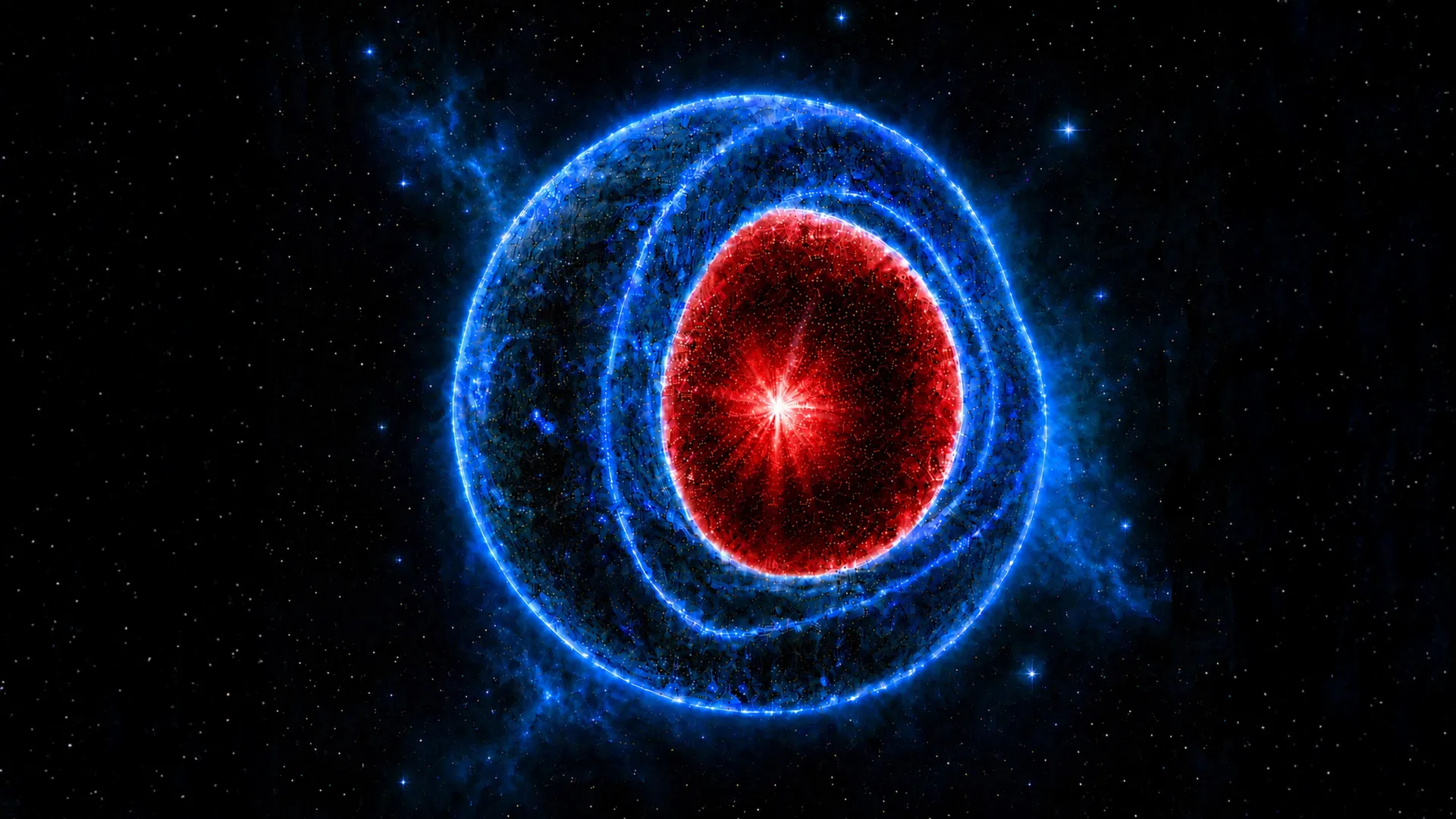
Gravasters are almost as dense as black holes and have strong gravity, making them extremely difficult to detect. However, unlike black holes, they do not contain singularities or event horizons. Instead, dark energy fills beneath the outer layer of ordinary matter. This mysterious form of energy creates an outward pressure that counteracts gravity and prevents complete collapse.
For many physicists, gravaster offers an attractive alternative because it avoids some of the conceptual problems associated with black holes. But one big question has remained unanswered for decades. So how is Gravaster actually formed?
The shape of a mini-universe proposed by a new solution
Theoretical physicists Daniel Jampolski and Professor Luciano Rezzola have proposed the first dynamic solution to the equations of Albert Einstein’s theory of general relativity to explain how collapsing stars create gravasters.
Their research suggests that the collapse of massive stars can trigger the birth of miniature universes within the collapsing matter itself. This newly formed universe will not be all that different from the Big Bang that gave birth to our universe. As with our universe, dark energy will drive its expansion.
As the mini-universe expands, it is pushed outward against the inward force of gravity. This opposing force can stop the collapse before a black hole forms. As a result, a stable balance is maintained between the collapsing stellar material and the expanding inner universe. That balance creates Gravaster.
The researchers say their solution provides the first explanation for a question that scientists have been debating for about 25 years: how Gravaster can emerge from the decay of ordinary matter.
Room for new physics
“The big bang of the emerging universe could unfold after a star collapses to the point of becoming a black hole,” explains Daniel Jampolsky, who developed the solution during his master’s thesis under the supervision of Luciano Rezzola.
The behavior of matter compressed to such unusual densities remains poorly understood, leaving open the possibility of new physical phenomena. Jampolsky said: “It is easy to imagine that the Big Bang occurs only at a very late stage, when matter is already extremely compressed, thereby triggering new effects.”
Rezzola, professor of theoretical astrophysics at Goethe University, emphasizes that exploring alternatives does not mean rejecting black holes. “The search for alternatives to black holes should not suggest skepticism about black holes, which are the most natural and simplest solution to the fate of gravitational collapse. However, as scientists in general and theoretical physicists in particular, it is essential that we maintain an open-minded approach to what we do not know, and therefore explore both the accepted wisdom and more exotic interpretations. History has taught us that it is not unusual for the latter to become the former.”
