


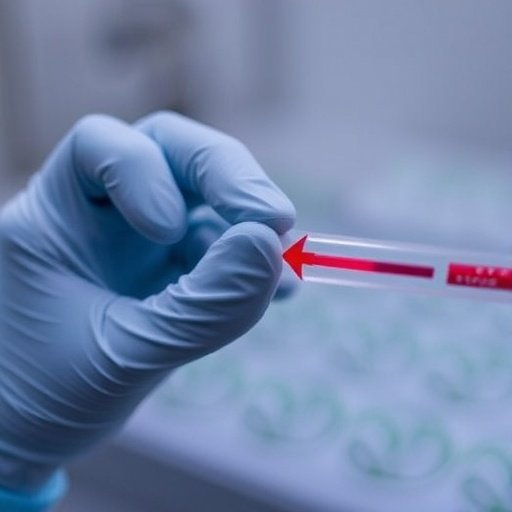
In a groundbreaking study recently published in the Journal of Exposure Science and Environmental Epidemiology, researchers have uncovered a new approach to monitoring environmental pollution through an innovative capillary blood collection device. This cutting-edge technology was applied to a cohort of veterans living near potential sources of per- and polyfluoroalkyl substances (PFAS), which are notorious for their persistence in the environment and suspected health effects. This study represents a significant advance in biomonitoring technology and addresses the critical need for minimally invasive, accurate, and field-deployable tools to assess human exposure to these hazardous compounds.
PFAS are sometimes referred to as “forever chemicals” due to their exceptional resistance to degradation and are widely used in a variety of industrial applications, from firefighting foams to nonstick cookware. Their ubiquity has resulted in widespread infestation of the environment, contaminating water supplies and creating exposure pathways for nearby populations. Given the historical use of PFAS-containing materials, veterans living adjacent to military installations and industrial sites are disproportionately affected. However, traditional exposure assessment methods that rely on venous blood sampling are invasive and logistically difficult, limiting large-scale surveillance efforts.
The authors of this study, led by Havens et al., utilized a minimally invasive capillary blood sampling technique to overcome these limitations. This method uses a small, easy-to-use device to collect a blood sample through a finger prick, greatly simplifying the process of obtaining biological samples for chemical analysis. This innovation is expected to facilitate broader surveillance efforts and enable researchers to monitor PFAS exposure in vulnerable communities with unprecedented efficiency and scalability.
To test the effectiveness of the capillary device, the team conducted a comparative analysis with traditional venous blood sampling in a cohort of veterans living near known environmental PFAS sources. The results showed strong agreement between the two sampling methods and confirmed that capillary blood sampling can reliably capture the internal burden of PFAS. This breakthrough reduces the burden on participants while maintaining data integrity and holds great promise for epidemiological research.
Importantly, this study also delves into spatial exposure gradients, showing how PFAS serum concentrations correlate with residential proximity to contamination hotspots. Veterans near such sites showed significantly elevated PFAS levels, raising concerns about local environmental exposure risks. This spatial analysis highlights the critical need for targeted public health interventions and continuous biomonitoring of at-risk populations.
Furthermore, by employing advanced analytical chemistry techniques that can detect trace levels of PFAS, researchers uncovered diverse exposure profiles among individuals, reflecting complex contamination patterns and lifestyle factors. Such granularity enables sophisticated risk assessments and individualized exposure mitigation strategies in line with modern precision public health paradigms.
Beyond its direct implications, this study paves the way for the integration of capillary blood sampling into routine environmental health monitoring. The portability and minimally invasive nature of this device has the potential to facilitate community-based surveillance programs and allow affected populations to actively participate in exposure assessments. This democratization of environmental health research has the potential to transform public engagement and policy advocacy around chemical pollutants.
This study also acknowledged the limitations inherent to capillary sampling, including potential variations in sample volume and matrix effects. Nevertheless, careful methodological standardization and quality control measures implemented by the researchers have alleviated these concerns and paved the way for robust application in diverse settings. Future studies are warranted to further optimize the performance of the device and expand the analyte panel.
Importantly, the timing of this study coincides with increased scientific and regulatory attention to PFAS contamination around the world. Regulatory agencies are enacting stricter limits on PFAS levels in drinking water, and increased public awareness is driving demand for more accurate exposure data. The capillary blood sampling approach may serve as an important tool in these efforts and provide actionable insights to shape policy and corrective actions.
Veterans health advocacy groups welcome these findings, highlighting the urgent need for accessible exposure monitoring tools that can better capture the environmental realities facing military personnel. The potential to implement large-scale biomonitoring efforts with minimal disruption has the potential to fill knowledge gaps and promote equitable health protection.
Additionally, incorporating this technology into longitudinal cohort studies may reveal chronic health effects associated with PFAS exposure. By enabling repeated measurements, researchers can track the dynamics of biomarkers over time and link exposure trajectories to disease outcomes. This long-term perspective is essential to unraveling the complex toxicokinetics and pathophysiology of PFAS-related conditions.
As environmental pollution patterns evolve with industrial practices and remediation efforts, adaptive and responsive biomonitoring methods will be essential. Capillary blood collection devices exemplify such adaptability, providing a scalable platform applicable not only to PFAS but also to a broader class of environmental contaminants of potential concern. This versatility places this technology at the forefront of exposure science.
In conclusion, the advent of capillary blood sampling for PFAS biomonitoring represents a pivotal advance in environmental health research. Havens et al. have demonstrated a practical, reliable, and innovative tool that has the potential to revolutionize exposure assessment, especially for vulnerable populations such as military veterans living near pollution sources. This research heralds new possibilities for surveillance, risk communication, and environmental justice, with reverberations across the scientific, regulatory, and community realms.
Pioneering approaches like this are critical as the global community faces challenges posed by persistent chemical pollutants. By providing accessible biomonitoring capabilities to researchers and affected people alike, science can pave the way to healthier environments and more resilient societies. The possibilities of capillary blood sampling technology usher in a new era of dynamic, accurate, and participatory environmental health science.
The implications of this research extend far beyond its initial applications and suggest fertile ground for interdisciplinary collaboration. Toxicologists, epidemiologists, engineers, and policy makers can benefit from integrating this tool into collaborative campaigns to address the pervasive legacy of “forever chemicals.” Continued innovation and adoption are essential to realizing the full potential of this breakthrough.
Overall, this study highlights how technological ingenuity, intertwined with environmental health imperatives, can move the field forward. By transforming the way exposure data is collected and interpreted, this study sets a new gold standard for monitoring invisible but insidious chemical threats in the environment and raises the bar for future research.
Research theme: Use of capillary blood collection devices to monitor exposure to per- and polyfluoroalkyl substances (PFAS) in veterans near potential sources of environmental contamination.
Article title: Use of capillary blood collection devices to monitor exposure to per- and polyfluoroalkyl substances (PFAS) in veterans living near potential sources of environmental contaminants.
Article references:
Los Angeles, Havens, ER, Hartley, KR Use of capillary blood collection devices to monitor exposure to per- and polyfluoroalkyl substances (PFAS) in veterans living near other potential sources of environmental contamination. J Expo Sci Environ Epidemiol (2026). https://doi.org/10.1038/s41370-026-00884-5
image credits:AI generation
Toi: April 30, 2026
Tags: Capillary blood collection devices for PFAS monitoringEnvironmental contamination tracking methodsField-deployable PFAS testing techniquesInnovative blood collection for toxicologyLarge-scale PFAS monitoring methodsMinimally invasive biomonitoring techniquesNon-invasive PFAS exposure assessment toolsNovel environmental exposure biomarkersPar and polyfluoroalkyl substances health effectsPFAS contamination in the veteran populationExposure to PFAS near military facilitiesAssessment of PFAS exposure in veterans
