


Quantum mechanics is famous for its strange and often counterintuitive ideas. At very small scales, particles do not behave like everyday objects. Instead, they can exist in multiple states at once, a concept known as superposition. Physicists describe this behavior using a mathematical object called a wave function. However, this picture conflicts with what we observe in everyday life, where objects occupy one distinct place or state at a time. To solve this, scientists typically propose that when a quantum system is measured or interacts with an observer, its wavefunction collapses into a single result.
Now, with support from the Foundational Question Institute (FQxI), an international group of physicists has taken a closer look at an alternative explanation known as the quantum decay model. Their findings suggest that these ideas could have surprising consequences for the behavior of time itself. This also includes slight limitations on the accuracy of time measurements. This study physical review studywe also provide a possible way to test these models against standard quantum theory.
“What we did was to take seriously the idea that the collapse model could be related to gravity,” says Nicola Bortolotti, a doctoral student at the Enrico Fermi Museum and Research Center (CREF) in Rome, Italy, who led the study. “And we asked a very specific question: What does this mean about time itself?”
Spontaneous decay and testable quantum models
In the 1980s, researchers began developing a theory that the collapse of the wave function occurs spontaneously, without the need for observation or measurement. Unlike traditional interpretations of quantum mechanics, which mainly provide different ways of thinking about the same equations, these collapse models make predictions that can in principle be tested experimentally.
“What we did was to take seriously the idea that the collapse model could be related to gravity, and we asked a very specific question: What does this mean about time itself?” says Nicola Bortolotti.
Bortolotti and colleagues Catalina Curceanu, Kristian Piscicchia, Lajos Diósi, and Simone Manti investigated two major versions of these models. One is the Diosi-Penrose model, which has long proposed a link between gravity and the collapse of the wave function. The other is continuous spontaneous localization. In a new study, researchers established a quantitative relationship between this second model and gravity-induced fluctuations in space and time.
Small time uncertainties and the limits of clock accuracy
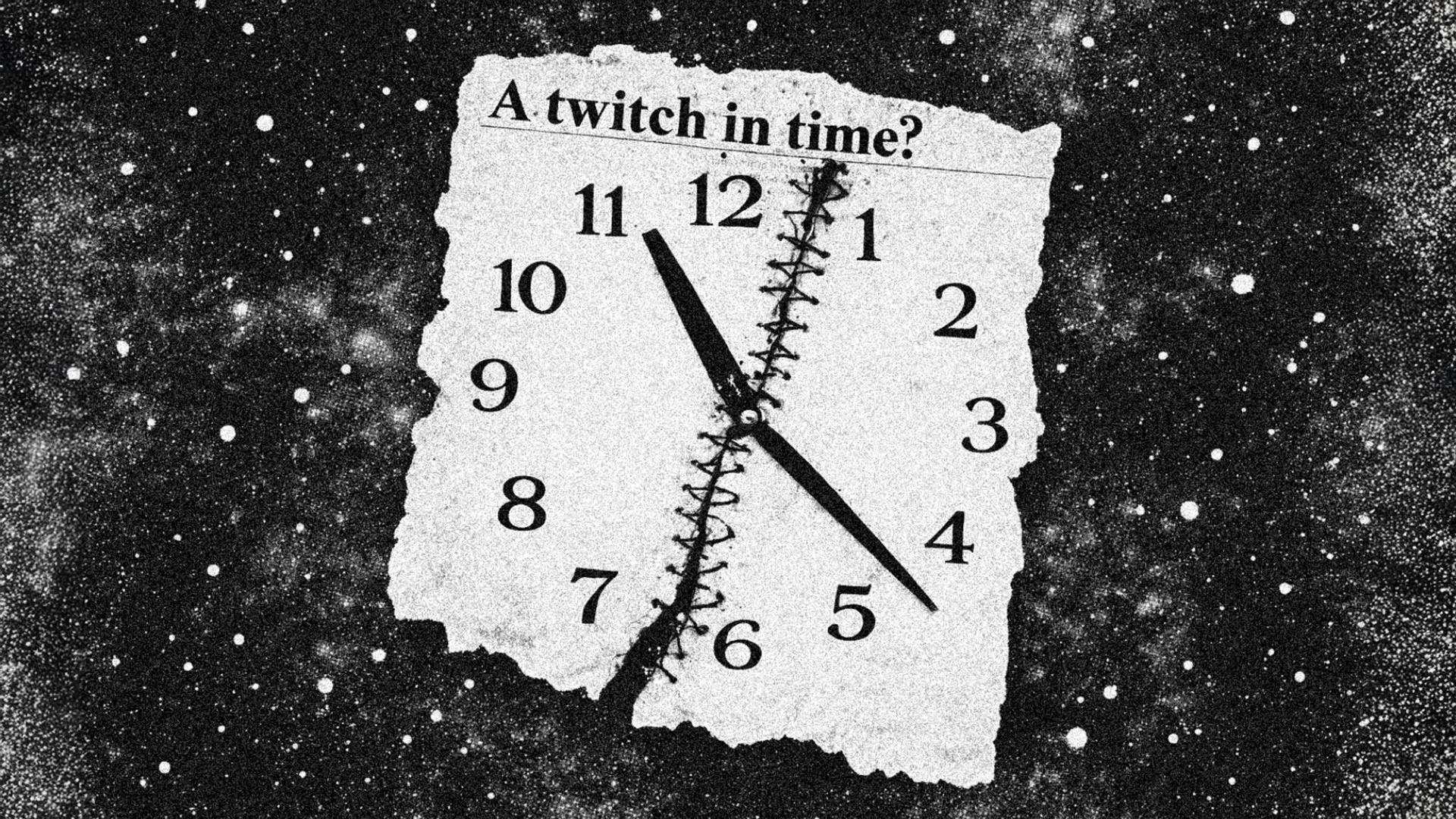
Their analysis shows that if these collapsing models accurately depict reality, it is impossible for time itself to be completely accurate. Instead, it involves a very small level of inherent uncertainty. This places a fundamental limit on the accuracy of the clock.
“Once you do the math, the answer is clear and surprisingly reassuring,” Bortolotti said.
Importantly, this effect is too small to affect current technology. Even the most advanced atomic clocks cannot detect it. “The uncertainties are orders of magnitude lower than what we can currently measure, so there is no practical impact on routine timekeeping,” Cruceanu says. “Our results clearly show that modern timekeeping technology is completely unaffected,” Pisicchia added.
Quantum mechanics, gravity, and the nature of time
For decades, physicists have been trying to integrate quantum mechanics and gravity. Each theory works very well within its own field. Quantum mechanics explains the behavior of particles on a microscopic scale, while general relativity explains how gravity shapes the large-scale structures of the universe, including stars and galaxies. However, the two frameworks treat time quite differently.
“Standard quantum mechanics treats time as a classical parameter that is external and unaffected by the quantum system being studied,” Cruceanu explains. In contrast, general relativity describes time as something that can stretch and bend under the influence of mass and energy.
“The uncertainties are orders of magnitude lower than what we can currently measure, so there is no practical impact on daily timekeeping,” says Catalina Cruceanu.
Building on previous ideas that quantum mechanics may be part of a deeper theory, new research points to a possible link between quantum behavior, gravity, and the flow of time itself.
Cruceanu emphasized the importance of exploring unconventional ideas in physics. “There aren’t many foundations in the world that support research into these kinds of fundamental questions about the universe, space, time, and matter,” Cruceanu says. “Our work shows that even radical ideas about quantum mechanics can be tested against precise physical measurements, and, reassuringly, time measurement remains one of the most stable pillars of modern physics.”
This research was partially supported through FQxI’s Consciousness in the Physical World program. For more information about team grants, see FQxI’s article “Can We Feel What It’s Like to Be Quantum?” Written by Brendan Foster.
