


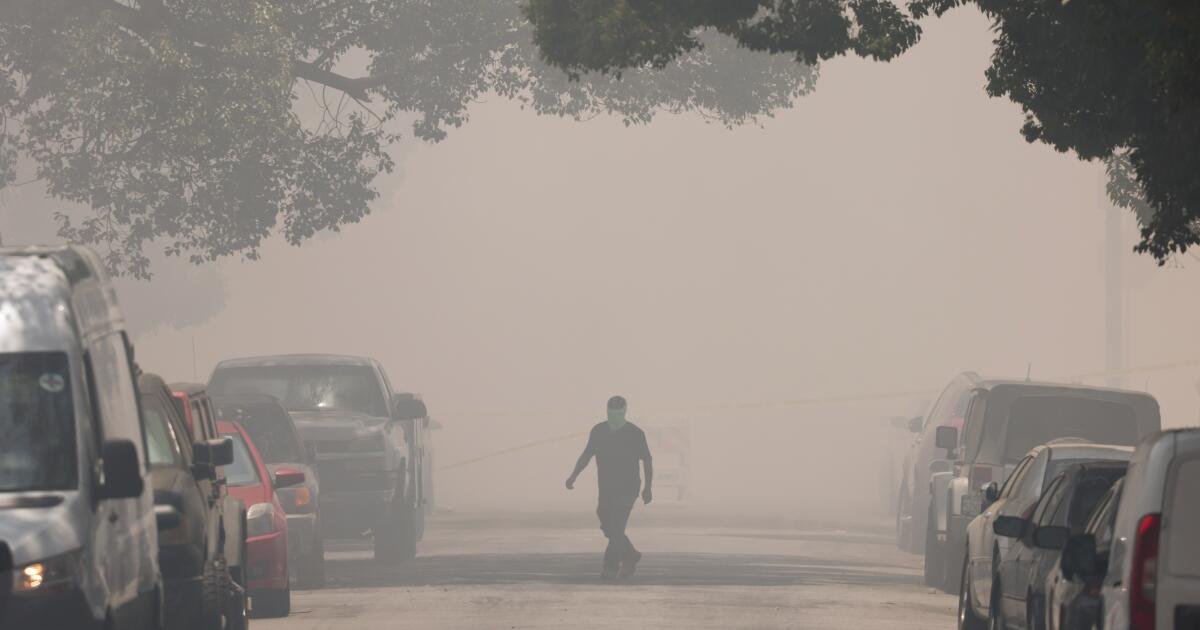
This month, a fire at the massive Lineage cold storage warehouse in Boyle Heights caused a spike in the number of Angelenos visiting hospitals with sore throats and concerns about smoke inhalation, the Times reported.
The fire burned for eight days starting June 17, burning solar panels, insulation foam and other industrial materials.
During that time, more than three times as many people visited emergency departments within 10 miles of the warehouse with complaints of fire or smoke inhalation than two weeks earlier, according to Los Angeles County Department of Public Health data obtained through a public records request.
The agency also noted that the number of people reporting sore throats within eight miles of the June 21 fire has nearly doubled, which is 1.9 times the baseline.
Typically, fewer than 50 people visit emergency departments each day for sore throats and fewer than 20 for smoke inhalation, the department said.
Hospitalization data was tracked through the ministry’s Syndrome Surveillance Project. The project will monitor trends in what people report when visiting emergency departments in Los Angeles County, as well as diagnosis codes cited by health care providers. The system is not as comprehensive as a complete patient health record, and clinicians do not necessarily include keywords for “fire” or “smoke” or other situational information in their diagnoses, Public Health said.
As a result, “the number of (emergency department) visits related to fire-related symptoms cannot be accurately determined and is likely an underestimate of the true burden of fire-related symptoms,” the ministry said.

Jesus Negrete Gutierrez, 71, a medical worker known as “Don Chuy,” visited the scene of the Lineage Logistics Warehouse fire in Boyle Heights on Tuesday to pray to the four elements to heal the community. “This is heartbreaking,” Gutierrez said. “One week with the fire, the next week with the smell.”
(Genaro Molina/Los Angeles Times)
Perhaps unexpectedly, the ministry said it did not see a significant increase in emergency department visits related to asthma, acute respiratory symptoms or chronic obstructive pulmonary disease during the fires.
But experts said even these preliminary findings were concerning. The fire is believed to have started in a solar array on the roof of the 500,000-square-foot building that housed 85 million pounds of frozen food. The ammonia line was then reached, prompting two short-term shelter-in-place orders for nearby residents.
Over the next week, the fire continued to burn through dense insulation foam and other unknown industrial materials within the building’s walls, blanketing much of Los Angeles in sharp smoke. Residents in Downtown Los Angeles, Northeast Los Angeles, Burbank, the San Gabriel Valley, and many other areas of the city and county reported seeing and smelling smoke.
The South Coast Air Quality Management District issued multiple warnings about unhealthy levels of PM 2.5, or fine particulate matter. The city and county opened two smoke shelters nearby so people could breathe cleaner air.
It is still unclear what exactly was in the smoke that people inhaled. Industrial fires release far more substances than the wood smoke produced during wildfires.
“Depending on the fire conditions and what is burning, smoke components can include toxic chemicals, particulates, and other significant risks to lung health,” Will Barrett, American Lung’s assistant vice president for national clean air policy, said while the fire was burning. Children and the elderly are particularly at risk.
David Eisenman, director of the UCLA Public Health Hazards Center, said industrial fires in urban areas can represent a hazard that standard PM2.5 alarms don’t necessarily address. He said these advisories are “blunt instruments” that don’t adequately capture emissions from the combustion of man-made products or convey that sources of pollution could include burning batteries or toxic refrigerants.
The fact that the first numbers don’t show a spike in asthma attacks is “somewhat reassuring,” Eisenman said. But “people may be seeing their GP, but this doesn’t capture it. This data is worth tracking.”
The air district and the U.S. Environmental Protection Agency deployed air monitors early in the fire to assess particulate matter, toxic metals and other hazardous compounds in the air. The aviation district said that while no significant levels of air pollutants were detected during the first two days of the fire, it recorded a significant increase in the concentration of particulate matter in the downwind plume.
Some of the five-minute snapshots measured by mobile monitors also showed increases in bromine and chlorine, which are common when buildings burn, and were at levels “below short-term health-based exposure thresholds,” the air district said. Continuous PM2.5 has started. On the third day, monitoring was conducted at two nearby elementary schools.
The Los Angeles Fire Department announced on the second day of the fire that it detected low levels of toxic hydrogen fluoride, which may be a byproduct of burning lithium-ion batteries.
The warehouse’s tenant operator, Lineage, said no ammonia levels were detected in the air at any time.
“There is no question that this fire has had a significant impact on the community, and we are committed to responding in every way possible,” company officials said in a statement last week. They said Lineage works closely with the fire department in the event of a fire, delivering masks, air purifiers and other supplies to the community and working to ensure the quickest possible removal.
Eisenman, of the University of California, Los Angeles, said the long-term health effects of the fire and its smoke likely won’t be known until researchers conduct follow-up studies.
For example, delayed lung effects from burning hydrogen fluoride and insulation foam, combined with elevated PM 2.5 levels in dense urban environments, may have caused health effects not shown in emergency room data.
“In the coming weeks, we will see those symptoms in increased primary care visits and worsening of chronic conditions,” he said. “So from a public health perspective, this fire is not over yet.”
