


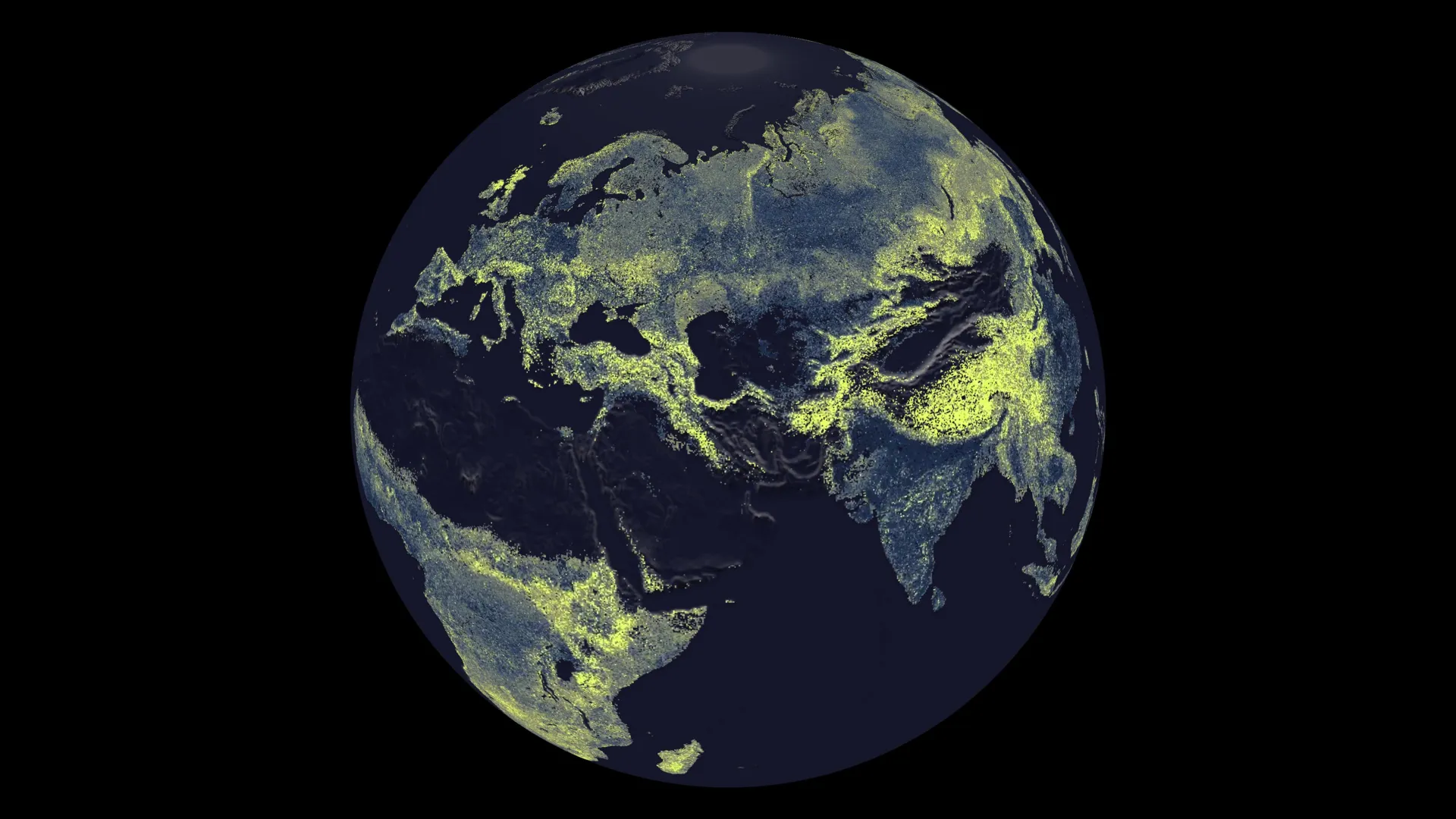
Beneath the ground, a vast network of fungi quietly supports plant life and plays a key role in regulating Earth’s climate by moving carbon into the soil. Now, researchers have created the first global map showing where these subterranean fungal networks are found and how many exist around the world.
This study sciencefocuses on arbuscular mycorrhizal fungi, a group of fungi that form partnerships with most plants on Earth. Alongside the research, scientists have released an interactive visualization that allows users to explore the surprising scale of this hidden underground infrastructure. The map is expected to help researchers and policymakers identify areas where these fungal networks are thriving and where they may be under threat.
Key findings of the study include:
- An estimated 110 quintillion kilometers (approximately 68 quintillion miles) of arbuscular mycorrhizal fungi networks, made up of filamentous structures called hyphae, exist on Earth’s topsoil. Its distance is almost one billion times the distance from Earth to the Sun.
- Grasslands contain approximately 40% of Earth’s arbuscular mycorrhizal fungal base. Particularly dense networks are predicted in the flooded grasslands of South Sudan, the Florida Everglades, and the Tibetan Plateau.
- AM fungal networks move an estimated 4 billion tons of CO2e into soil each year (equivalent to 11% of all human carbon dioxide emissions).
- Network density is predicted to be approximately 50% lower on average in large agricultural areas. Researchers warn that a low density of fungal networks can reduce a soil’s ability to store carbon, cycle nutrients and withstand environmental stress.
The hidden partnership that supports plant life
Arbuscular mycorrhizal fungi, commonly referred to as AM fungi, have mutually beneficial relationships with approximately 70% of plant species worldwide. Plants provide carbon produced through photosynthesis to fungi, which provide nutrients and water to plants.
These underground networks serve as living infrastructure that helps maintain ecosystems and move carbon underground. In 2025, researchers published a global analysis of below-ground mycorrhizal fungal diversity. nature And we’ve launched a digital platform called Underground Atlas to help identify biodiversity hotspots that may exist underground. However, until now scientists had not attempted to estimate and map the physical density and global distribution of the AM fungal network itself.
Mapping a fungal network spanning 110 quintillion kilometers
To create the new map, researchers compiled measurements from more than 16,000 soil cores collected around the world. They then used a machine learning model that incorporated environmental data from deserts, tundra, forests, and other ecosystems to predict fungal network density in areas where direct measurements were not available.
In collaboration with the AMOLF Institute’s Behavioral Physics Group, the team also used robotic imaging to analyze more than 300,000 live AM fungal hyphae grown in laboratory conditions. By combining all of these data sources, researchers have been able to estimate both the total length and mass of the global network.
Their analysis suggests that the AM fungal network spans about 110 quadrillion kilometers and contains about 300 megatons of carbon (four to six times the mass of all living humans).
“The importance and enormity of these fungi cannot be overstated,” said lead author Dr. Justin Stewart of the Society for the Protection of Underground Networks (SPUN). “There can be up to 10 meters (32 feet) of mycorrhizal networks in just a teaspoon of soil.”
Earth’s underground circulation system
Scientists often describe mycorrhizal networks as one of Earth’s circulatory systems because they transport carbon, nutrients, and water throughout underground ecosystems.
In healthy soil, these fungal networks can expand the effective foraging area of plant roots by up to 100 times and provide more than 80 percent of the phosphorus that plants need.
“With the advent of new technologies in high-resolution imaging, machine learning, and robotics, we are beginning to uncover what has long been hidden beneath our feet,” said co-first author Dr. Corentin Bizot, a biophysicist at AMOLF. “We are learning how the complex networks of fungi transport nutrients and help regulate the climate.”
New global fungal infrastructure map
To help visualize the results, the researchers collaborated with award-winning data visualization designer Moritz Stefaner to create a mycorrhizal infrastructure map.
This project provides the most detailed global view of Earth’s fungal infrastructure to date. Estimates were calculated for each square kilometer of land area, excluding ice sheets and areas with insufficient data to make reliable predictions.
The data behind the map is publicly available, giving governments and other decision makers new tools to monitor the health of underground fungal communities.
This study builds on previous research published by several of the same authors. nature. The study looked at how mycorrhizal fungi and plants create highly efficient systems for exchanging carbon and nutrients. The researchers measured the movement of carbon through these living networks at speeds reaching 120 um/s (if you were inside the network, this speed would feel like about 400 km/h). The new study extends that work by investigating how these flows work on a planetary scale.
Threats to underground fungal ecosystems
The researchers also identified areas of concern.
Network density in cultivated land is predicted to be about half that found in wild ecosystems. At the same time, wild grasslands contain approximately 40% of the world’s arbuscular mycorrhizal biomass.
Despite their importance, grasslands remain among the least protected ecosystems on Earth and are converted to agricultural land four times faster than forests.
These findings confirm previous SPUN research that showed that 95% of arbuscular mycorrhizal fungal biodiversity hotspots are outside protected areas.
For evolutionary biologist Dr. Toby Kiers, executive director of SPUN, growing evidence highlights the need to include fungi in climate and conservation planning.
“Fungi have been ignored in climate and conservation for far too long, and now is the time to change that trajectory.”
Kiers was recently named a MacArthur Fellow and won the Tyler Prize, also known as the “Environmental Nobel Prize,” for his research on the relationship between plants and fungi.
What scientists still don’t know
Co-author and biologist Dr Merlin Sheldrake added: “Mycorrhizal fungi have shaped life on Earth for hundreds of millions of years, but we still have little understanding of how the infrastructure of these life transport systems is distributed across the planet.” “This research is an exciting step toward understanding how our planet’s circulatory systems work and suggests how we can better work with fungi to address many of the emerging challenges of our time, from food security to climate change.”
While a new map reveals the extraordinary scale of Earth’s underground fungal networks, it also highlights major gaps in scientific knowledge. Large areas of the world remain unsampled, providing a roadmap for future research on one of the most important yet least visible ecosystems on Earth.
