


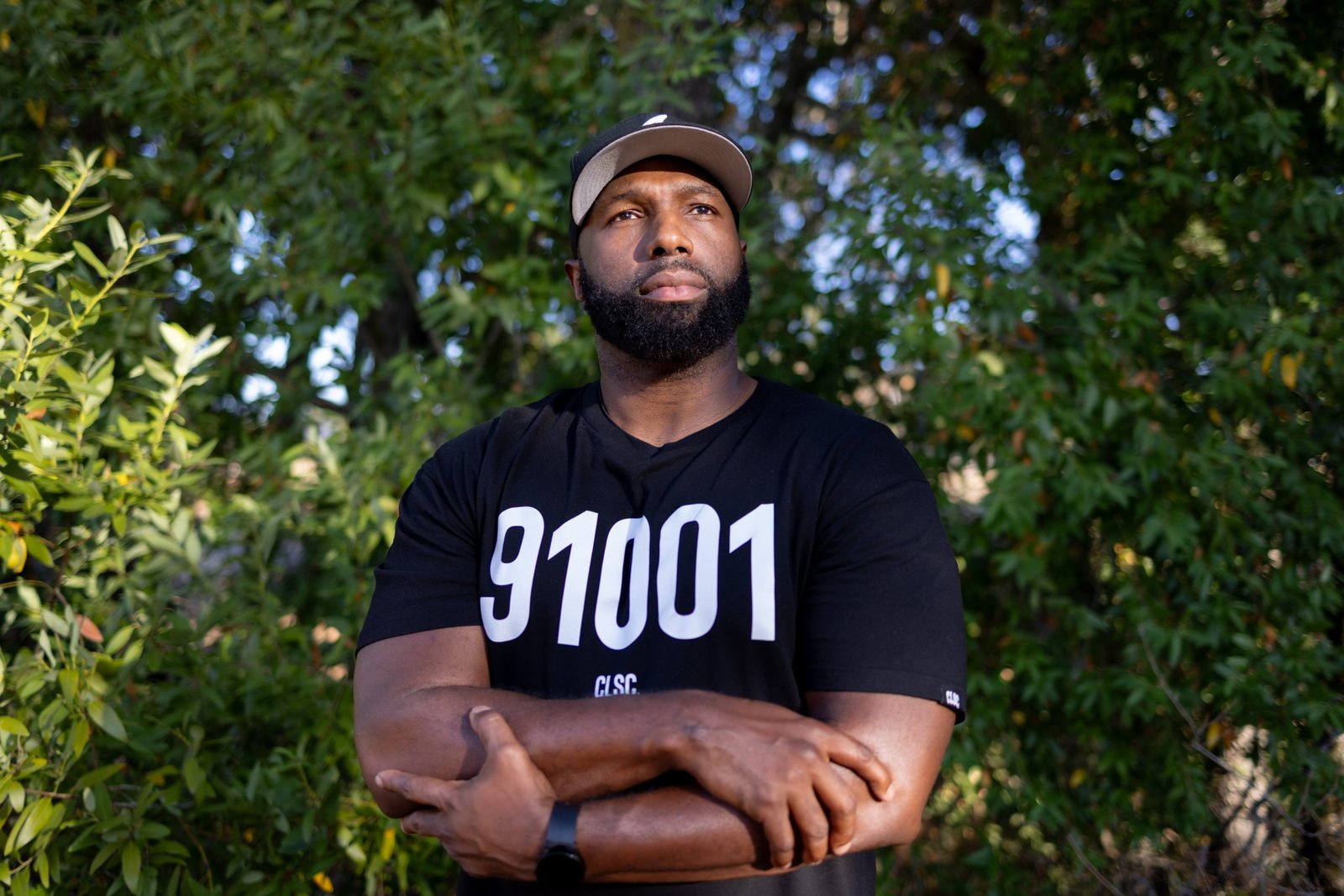
Zaire-Calvin’s insurance check to rebuild his family’s fortune was just under $300,000, far less than the value of the property, which was about $2.1 million.
His family had spread five homes across two lots in the leafy suburb of Altadena, California, until the Eaton Fire unleashed its fury, destroying both his and his mother’s homes and turning the tight-knit black homeownership enclave into a prime location for speculators.
Even more tragically, this hell also took away his sister, Evelyn McClendon.
Calvin, 48, said the past 15 months had been like a “war”, especially with his insurance company. She is also raising a toddler throughout this ordeal. “We have lost everything. Families here are being torn apart because they can’t fight,” he added.
Across the country, Black homeowners trying to recover from natural disasters are seeing increasing hardship as insurance companies that come to their rescue refuse to pay claims, drop longtime customers or demand itemized lists of total losses that families can’t document. It’s part of a national home insurance crisis fueled by climate change, with premiums soaring in nearly every ZIP code and businesses fleeing high-risk markets, with costs hitting Black households hardest.
Research shows that black households are less likely to be approved for major disaster aid, receive fewer benefits through the federal government or private home insurance companies, and lose wealth after a disaster, while white households tend to gain wealth, even after accounting for factors such as income, homeownership, and neighborhood damage.
“This is the most predatory thing you can do. You just have to ask them for money,” Calvin said.
After experiencing rate increases the year before the fire, Calvin struggled for months to prove the renovations and contents destroyed in the fire, only to be told by his insurance company that without receipts and documents, many of which were destroyed in the fire, they couldn’t fully compensate him for his losses.
“No one is losing out except the homeowner,” Calvin said.
At least 6 million households have seen their premiums increase since 2021, with the biggest increases in the Southeast, where Black homeowners are concentrated. This puts a strain on families who are already burdened by soaring food and transportation costs. Homeowners with mortgages are required to buy insurance, and renters often feel the pinch when landlords raise rents to cover rising insurance premiums.
Additionally, at least 1.4 million households have had their insurance policies canceled entirely. One in four cancellations is clearly related to extreme weather.
“Whether it’s here in Altadena or in Maui or Louisiana, this is disaster capitalism at its finest.”
Zaire Calvinlives in Altadena, California
Last year, pastor Timothy Williams lost insurance coverage for his home in rural Elba, Alabama, after several flooding incidents caused by heavy rains and a poor drainage system on a nearby state highway.
“When you hear that something like a storm or flood or tornado is coming, it’s stressful because you know that if it hits and damages your home, you’re going to be homeless,” he says.
Hundreds of policies have been canceled in Alabama since 2020, when widespread damage from extreme weather conditions made Alabama’s home insurance industry unprofitable for the first time.
For those still insured, annual premiums increased by an average of $648 nationwide from 2021 to 2024.
“The state and the (insurance) companies are passing the costs that they create onto homeowners, and that’s making us worse off,” Williams told Capital B in February.
 Timothy Williams assesses the flood risk in his neighborhood. Studies have found that Black households are nearly twice as likely as white households to experience flood-related property damage due to the location and condition of their homes. (Courtesy of Shiloh Community Center and Bullard Center)
Black homeowners spend more of their income on home insurance than any other major racial group in the United States, which leaves more than 1 in 10 Black homeowners uninsured.
This dilemma widens the racial wealth gap, as nearly half of Black people’s wealth is tied to housing equity. In counties hit hardest by the disaster, white households gained an average of about $126,000 in wealth, while black households lost an average of about $27,000.
“This is the new redlining,” Calvin said.
Redlining made it difficult for black households to obtain mortgages in the 20th century, and concentrated them in areas with high levels of toxic industry and pollution. Historically redlined areas now face higher risks of flooding, fire, and extreme heat. This is partly because these regions are located on more vulnerable floodplains and have lacked decades of investment in basic infrastructure such as drainage, roads, and emergency services. Now, insurance companies are using artificial intelligence algorithms to exploit that reality to charge higher premiums in Black neighborhoods or withdraw from Black neighborhoods.
Research also shows that higher premiums can reduce property value by up to $43,000. That’s part of the reason why the value of black-owned homes has declined more since 2023 than the value of homes owned by other racial groups.
“The home insurance crisis is not race-neutral,” climate change communications organization Climate Power said in a statement to Capital B. “It extends decades of housing discrimination, drains Black wealth, and puts millions of families at risk of losing their largest financial asset.”
 Zaire Calvin (center) stands near his mother, Evelyn Cattiller (seated), after a memorial service for area wildfire victims at First AME Church in Pasadena, California, on February 6, 2025. (Tama Mario/Getty Images)
Why America’s home insurance system is failing black homeowners
The modern home insurance industry in the United States evolved from 18th-century mutual fire associations that aimed to spread risk among neighbors rather than maximize profits. Early companies were highly regulated and employed coordinated interest rate settings that sought to match prices to long-term loss patterns rather than to a company’s quarterly profits. Over time, that mutual model was replaced by state-owned, publicly traded companies whose profits increasingly depended on their ability to generate investment returns for shareholders from the premiums they collected. Climate risk analysis now makes it easier to cancel insurance policies in “unprofitable” areas affected by disasters.
Altadena “was a community that did everything right, but it still wasn’t enough,” said Lisa Odigi, an Altadena native and president of the community’s long-term recovery housing committee group. “Black families are the slowest to recover, and the systems built to support them are not reaching us.”
Many are still stuck in conversations with the Federal Emergency Management Agency, seeing state and county inspectors backtracking on their promises, and hearing insurance companies claiming they haven’t received hand-delivered and stamped documents. For black households in Altadena, most of the vacant land remains untouched as the community attempts to rebuild it.
So far, the federal government’s response has been piecemeal. Historically, the National Flood Insurance Program has provided subsidized coverage in areas avoided by private insurance companies, but the NFIP is highly indebted and leaves most flood-prone areas poorly protected. The Treasury Department’s Federal Insurance Administration is convening insurers, state regulators and consumer groups to discuss keeping coverage affordable, and FEMA is working on acquisition and mitigation programs that could theoretically move people out of the most dangerous areas.
Still, these efforts have been slow due to lack of funding and do not address the core issue: home insurance is regulated state by state, with virtually no federal guardrails for how companies set prices and increase coverage as climate risks increase.
In North Carolina, average homeowner insurance rates have increased 75% since 2014, and more than 10,000 households lost their insurance in the months before Hurricane Helen devastated the state in 2024.
One way the state tries to protect homeowners is through the Attorney General’s Consumer Protection Division, which investigates complaints and can take legal action if it sees a pattern of illegal business practices by insurance companies or other companies.
But “the Consumer Affairs Agency needs more resources to fight all the battles on behalf of consumers,” explained state Rep. Dante Pittman, who represents a majority-black district in the House.
“The state has a role to play in ensuring that residents have access to insurance and that insurance is affordable, because many communities are waking up to the reality that one storm can completely render their area uninsurable, or leave their lifelong home unable to pay for repairs,” Pittman said.
“This is the American way of finding a way to monetize our pain.”
Zaire Calvinlives in Altadena, California
Since last year’s Eaton Fire, Calvin has learned new phrases to describe their reality.
“Whether it’s here in Altadena or in Maui or Louisiana, this is disaster capitalism at its finest,” he said.
Disaster capitalism has been outlined by advocates and scholars as a system in which federal policies and corporate loopholes favor companies seeking to recoup costs while victims absorb losses.
He said that over decades of payments, Mr. Calvin’s payouts were so small that it became clear that the insurance industry was “acting to make sure the shareholders are good and the companies are profitable.”
“This is America’s way of finding a way to cash in on our pain,” he added.
Like the homes of many black families, the Calvin family estate has been a home base for multiple generations. Grandparents, parents, and children lived side by side on the property that her mother first purchased in the 1970s. At the time, Altadena was one of the few places in Southern California where black families could own property.
Calvin’s mother, Evelyn Cassirer, now spends her days in a senior living facility about 24 miles from the vacant lot. She says she sheds tears when she sees the school bus rattling by. It reminds her of her namesake daughter, who was driving the car before taking her life.
She tells Calvin every day that she just wants to “go back to our land.” That motivated him to move forward, but “at this point I thought I could get back 50%, not 10%.”
“The longer it takes to get people home, the more people will die,” he added. “When we harm this generation, we also change the life outcomes of the next generation.”
read more:
