


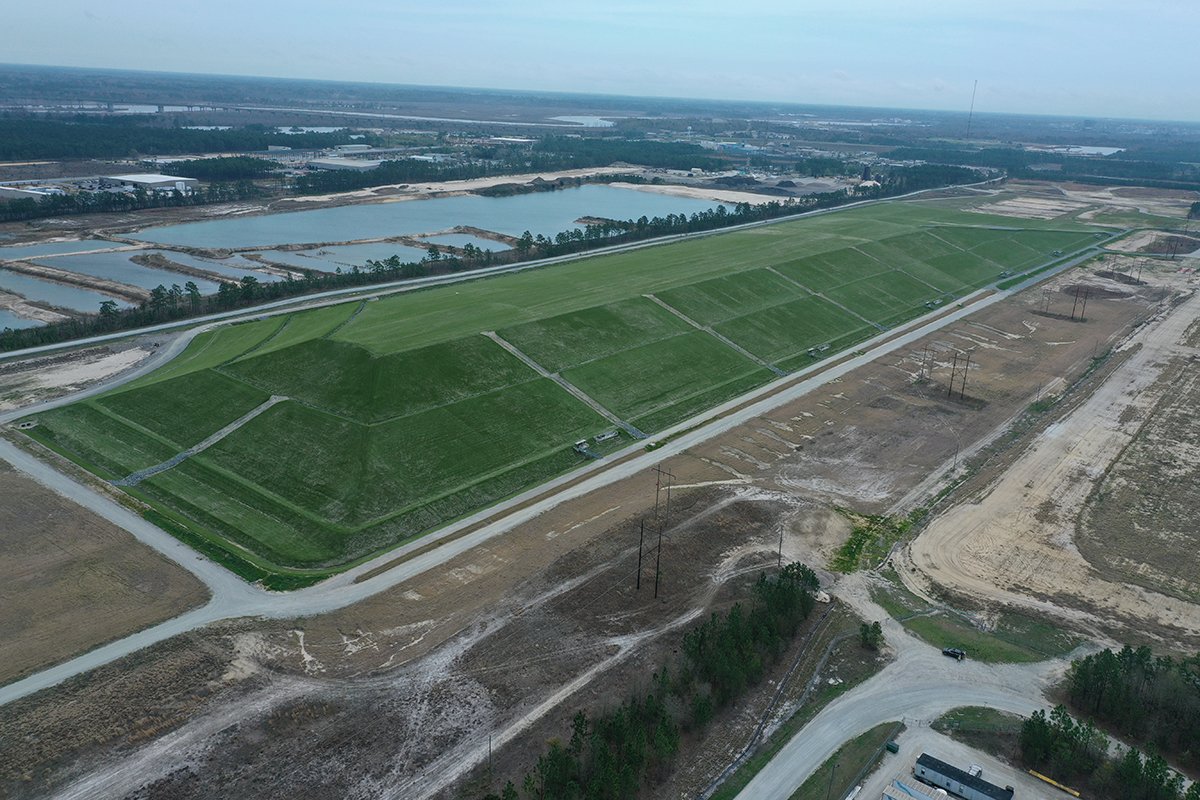
 Coal ash excavated at Duke Energy’s Sutton Steam Plant in Wilmington was placed in a landfill on the site, which was completed in 2019. Photo: Duke Energy
Energy providers wasted no time last year in urging the Trump administration to rescind the 2024 federal standards for coal ash disposal.
Five days before President Donald Trump returned to the White House for a second term on January 20, 2025, 10 electric power companies, including Duke Energy, sent a letter to Lee Zeldin, then President Trump’s nominee to head the Environmental Protection Agency, urging him to “decline to defend these illegal regulations.”
Now, the EPA is proposing changes to federal regulations for coal ash disposal that would relax Biden-era national standards for inactive, often unlined impoundments designed to store a slurry mixture of water-diluted fly ash and bottom ash.
Although comprehensive coal ash laws were pioneered here in North Carolina, the changes proposed at the federal level are not expected to impact the state’s strong coal ash management laws, at least for the time being.
The federal amendments also do not affect the terms of a 2019 settlement agreement between the North Carolina Department of Environmental Protection, Duke Energy, and public interest groups that set closure schedules and monitoring requirements for the utility’s remaining coal ash ponds.
“Nothing the EPA is trying to do now at the federal level is going to change that at all,” said Nick Torrey, senior attorney at the Southern Environmental Law Center.
But Tory warned that there could still be groundwater contamination in areas where coal ash has been removed.
“Federal regulations require monitoring and corrective action for that contamination,” he said. “If utilities are able to obtain these exceptions and exemptions, that is potentially concerning. Fortunately, there are also state processes to address groundwater issues, but they are in no way intended to be a substitute for federal standards. There is an added vulnerability that coal ash contamination could persist. So we will need to monitor that closely as things progress.”
Coal ash, known by regulations and industry as coal combustion residue (CCR), is a byproduct produced when coal is burned for electricity. The EPA says it contains toxic heavy metals such as arsenic, mercury, cadmium, lead and radioactive elements.
In early February 2014, a collapsed pipe at Duke Energy’s decommissioned Dan River Steam Station near Eden released approximately 39,000 tons of coal ash slurry into the river. The spill extended 70 miles downstream.
In the fall of that year, the North Carolina General Assembly enacted the North Carolina Coal Ash Management Act (CAMA).
CAMA (not to be confused with the Coastal Area Management Act) originally set a deadline for Duke Energy to shut down a series of basins at its four power plants by a certain deadline.
EPA finalized the federal CCR rule in 2015 during the Obama administration. The Biden administration tightened these regulations in 2024.
By then, DEQ had finalized basin closure schedules for all 14 of Duke Energy’s facilities in North Carolina. Following litigation and a settlement agreement between the community and conservation groups, DEQ and Duke Energy, a 2020 consent order was approved to govern the cleanup process for the remaining site.
Duke Energy expects the 12th of its 32 coal ash pits in North Carolina to be officially fully excavated by the end of the year. Both coal ash impoundments at the Sutton Steam Plant in Wilmington were excavated by July 2019.
Duke Energy spokesman Bill Norton confirmed in an email earlier this week that ash drilling at the company’s WH Weatherspoon power plant in Lumberton was completed well ahead of schedule. Norton said in an email that the company is in the process of clean closure certification for the basin, a process expected to be completed later this year.
“We haven’t counted Weatherspoon yet, but we have completed drilling in 11 basins in North Carolina and are making good progress in the remaining 20 basins, with more than half of the basin’s ash safely drilled in the state,” he said. “All facilities remain on schedule or ahead of their basin closure deadlines as shown here.”
Norton said the EPA’s proposed rule change would not affect Duke Energy’s coal retirement date.
“We continue to advance coal retirement while balancing regulatory approvals with increased load growth. Regulators have made it clear that alternative generation must come online and serve customers before we retire any more coal-fired power plants,” he said. “While EPA’s potential CCR rule changes do not affect our proposed coal retirement date, we are grateful for previous changes in federal regulations that have provided flexibility for our coal facilities. This will allow us to maximize the value of our existing generation by extending the operational life of these assets to accommodate increased load with minimal burden to consumers. Retirement dates are subject to regulatory approval.”
The Bellews Creek Steam Station coal-fired power plant in Stokes County is scheduled to be shut down no later than January 1, 2040. The retirement of the plant’s coal-fired operations will mean the end of Duke Energy’s coal-fired power generation in the state.
“We are making significant progress in meeting all of the obligations we agreed to in the North Carolina settlement with state regulators and environmental groups many years ago. That commitment remains, and state regulators have confirmed that our plan will protect public health and the environment,” Norton said.
He said beneficial reuse facilities at the company’s Buck Combined Cycle Plant in Salisbury, Cape Fear Plant in Moncure and HF Lee Energy Complex on the Neuse River in Goldsboro have been reprocessing coal ash at these sites to make it suitable for use in concrete since 2020.
Katherine Lucas, a spokeswoman for DEQ’s Waste Management Division, said in an email that the agency is “evaluating the proposed changes to determine whether they could potentially impact ongoing drilling and remediation activities at Duke Energy facilities.”
“In the absence of a state permitting program approved by the U.S. Environmental Protection Agency, utilities must comply with both federal and state requirements. North Carolina remains a national leader in coal ash management, both in establishing comprehensive regulations and in the scale and pace of closure and remediation efforts. DEQ believes that the state’s regulatory framework is at least as protective as federal requirements and does not expect the federal changes to reduce existing environmental and public health protections.”
EPA is accepting public comments on the proposed rule changes until June 12.
The agency will hold an online public hearing from 9 a.m. on May 28.
