


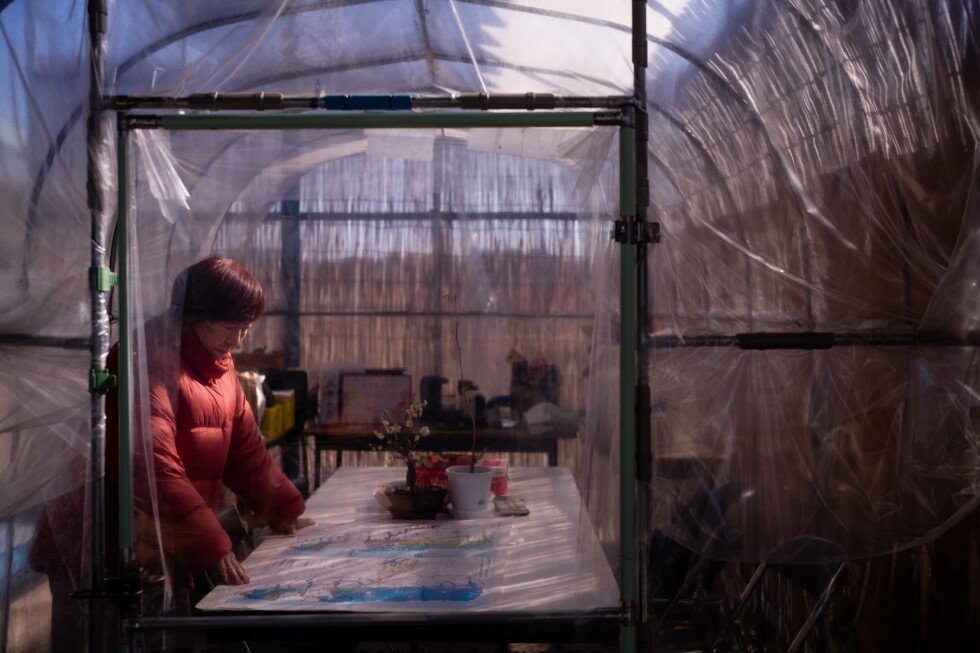
ODAKA, Japan (AP) — 15 years later 2011 nuclear disastera color-coded radiation map is posted on the wall of Futabaya Ryokan, a family-run inn run by Tomoko Kobayashi in her almost remote hometown in northeastern Fukushima.
Kobayashi conducted her own radiation study before reopening the inn in 2016. Now, Kobayashi and other monitors are sharing radiation data as part of an effort to rebuild this once-bustling textile town.
As Kobayashi passes by the kindergarten he attended as a child on his way to the Radiation Monitoring Institute, he talks about the town before the earthquake. Since the nuclear accident, there have been too few children, so it is now used as a museum.
“There used to be businesses, community activities and kids playing,” she says. “We had a normal daily life here, and I hope to see that again.”
Only about a third of Odaka’s pre-earthquake population of 13,000 has returned in the past 10 years.
“The town was destroyed and needs to be rebuilt. This is a slow process and cannot be completed in just a few decades,” she said. “But I hope to see progress, with new people and new development adding to what this town once was.”
face invisible danger
On March 11, 2011, at 2:46 p.m., Kobayashi was at the Futabaya inn when a magnitude 9.0 earthquake occurred off the coast of Tohoku, Japan. Despite the long and violent shaking, the walls of the inn did not collapse. But about an hour later, the tsunami hit the kitchen “like a river,” she said.
Much higher waves hit Fukushima Daiichi Nuclear power plant. The main cooling system was destroyed, causing meltdowns in three reactors.
The reactor building of Unit 1 was damaged in a hydrogen explosion on March 12th. Two days later, the Unit 3 reactor building exploded, followed by the Unit 4 reactor building, spewing out radioactive particles that contaminated the surrounding area and evacuated hundreds of thousands of residents. Some areas remain uninhabitable.
The Kobayashi family first headed to a gymnasium in the nearby town of Haramachi, but it was packed. Eventually they made it to Nagoya, where she and her husband stayed for a year.
In 2012, the couple returned to Fukushima and began measuring radiation while living in temporary housing near Odaka, which was still off-limits.
Since then, the town has made some recovery. Guests include students who want to learn more about Fukushima and people who are interested in starting a new business.
“I needed to understand what the nuclear accident was. I thought someone had to go back and monitor it,” she said. As I continued to take measurements, I was able to see things that I couldn’t see before, and I was able to understand more about radiation. “Now it has become my life’s mission.”
Citizens record radiation from disasters
Kobayashi and his colleagues meet twice a year, each time for two weeks to measure the air at hundreds of locations and create color-coded maps. We also established a laboratory to test local produce to determine what is safe to eat and serve.
“We are not professional scientists, but we can measure and show the data. The important thing is to keep measuring, because the government claims that the radiation is as safe as if it no longer existed,” she says. “But it’s true that it still exists.”
Their lab is now located next to a free folklore museum exhibiting paintings, sculptures, photographs, and other artwork inspired by the Fukushima disaster.
Fukushima Daiichi Nuclear Power Plant has been renovated, but chaos remains
Fifteen years ago, a hydrogen explosion in the reactor building made the factory look like a bombed factory, where workers were risking their lives to contain the crisis. Since then, radiation levels have dropped significantly and the factory once again built a reinforced seawall designed to withstand large tsunamis. For the first time since the disaster, the roofs of all reactor buildings at the nuclear power plant are now sealed.
“Our nuclear power plant decommissioning work is about how to reduce radiation risks,” says Akira Ono, head of decommissioning at Tokyo Electric Power Company Holdings, which operates the nuclear power plant. Remotely controlled robots, careful planning and practice are key to keeping workers safe, he said.
At Unit 1, decontamination of the top floor will begin under a brand new roof, prior to the planned removal of spent fuel from the cooling pool.
The three reactors contain at least 880 tons of molten fuel debris, radiation levels remain dangerously high, and few details are known.
Last year, TEPCO succeeded in collecting a small sample of molten fuel from the No. 2 reactor. Workers deployed microdrones last week to examine melted fuel inside the Unit 3 reactor, a technology that was simply not practical 15 years ago, Ono said.
Tokyo Electric Power Company plans remote-controlled internal probes to analyze molten fuel and develop robots for further analysis Fuel debris retrieval Experts say it could take several more decades.
“Pressure to keep quiet”
Fukushima prefecture tests thousands of samples each year before shipping and says all produce, seafood and dairy products in stores are safe.
The sale of some fruits, mushrooms, river fish and many other crops remains restricted in the former exclusion zone.
“Although radiation levels have fallen significantly over the past 15 years, I still don’t want to use the word ‘safe,'” says Yukio Shirahige, a former decontamination and radiation investigator at the Fukushima Daiichi nuclear power plant who is now assisting Kobayashi with the monitoring project.
Recently, wild boar meat was tested and found to be more than 100 times the safety standard, making it inedible.
In a major reversal after a decade of phasing out nuclear technology, Japan has announced plans for 2022. Plan to accelerate reactor restart Strengthen nuclear power as a stable energy source.
Whitebeard was at Fukushima Daiichi when the 2011 earthquake and tsunami occurred. After evacuating his family, he returned in late March and spent six months helping with emergency cleanup at the nuclear power plant.
Whitebeard receives support and equipment from university researchers and is responsible for testing locally produced food and other samples.
Shirahige, now 76 years old, says his life’s work is measuring radioactive materials and sharing the data.
As the government pushes for the safety and reconstruction of Fukushima, “pressure for silence is mounting,” Whitebeard said.
