


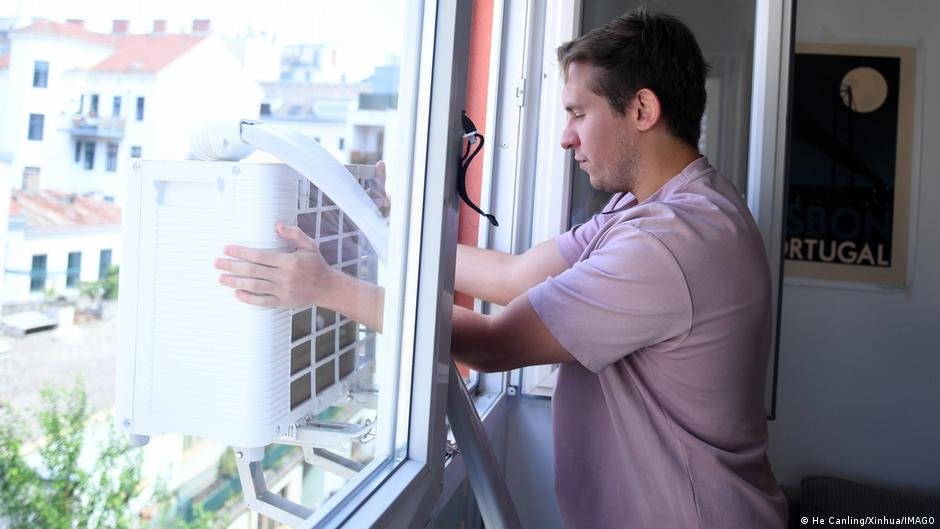
Around 65% of British adults struggled to sleep during the June heatwave, which brought record temperatures to Western Europe, according to a recent poll. Almost half of people lost three or more hours of sleep.
Sleep disorders are an inevitable consequence of longer and hotter summers due to anthropogenic climate change. Europe is a hotspot for sleep deprivation, as the continent is warming more than twice as fast as the global average.
In the German state of Saxony, the weather observatory reported a tropical nighttime minimum temperature of 29.4 degrees Celsius (85 degrees Fahrenheit) in June.
World Weather Attribution, a global scientific organization that analyzes how the climate drives extreme weather events, notes that climate change, driven primarily by the burning of fossil fuels, is now 100 times more likely to cause such nighttime extreme weather events.
Climate change disrupts sleep
Heat-related sleep deprivation has only recently been recognized as an important indicator of how climate change is impacting both physical and mental health.
A global team of researchers collated 165 million nights of data from nearly 318,000 users of wearable and under-mattress sleep trackers to monitor the impact of rising temperatures on sleep. A paper published in July showed that as nighttime temperatures rose from about 12°C to 27°C, people were about 40% more likely to get less than six hours of sleep.
Ty Ferguson, a researcher at the University of Adelaide in Australia who studies the potential health and social impacts of climate change-related sleep disturbances and was not involved in the July study, said humans cannot maintain cognitive, memory and emotional balance with less than seven hours of sleep each night.
Heatwave in Europe: The worst is yet to come
To view this video, please enable JavaScript and consider upgrading to a web browser that supports HTML5 video.
Ferguson says disrupted sleep can not only affect mood and alertness, but also increase the risk of diabetes, depression, heart disease and even obesity.
“Sleep is essential for immune function and mental health”
“Sleep is a fundamental physiological need that is essential for human immune function, mental health, and daily well-being,” said Bowen Zhu, a researcher at China’s Nanjing University School of Atmospheric Sciences and co-author of a March study on the potential economic impact of climate change-induced sleep erosion in children.
Parisians cool off in a local fountain in June amid extreme temperatures Image: Mustafa Yalcin/Anadolu/picture Alliance
Unlike traditional climate impact research, which has often focused on extreme weather events, understanding sleep deprivation “allows scientists to quantify the gradual, day-to-day cumulative effects of rising ambient temperatures on the daily lives and health of people around the world,” Chu told DW.
“Temperatures are also rising faster at night than during the day,” said Kelton Minor, an associate professor at the University of Copenhagen in Denmark. His research team, along with the World Sleep Association, are calling for the creation of a global sleep panel to better understand and prepare for sleep deprivation in a hotter world.
One reason why nights are hot is because unlike during the day when sunlight is reflected, clouds absorb heat and send it back to Earth after dark. Researchers have found that cloud patterns are changing in ways that amplify global warming.
Sleep loss that ‘accumulates silently’ is underreported
Kim van Daalen, an environmental epidemiologist at the University of Cambridge and co-author of a recently published paper on sleep deprivation in a warming world, said sleep deprivation is probably an underreported climate impact because it “doesn’t cause a single dramatic event, there’s no noticeable death toll, there’s no measurable damage.”
“Sleep deprivation accumulates silently, night after night, so it is often overlooked in news coverage that tends to focus on deaths and hospitalizations from acute heatwaves,” van Daalen said of the subtle effects of sleep deprivation.
“Heat-related sleep deprivation is likely to exacerbate existing health and socio-economic inequalities,” van Daalen said. Children can struggle to concentrate, learn and emotionally, while older adults and people with chronic illnesses experience a “greater cardiovascular and metabolic burden” when they get less sleep.
Europe’s heatwave exacerbates burden on elderly and homeless people
To view this video, please enable JavaScript and consider upgrading to a web browser that supports HTML5 video.
“Chronic sleep deprivation due to high temperatures is associated with reduced work productivity, reduced learning efficiency, potentially increased risk of road accidents, and increased long-term health care burden on society,” Chu said of the broader societal implications of sleep disruption.
“Poor sleep quality makes it difficult to work, learn, care for others, and stay healthy,” he said, adding that low-income households are more exposed because they live in poorly ventilated homes or cannot afford air conditioning.
Both low-income groups in wealthy countries and residents of low-income countries can be up to three times more vulnerable to the effects of heat on sleep, Miner said.
He said this was explained by “reduced access to heat-blocking air conditioning and other economic lifelines,” pointing to “houseless people trying to sleep on the streets, migrants living in sweltering tents, people imprisoned in scorching heat solitary confinement, young children in scorching hot bedrooms, and pregnant and newborn mothers already struggling to sleep.”
People cool off at a spray-mist fountain in Warsaw, Poland in late June.Image: Jaap Arriens/Sipa USA/picture Alliance
What is the solution?
Mr. Ferguson pointed out that even in a scenario where countries achieve net-zero emissions, it will take decades for temperatures to drop, necessitating continued adaptation to the sleep deprivation caused by climate change.
Increased use of fans and air conditioning, lightweight and breathable bedding, better insulation in buildings, and limiting heat-trapping concrete in urban areas are some of the ways climate-related sleep loss can be reduced, he explained.
Passively cooled building designs that use more green space, reflective surfaces, and window shading to improve ventilation will be important structural solutions, according to Chu.
Adjusting your schedule to avoid working in extreme heat is also fundamental to adapting to maintaining sleep in a hotter world, he said.
These solutions will be especially important in European countries like Germany, which traditionally have less air conditioning than, say, the United States or Australia, Miner said.
“Adapting to nighttime warming, where we spend around a third of our lives sleeping, already justifies European policy prioritization and adaptive innovation,” he said.
Editor: Sarah Stephan
