


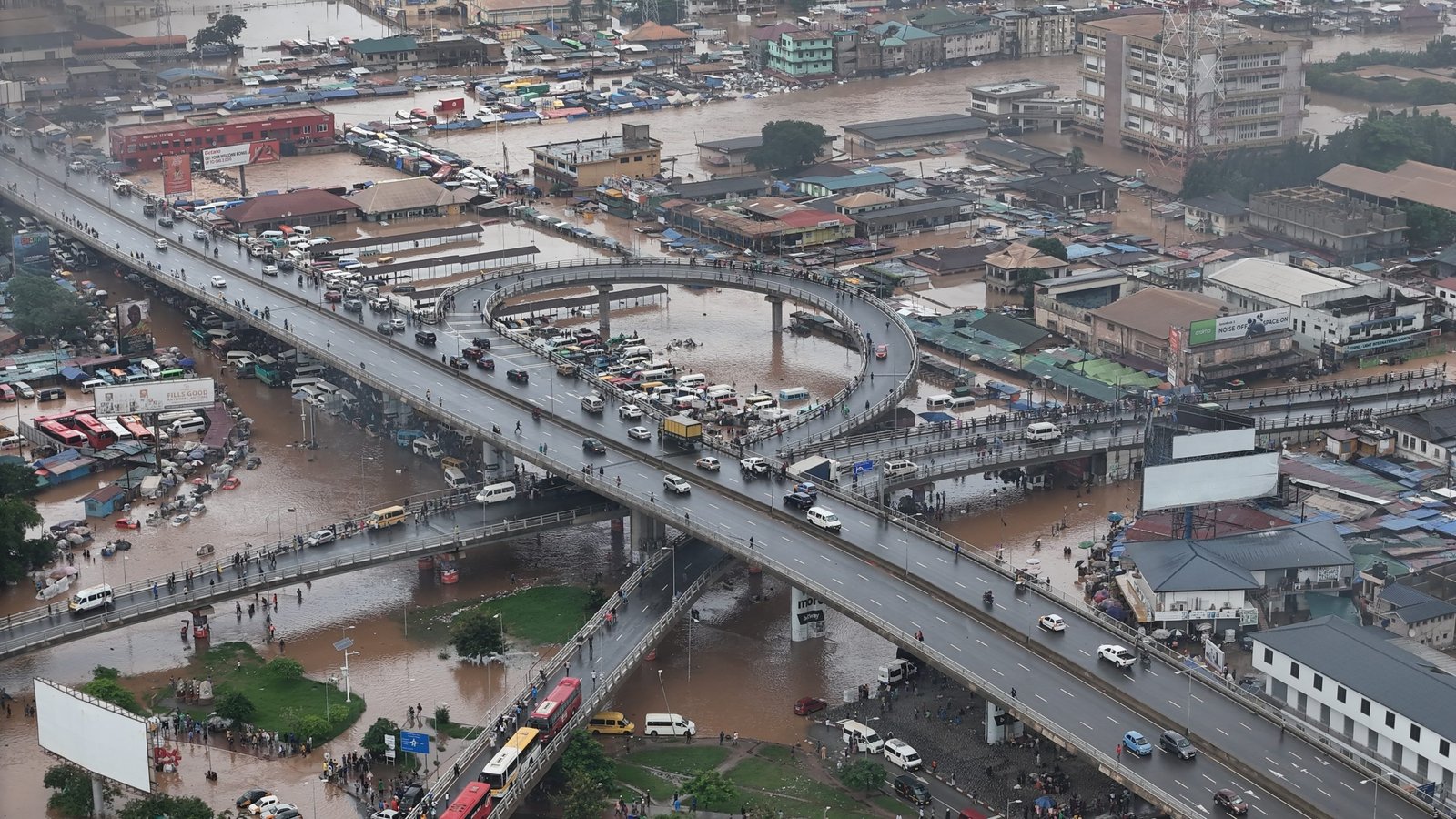
Scientists have found that the deadly floods in parts of West Africa in recent weeks have become more likely and more intense due to human-induced climate change, while the expansion of cities into flood-prone areas is amplifying the devastation and raising difficult questions about how to protect poorer urban communities.
A report by the World Weather Attribution (WWA) organization highlights how flooding has hit some of West Africa’s most densely populated coastal regions, where rapid urbanization is pushing formal and informal settlements dangerously into flood plains and reducing drainage by converting land to farms.
Since May, West African countries including Ghana, Togo, Ivory Coast and Nigeria have been hit by weeks of torrential rains and deadly flash floods. Homes were flooded, thousands of people were evacuated, and more than 70 people died.
WWA scientists said human-induced climate change has dramatically increased rainfall, with climate models showing once-rare rains can now occur in as little as three days, with heavy rains now expected to occur once every two to four years.
Friederike Otto, professor of climate science at Imperial College London, said: “This event is already not uncommon today, so the risk of flooding will certainly not go away, but will increase, especially with further pressures from population growth and urbanization.”
Already have an account? Click here to log in →
for 15 years we have We rigorously reported on the decisions that shape our climate. You can help readers like you continue this work by upgrading to a paid subscription.
Subscribe for £40 quarterly →
Or £130 a year — the best value.
Scientists have found that the deadly floods in parts of West Africa in recent weeks have become more likely and more intense due to human-induced climate change, while the expansion of cities into flood-prone areas is amplifying the devastation and raising difficult questions about how to protect poorer urban communities.
A report by the World Weather Attribution (WWA) organization highlights how flooding has hit some of West Africa’s most densely populated coastal regions, where rapid urbanization is pushing formal and informal settlements dangerously into flood plains and reducing drainage by converting land to farms.
Since May, West African countries including Ghana, Togo, Ivory Coast and Nigeria have been hit by weeks of torrential rains and deadly flash floods. Homes were flooded, thousands of people were evacuated, and more than 70 people died.
WWA scientists said human-induced climate change has dramatically increased rainfall, with climate models showing once-rare rains can now occur in as little as three days, with heavy rains now expected to occur once every two to four years.
Friederike Otto, professor of climate science at Imperial College London, said: “This event is already not uncommon today, so the risk of flooding will certainly not go away, but will increase, especially with further pressures from population growth and urbanization.”
Effects exacerbated by informal settlements
Scientists said that in addition to climate change, urbanization, inadequate drainage, poor waste management and the expansion of informal settlements into floodplains are exposing millions more people to flooding.
Informal settlements are areas developed without permission from government authorities. Commonly known as slums or shantytowns, these areas tend to be populated by poor communities, often lacking land ownership and services such as water and electricity.
In West Africa and many parts of the developing world, these settlements expanded into wetlands, floodwater storage areas, and riverbanks as people moved from rural to urban areas in search of work. This has further increased the risk of flooding across West African cities.
Kiswenjida Gigma, technical advisor at the Red Cross Climate Center, said West Africa’s coastal cities are “caught between repeated flooding and rapid urban growth”, pushing infrastructure beyond its limits and making it difficult for communities to recover.
Roussel Teguia, a postdoctoral researcher at Canada’s Laval University, said the recent floods have exposed long-standing failures in urban planning across West Africa’s fast-growing coastal cities, where much of the region’s economy is concentrated.
Campaigners oppose Dangote’s Kenya oil refinery plans due to climate and ecological risks
Teguia said factors such as rapid urbanization in low-lying areas, lack of affordable housing alternatives and long-standing marginalization of poor communities further increase the risk of flooding. He also decried the destruction of wetlands, mangroves and floodplains to make way for roads and buildings, saying instead these natural bodies “should be treated as critical public safety infrastructure.”
“These floods should not be understood only as natural disasters,” he says. He added that residents of informal settlements should stop being treated as a problem because they are often the first victims of “an urban model that puts them at risk and then blames them for putting them at risk.”
A short-sighted approach to relocation
Fifty-nine of the deaths were recorded in Ivory Coast’s capital, Abidjan, of which around 20 died near the densely populated Mosiclo slopes. Authorities had previously relocated residents from the area over concerns about its vulnerability to deadly landslides and flooding, but some returned to previously evacuated areas and died when rain-induced hillsides collapsed, local media reported.
Local authorities have since begun demolishing homes in the area, leaving many angry local residents saying they were not consulted or warned about the demolition, resulting in damage to their properties and livelihoods. “If we destroy this place, where will I go?” one anonymous resident told Al Jazeera.
The government says many of the structures were illegally built in areas prone to flooding and landslides, and plans to first relocate 3,000 people, followed by 2,000 more. City official Huet Hilaire told the TV station that the city has been trying to persuade residents to leave for years. “Frankly, we’re tired,” he said. “The mayor told us to evict them because we don’t want to witness another tragedy every year.”
Loss and Damage Fund delays approval of first project because dwarf resources are required
Gigma said that to avoid people returning, the government “needs to also ensure that where people are relocated, there are relatively good economic opportunities for them to stay.”
Demolishing the homes of the poor without offering real alternatives is not prevention, Tegia argued, calling on governments to provide safe, well-maintained and affordable land close to workplaces and transportation, stop the appropriation of wetlands and regulate powerful land owners and users.
He explained that resettlement programs often fail because they are designed as land clearing and security operations rather than social processes.
Tegia said governments need to move from reactive crisis management measures to a long-term, comprehensive approach to risk. He warned that relocation policies must compensate fairly and equitably, be inclusive of affected communities, and encompass their economic and social networks, but otherwise “will only shift vulnerabilities elsewhere.”
Fiscal gaps limit flood response
WWA scientists said deadly flooding will continue unless governments do more to reduce people’s exposure and vulnerability, calling for investment in safe and affordable housing, improved drainage and sanitation, stronger building regulations, more effective early warning systems and greater involvement of at-risk communities in planning.
Overpay El Niño is coming – are you ready?
Joyce Kimutai, a researcher in extreme weather and climate change at Imperial College London, said the study was a clear example of “the need for international cooperation on climate justice”, adding that developed countries had a responsibility to help countries such as Togo, Ivory Coast and Ghana adapt to worsening problems that they did not cause as low greenhouse gas emitters.
But large-scale financial support for countries facing growing climate disasters may still be a long way off. Earlier this month, the UN’s fledgling Loss and Disaster Response Fund (FRLD) postponed approval of its first round of projects after requests for assistance far exceeded available funds.
One of the approximately 180 proposals received by the fund was for a rehabilitation and resilience project in Nigeria that would address the loss and damage caused by flooding in Lagos, a city prone to flooding every year.
Otto, from Imperial College London, said that situations like this, where the effects of climate change are certain, “should be the kind of events that foundations should put money into and support, but of course you need to put money into the foundation first.”
Ghana and Togo have also identified increasingly frequent flooding as a major climate risk in their national adaptation plans, prioritizing investments in drainage, resilient infrastructure, flood management, early warning systems and climate-resilient urban planning.
Most ‘zombie credits’ to be locked out of UN’s new carbon market after scorn from China and India
However, while these adaptation plans acknowledge that more international aid is needed to realize the proposed measures, rich countries are likely to fall short of their 2025 goal of doubling adaptation funding to developing countries. Funding in 2024 reached just over $30 billion, well below the goal of $40 billion by 2025.
UN Climate Change Executive Director Simon Steel said WWA’s findings underlined the urgent need to accelerate support for vulnerable communities that contribute little to the cause of climate change, adding: “All climate finance commitments must be met.”
