


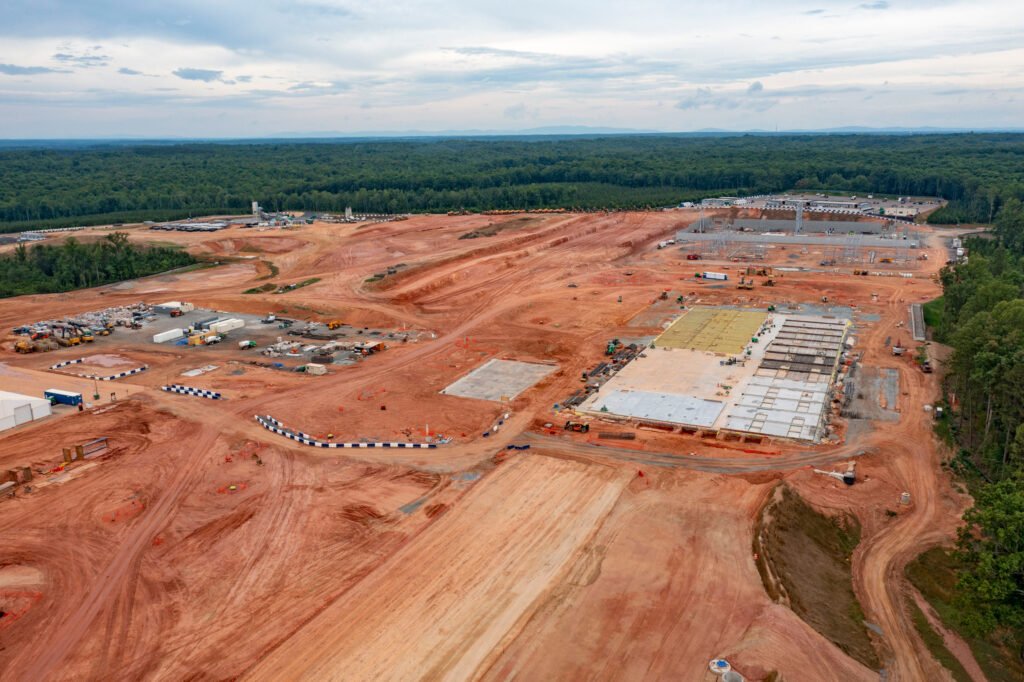
RICHMOND, Va. — Before the Virginia General Assembly opened in January, 53-year-old William Ward attended a Virginia Conservation League constituency meeting in Petersburg to learn how the state’s data center industry is straining the power grid, harming the environment and driving up electricity bills.
He also learned about the $1.9 billion in sales and use taxes the state waived for data centers in 2025.
“It’s impacting the public,” Ward said. “We have to pay, they don’t have to pay. We understand we need data centers, but why is it here? They have to pay their fair share.”
What began in February as a promising pitch to address the concerns of Ward and other Virginians by tying environmental protections to tax credits ultimately fell through. Virginia lawmakers rejected this and instead created a new tax.
On June 29, two days before the budget deadline, after months of debate over tax exemptions, the spending plan was approved without adding clean energy requirements or making any changes.
Instead, the law created a new tax on data center energy consumption, capped at $600 million annually, to generate revenue for the state. This amount represents about one-third of the amount of forgiveness the industry receives. It has directed the commission to submit a report by Dec. 15 on the impact of data centers and recommended changes to existing tax credits, similar to a multi-year study released less than two years ago.
Language was added to the budget requiring reporting on electric, water and diesel backup generators, but many of those efforts are already underway. Language was added to establish rules for water-dependent cooling technologies that data centers can use in water-scarce areas, but there are no specific standards and less conservative evaporative cooling is allowed.
The budget also includes provisions that address the potential economic impact of data centers in “historically economically disadvantaged communities” where facilities want to connect to the power grid of Dominion, Virginia’s largest power company. Communities often lack the resources to oppose projects and have long been dealing with the industry’s ills.
“What was passed didn’t improve anyone’s life,” Lee Francis, program and communications director for the Virginia League of Conservation Voters, said in an interview. “(Lawmakers’) actions go back to the original purpose of holding industry accountable to strong environmental standards, which is no longer on the table.”
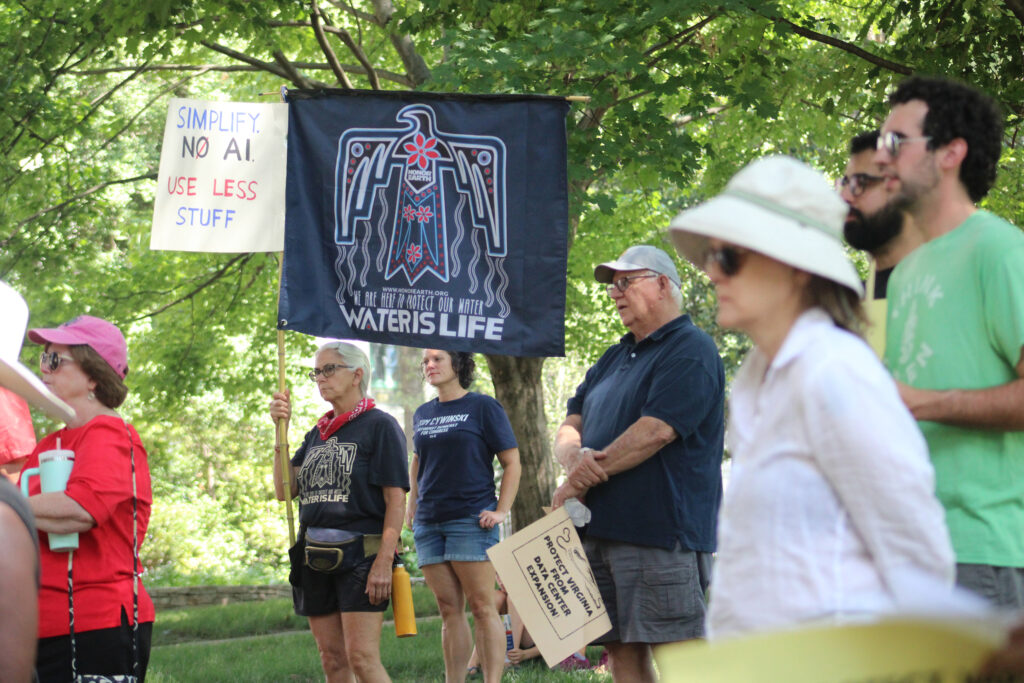 People participate in a rally to protest the Virginia Legislature’s inaction on data centers. Credit: Charles Paullin/Inside Climate News
Known as the data center capital of the world, Virginia has more warehouse-like facilities to process and store the data that powers the Internet and artificial intelligence than any other state or country outside the United States, with more on the way.
This tax exemption system was established in 2008 to promote economic activity, and allows companies building data centers to exempt from 4.3% to 7% tax when purchasing equipment such as servers and backup generators. Big tech companies such as Amazon, Microsoft, Google and Meta, the world’s richest companies, defend the exemption, which applies to about 90 percent of the industry.
As the industry grows, Dominion is proposing its first new gas plant in years, with regulatory approval expected in 2025, with other gas plants and fossil fuel construction likely to follow. To make Virginia’s data centers more sustainable, environmental and community advocacy groups lobbied lawmakers to end the exemption and force the industry to pay its “fair share.” The proposed changes were seen as one model for how other states might respond to data center development.
The last state study on data centers, released in 2024, found that electricity generation and transmission costs could increase monthly bills by $37 by 2040. Dominion’s long-term plan found that if it builds out all the gas, nuclear, renewable technologies, etc. to accommodate the data, monthly home bills could increase from $142.77 in 2024 to $255 by the end of 2035 and $268 by the end of 2045. Center’s requests.
A recent poll, similar to one conducted in January by Christopher Newport University’s Wason Center, found that 63 percent of Virginians support data center site assessments that assess impacts to water, the power grid, emissions, agriculture, and other conservation.
The Democratic Party won its third straight state government in November, thanks in part to a pledge to curb the growth of data centers. But as the debate heated up during the actual legislative process, industry and economic development officials warned that changing the exemption would negatively impact “4,000 jobs, $5.5 billion in labor income, and $9.1 billion in gross domestic product,” a data center of local tax revenue that contributes annually to Virginia’s economy, which has been hit hard by the Trump administration’s DOGE cuts.
The Data Center Coalition, an industry advocacy group, did not respond to a request for comment. President Josh Levi said in a statement days before final approval of the budget that workers’ jobs are at risk as companies prioritize new investment in states with competitive and stable business environments.
This story is funded by readers like you.
Our nonprofit newsroom provides free advertising for our award-winning climate coverage. We rely on donations from readers like you to continue our work. Donate now to support our work.
donate now
“The message to businesses in every industry is clear: Virginia is no longer a trusted partner,” Levi said.
The House of Representatives took the lead by mandating several clean energy requirements for data centers seeking exemptions. The Senate took a bolder approach, proposing to end the exemption at the end of 2026, nine years before the current exemption expires in 2035, or 2050 in Amazon’s case, due to increased investment. Spanberger sided with the House, saying he wanted data centers to pay their “fair share” while respecting existing agreements.
Lawmakers adjourned in March without being able to agree on a budget. There was little agreement until both sides announced new proposals in June, less than a month before the closure deadline. Both kept their exemptions intact and produced studies. Tensions boiled over as environmental groups called for a moratorium on the industry while the government developed comprehensive environmental protection measures for data centres.
Instead, lawmakers postponed significant changes to the exemption.
Inside Climate News asked Spanberger, House Democrats and Rep. Lucas if they could guarantee that the exemption would be revised to include clean energy requirements in 2027.
 State Sen. Louise Lucas (D-Portsmouth) speaks at City Hall about data center tax exemptions. Credit: Charles Paullin/Inside Climate News
Lucas declined to comment, but wrote on X that the job is not done yet. In a statement, Virginia’s House Democratic Caucus said it was “proud” to fund the budget and “continues to work to ensure that our industry’s growing energy demands do not come at the expense of Virginia’s natural resources, residential customers, and small businesses.”
A spokesperson for Mr. Spanberger said he was “proud” to approve the data center energy sales tax, pointing to other data center bills passed at the same time. One includes a requirement for clean diesel backup generators, but the legislation removed the requirement for clean energy storage. The other would incentivize data centers to fund zero-carbon energy sources. None of the bills impose clean energy requirements on facilities.
“Governor Spanberger continues to listen to the needs of our communities and work to ensure data centers adhere to strong standards that protect ratepayers, strengthen the reliability of our electric grid, and keep the communities around us healthy,” the spokesperson said.
Jay Ford, Virginia policy manager for the Chesapeake Bay Foundation, said claiming the budget was a success “feels like a bit of a shell game.”
“If you’re slow to respond with a major industry, you’re rarely going to get a better answer from the other side,” Ford said. “I haven’t heard people say, “We’d love to see an electricity consumption tax put into the budget.” I’ve heard them say, “We want you to address the impacts of these facilities,” and that’s the main thing we’ve fallen short on.”
On Saturday, supporters held a rally outside the Virginia State Capitol to denounce Congress’ actions. Eric Kasten, who works in chemical pollution monitoring and now lives in Chesterfield County, said he and his family don’t regret voting Democratic, but he may consider other candidates in the future if he doesn’t see more action on data centers.
“We understand that the state entered into an agreement years ago that gave us certain tax breaks. Can we continue to provide that? I don’t think that’s really been addressed,” Kasten told Inside Climate News. “I don’t think we’ve made any progress toward real compromise. Data center development seems to be going the same way it always has, and nothing has really changed.[Lawmakers]just need to act faster.”
About this story
As you may have noticed, this article, like all news we publish, is free to read. That’s because Inside Climate News is a 501c3 nonprofit organization. We don’t charge subscription fees, keep our news behind paywalls, or fill our website with ads. We provide climate and environmental news free to you and anyone who wants it.
That’s not all. We also share our news for free with dozens of other news organizations across the country. Many of them cannot afford to do their own environmental journalism. We’ve established bureaus across the country to report on local news, partner with local newsrooms and co-publish stories to ensure this important work is shared as widely as possible.
The two of us started ICN in 2007. Six years later, we won the Pulitzer Prize for national reporting and now run the nation’s oldest and largest dedicated climate newsroom. We tell the story in its entirety. We hold polluters accountable. We expose environmental injustice. We debunk misinformation. We explore solutions and inspire action.
Donations from readers like you fund all aspects of our work. If you haven’t already, will you support our ongoing work, our coverage of the biggest crises facing our planet, and help us reach more readers in more places?
Please make a tax-deductible donation. Each one makes a difference.
thank you,

charles poulin
virginia correspondent
Charles Poulin is an energy and environmental reporter based in Richmond, Virginia. He has received several awards for his work covering state policy for the Virginia Mercury and local news for the Northern Virginia Daily in the northern Shenandoah Valley. His first reporting job was with the New Britain Herald in Connecticut, a few years after attending the University of Hartford, where he first studied sports journalism.
