


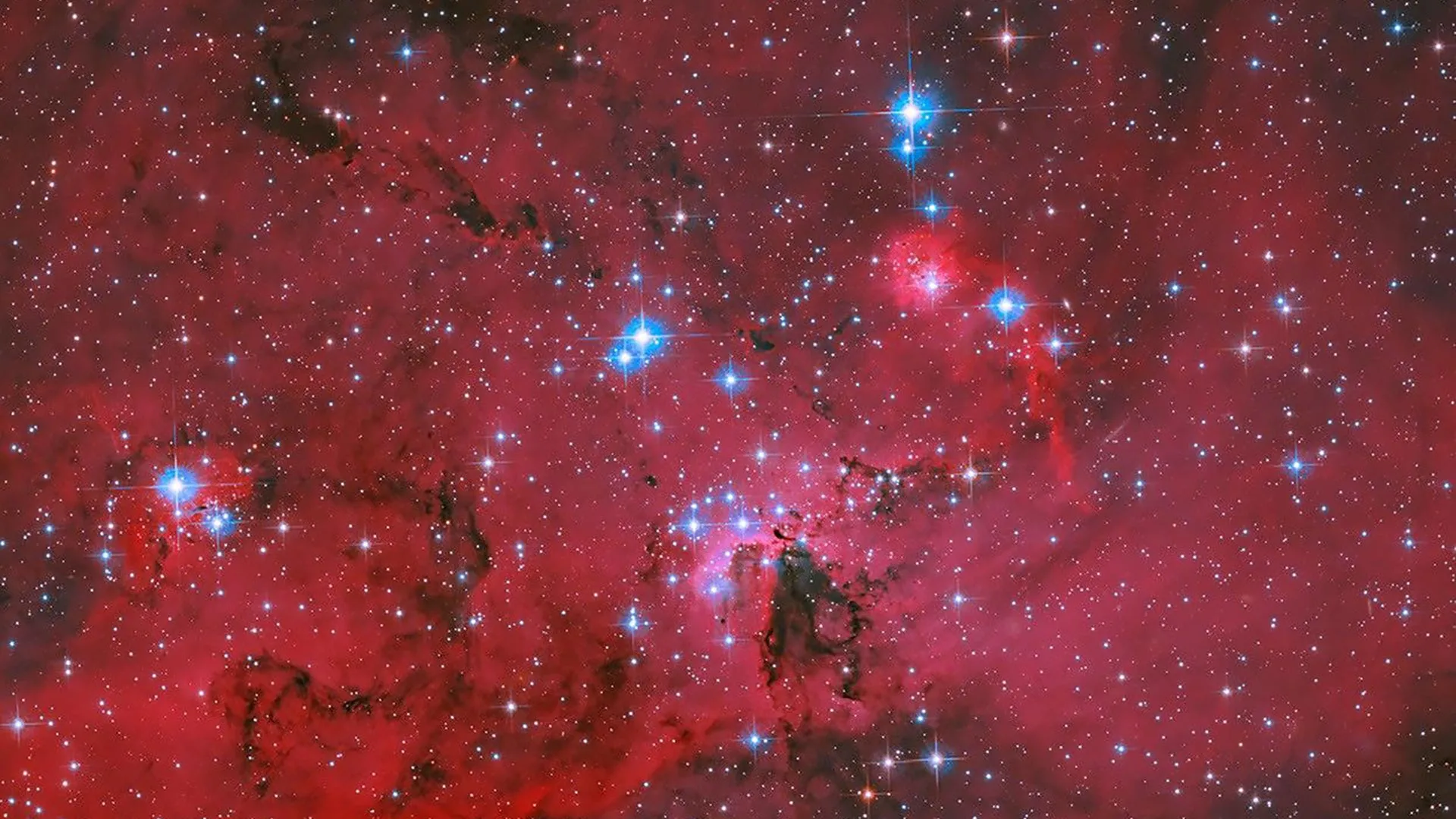
Stunning new images from NASA’s Hubble Space Telescope give us a front-row view of one of the universe’s busiest star nurseries. Brilliant blue and white stars sparkle amidst the red-hot clouds of hydrogen gas, creating a breathtaking sight that resembles fireworks sparkling amidst the drifting smoke.
This image shows LH 95, a vast star-forming region in the Large Magellanic Cloud, a dwarf galaxy orbiting the Milky Way. This remarkable region contains both newly formed low-mass stars and massive blue giants, making it one of the many stellar associations in the Large Magellanic Cloud.
A big star is rebuilding the environment around him.
The brightest blue star in LH 95 is also the most powerful. Each has a mass at least three times that of the Sun and sends out powerful stellar winds that bathe the surrounding region in intense ultraviolet light.
These energetic forces heat the surrounding hydrogen gas, gradually sculpting the nebula into its impressive appearance. Thick dust streaks are dense enough to withstand abrasion, so they stand out as dark filaments, creating a dramatic contrast against the glowing red clouds.
The colors you see in images are not what the human eye naturally observes, but instead represent specific wavelengths of light. Blue highlights shorter visible wavelengths, while red combines longer visible wavelengths and some near-infrared light. The nebula’s bright crimson glow comes from hydrogen alpha radiation, evidence that new stars are actively forming.
Thousands of young stars still growing
Hydrogen-alpha light allows astronomers to pinpoint some of the youngest stars hidden within the glowing gas. Hubble’s observations reveal that thousands of developing stars are still drawing material from the surrounding disks of gas and dust that gave rise to them.
The researchers identified about 2,500 stars that have accumulated nearly all of the required mass but have not yet begun fusion. These objects, known as pre-main sequence stars, form from collapsing gas clouds that continue to shrink under their own gravity. When the core becomes hot enough and dense enough, hydrogen fusion occurs and it turns into a full-fledged star.
Hubble reveals longer growth stages
Studying this vast number of young stars has given astronomers new insights into how stars grow.
The observations confirm that young stars’ accretion rates, or the rate at which they collect material, naturally slow down as they age. At the same time, the study showed that this process could last for millions of years, longer than some previously suggested assumptions.
This discovery will help scientists better understand how stars continue to build up their final mass, and how the disk surrounding them gradually evolves before eventually disappearing.
Multiple generations of stars share one cosmic nursery
LH 95 doesn’t produce stars all at once. Instead, multiple generations continue to coexist, creating new stars over time.
One object stands out in particular. The most massive star in the region is located slightly to the left of center near the top of the image and contains approximately 60 to 70 times the mass of the Sun. Despite its enormous size, the star appears to be about 1 million years younger than most of its neighbors, which are estimated to be around 4 million years old.
A star this massive burns through its fuel quickly, eventually ending its life in a spectacular supernova explosion. This explosion will help bring heavy elements to future generations of stars.
Why LH 95 is so valuable to astronomers
LH 95 offers scientists an excellent opportunity to study star birth because it is relatively close and less likely to be obscured by dust than similar star-forming regions in the Milky Way. This clearer view allows astronomers to observe the development of thousands of stars at different stages of evolution within the same cosmic neighborhood.
For more than 30 years, NASA’s Hubble Space Telescope has been changing our understanding of the universe through discoveries like this. Its observations are now being supplemented by other NASA missions, including the infrared-capable James Webb Space Telescope. Looking forward, the Nancy Grace Roman Space Telescope, currently scheduled for launch in late summer, will further expand scientists’ space exploration capabilities.
