


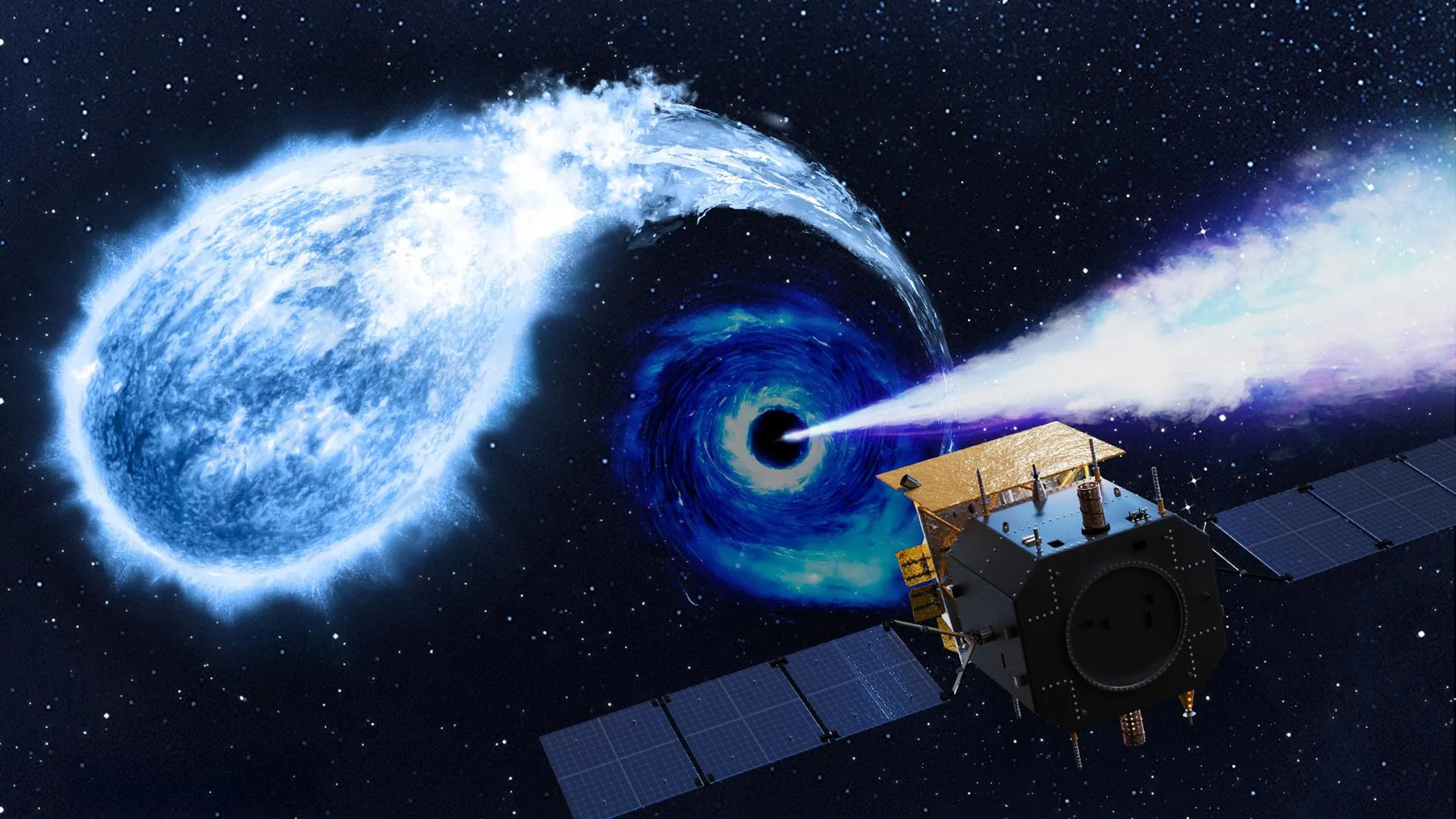
Unusual high-energy phenomena detected deep in space are giving astronomers a rare opportunity to study some of the universe’s most extreme phenomena.
On July 2, 2025, the Chinese-led Einstein Probe (EP) space telescope discovered an extremely bright X-ray source during a routine survey of the sky. The object’s brightness changed rapidly, quickly making it stand out from typical cosmic X-ray sources. This unusual detection triggered follow-up observations by observatories around the world.
The research was coordinated by the EP Science Center of the National Astronomical Observatory of the Chinese Academy of Sciences (NAOC), and scientists from research institutions in China and several other countries contributed to the effort. Researchers from the Department of Physics at the University of Hong Kong, a key member of the Einstein spacecraft scientific collaboration, helped interpret the observations. According to their analysis, this event could represent an intermediate-mass black hole tearing apart and swallowing a white dwarf. If confirmed, it would provide the first direct observational evidence of this kind of black hole feeding phenomenon. The results were published as a cover article. science bulletin.
Einstein probe detects unusual space explosion
The discovery relied on the Einstein spacecraft’s two complementary X-ray instruments.
During a routine survey on July 2, 2025, the mission’s Wide-Field X-ray Telescope (WXT), which combines advanced lobster-eye micropore optics with an extremely wide field of view and high sensitivity, detected a rapidly changing X-ray source, later designated EP250702a (also known as GRB 250702B). At about the same time, NASA’s Fermi Gamma-ray Space Telescope detected several gamma-ray bursts coming from the same region of the sky.
After reviewing previous WXT observations, scientists realized that this phenomenon was much more unusual. The telescope had already detected steady X-ray emissions from the same location about a day before the gamma-ray burst occurred. This series of phenomena has little to do with powerful cosmic explosions. Approximately 15 hours after initial detection, the source triggered a series of intense X-ray flares. At its brightest, it reached a brightness of approximately 3 × 1049 erg s-1, making it one of the brightest instantaneous explosions ever recorded in the universe.
“This early X-ray signal is extremely important,” said Dr. Dongyue Li, lead author of the paper from the National Astronomical Observatory of China. “This shows that this was not a normal gamma-ray burst.”
Rare X-ray signal shows black hole feeding phenomenon
Using the precise location determined by WXT, astronomers quickly pointed major telescopes around the world toward its source. Observations across multiple wavelengths confirm that this object is on the outskirts of a distant galaxy. The Einstein spacecraft’s second instrument, the Tracking X-ray Telescope (FXT), then monitored the evolution of the phenomenon.
Over about 20 days, the object’s brightness decreased by more than 100,000 times. During that time, the emission of X-rays also shifted from high-energy (“hard”) X-rays to low-energy (“soft”) X-rays.
By combining Einstein probe observations with data collected across the electromagnetic spectrum, researchers found that EP250702a exhibits several features that are difficult to explain with existing models. The X-ray emission began before the gamma-ray burst, reached unusual brightness, evolved unusually fast, and occurred in the outer regions of the host galaxy rather than near the galaxy’s center. This combination is rarely seen in known high-energy cosmic events. After evaluating multiple possible explanations, one scenario emerged as the most likely candidate. The idea is that an intermediate-mass black hole will tear apart and swallow a white dwarf.
