


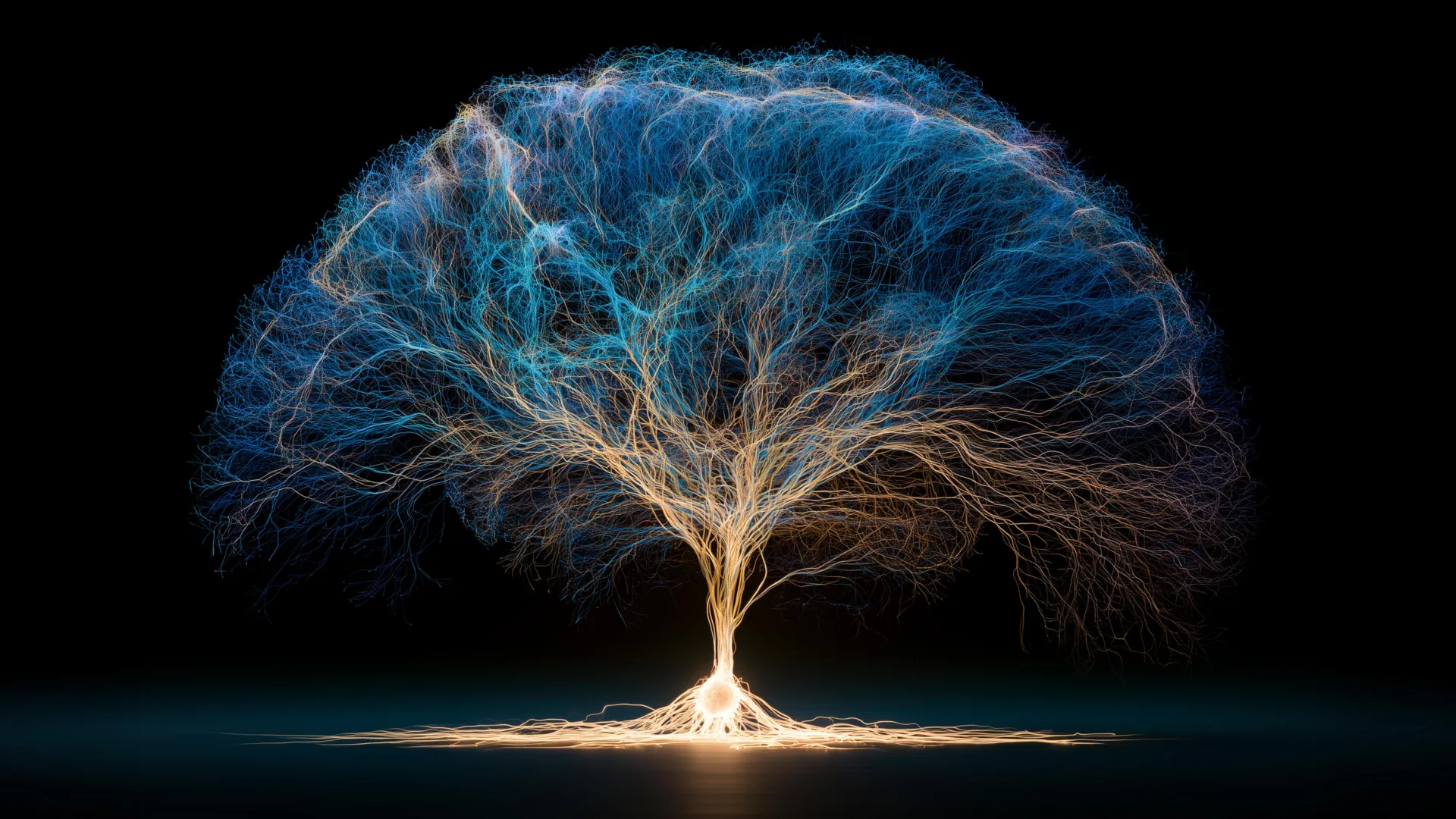
The human brain begins as a single cell. Over time, that single cell gives rise to a highly complex organ containing approximately 170 billion cells. One of the biggest questions in developmental neuroscience is how all these cells get to the right places to form a functioning brain.
Researchers at Cold Spring Harbor Laboratory now think the answer may be surprisingly simple. Their new research provides insight into how the brain is organized during development and could ultimately impact research in fields ranging from biology to artificial intelligence.
How brain cells determine their identity
Stan Kerstiens, a postdoctoral fellow in Professor Anthony Zador’s lab, explains this challenge from a location-based perspective.
“A cell ‘sees’ only itself and its neighbors,” he explains. “But the fate of a cell is determined by where it is located. If a cell is in the wrong place, it will be the wrong one, and the brain will not develop correctly. Therefore, every cell must solve two questions: where am I and who do I need to become?”
In a study published in neuronKerstiens, Zador, and their collaborators at Harvard University and ETH Zurich have proposed a new theory that explains how the developing brain achieves this remarkable level of organization.
Beyond chemical signals
For decades, scientists have widely believed that cells communicate location information through chemical signals. According to Kerstjens, this explanation works well for relatively small systems with a limited number of cells.
However, the developing brain contains billions of neurons, each of which must reach its correct position. Chemical signals weaken as they travel, so researchers have long wondered how cells located deep in the developing brain are able to accurately determine their location.
Part of the answer, Carstiens suggests, may come from a process similar to how human populations spread over generations.
“Think about how the human population spreads across a country over generations,” he says. “Because descendants settle close to their parents, people who share ancestry end up living in neighborhoods, giving rise to large-scale geographic structures without long-distance communication. We argue that a similar principle is at work in the developing brain: Cells descended from the same ancestor tend to stay close to each other.”
Testing lineage-based models
To explore this idea, the researchers developed what they describe as a “scalable location-based lineage-based model.”
They first used theoretical calculations to investigate whether the concept worked. Next, they examined patterns of gene expression in the developing mouse brain, examining both individual cells and larger cell populations. Finally, they tested their model in zebrafish and found similar results, suggesting that this mechanism may work across brains of different sizes.
This finding indicates that chemical signaling and cell lineages may work together to provide positional information during development.
Implications for biology and artificial intelligence
Although the study focuses on the brain, the underlying principles could be applied to many other developing tissues, including tumors, Carstiens says.
This theory may also be relevant for future self-replicating AI systems. Just as brain cells can pass on information across generations of cells, future AI models that transmit information from one generation to the next may rely on similar organizational principles.
Perhaps the most important implication is what this research can reveal about intelligence itself. Understanding how single cells grow into highly organized brains may help scientists answer some of the deepest questions about the mind.
“The brain somehow makes us smarter,” says Carstiens. “How were we able to accumulate this ability not just over a period of development, but over a period of evolution? This is one piece of a larger puzzle.”
