


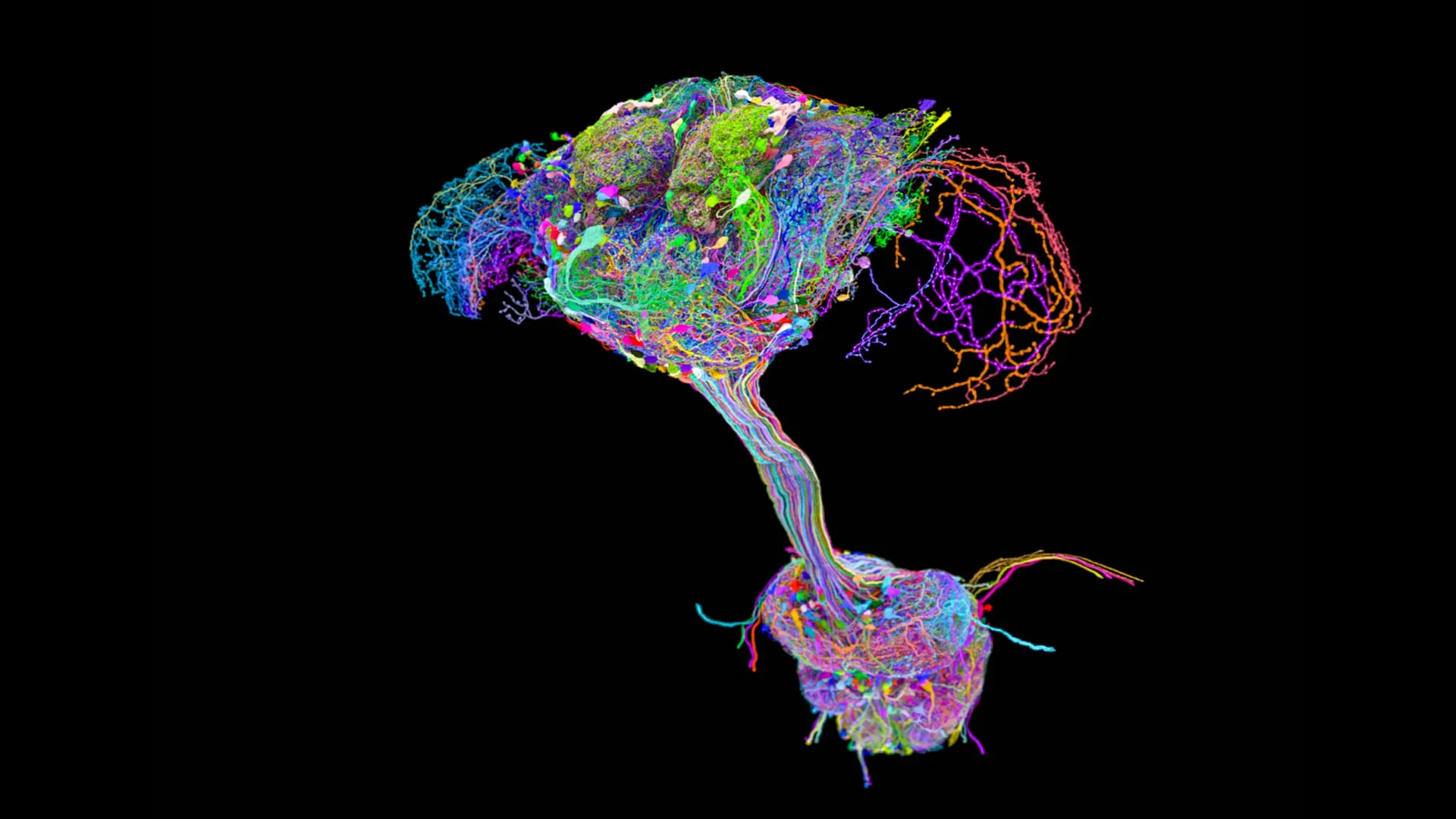
A large international research team led by groups from Harvard Medical School and Princeton University has reached a major milestone in neuroscience by publishing a complete map of every connection between neurons in the adult Drosophila central nervous system.
The results give scientists a new way to examine how the brain and body work together to produce complex movements such as walking and flying. It also opens the door to broader research into the central rules governing the nervous system.
“For the first time, we can look at every neuron and its connections as a complete unit and ask, ‘What can we learn from this?'” said Rachel Wilson, co-senior author of the study and the Joseph B. Martin Professor of Basic Research in the Department of Neurobiology at the Blavatnik Institute at HMS.
First complete Drosophila brain and body wiring map
The new neural connectivity map, known as the connectome, extends the previously published Drosophila brain connectome by adding a portion of the fly’s spinal cord called the nerve cord.
“It’s really important to have as complete a central nervous system connectome as possible so that we can connect the brain and body and start thinking holistically about behavior,” said study co-senior author Wei-Chung Allen Lee, associate professor of neurobiology at HMS and professor of neurology at HMS Children’s Hospital Boston.
When the researchers studied the connectome, they found that many of Drosophila’s behaviors appear to be directed by local neural circuits in relevant body parts, rather than by one central command area in the brain.
The complete connectome is now freely available online, providing researchers around the world with a powerful new resource for neuroscience research. The research, published June 8 in the journal Nature, was supported in part by U.S. federal funding, including the BRAIN Initiative (Brain Research Through Innovative Neural Technologies), the National Institutes of Health, and the National Science Foundation.
Why Drosophila is important in neuroscience
One of the major unanswered questions in neuroscience is how neurons in the brain and body connect and coordinate to produce behavior. The fruit fly Drosophila melanogaster is a valuable model for exploring this issue.
Drosophila melanogaster can be easily bred and kept in the laboratory. Although their nervous systems contain only about 160,000 neurons, they are still capable of complex behaviors such as locomotion, social interaction, learning, and responding to sensory signals. They also have what Lee calls an incredibly sophisticated genetic toolkit that allows scientists to access, control and record activity from single neurons or groups of neurons.
In 2024, the FlyWire Consortium, led by Princeton University’s Mala Murthy and Sebastian Seung, who are also co-authors of the new study, published the complete connectome of the fruit fly brain. At the same time, Lee and his colleagues were constructing the connectome of the Drosophila nerve cord. This connectome controls legs, wings, and other appendages, as well as processes sensory information.
“The brain and nerve cord connectomes are useful on their own, but until we can bridge the two, it will be difficult to understand how information moves between the brain and the body,” said co-first author Helen Yang, a neurobiology fellow at the Wilson Institute.
Co-lead author Alexander Bates, who is also a neurobiology fellow at the Wilson Institute, pointed out that while most neurons are found in the brain, nerve cords contain “some of the most useful neurons” and are easier to interpret because they are linked to sensation, movement, and function.
connect the brain to nerve cords
The FlyWire team was enthusiastic about moving to the Imaged Brain and Nerve Cord (BANC) dataset in the Lee lab, said co-senior author Marcy, the Karol Marney Marcin ’96 Professor of Neuroscience at Princeton University and director of the Princeton Neuroscience Institute (PNI).
“The new connectome represents a major advance in the field, with the ability to understand how circuits in the brain receive feedback from the body and control the body’s behavior,” she said.
“For the first time, we are now able to track the flow of information from sensation to behavior throughout the nervous system,” added co-author Aly Matsuria of PNI.
How scientists built the connectome
To create the connectome, the researchers sliced a single fruit fly into thousands of extremely thin serial sections. They then used an electron microscope to take millions of images showing the neurons and their connections. AI tools helped align and assemble these images into a unified 3D map.
The completed connectome shows how each neuron connects with other neurons in the brain and nerve cords at the level of individual synapses. Although the map does not cover the fly’s entire body, the researchers used identifiable neurons and previous scientific literature to link central nervous system neurons with neurons in many appendages and sense organs, effectively “reifying” the connectome.
Lee said scientists can use the connectome to generate new hypotheses for laboratory experiments. He compares it to having Google Maps’ detailed information when planning a route.
“The connectome has shown us that most of our hypotheses are too simple. Now we can develop more complex hypotheses and proceed with experiments to test them,” Lee said.
Amazing how movement is controlled
Researchers are already using the connectome to study motor control, particularly how flies move their legs and other body parts.
A long-standing idea in neuroscience is that the brain acts as a central controller that determines how an animal behaves. The Drosophila connectome offered a different answer.
The research team discovered that most of Drosophila’s motor control is localized. For example, the movement of one leg is primarily controlled by the neural circuits in that leg. These circuits communicate with circuits in other legs to produce coordinated movements such as walking.
The same pattern appeared in circuits associated with the flies’ wings, mouths, and other body parts. The researchers also discovered that motor circuits connect with other types of circuits, such as the visual and endocrine systems, which provide additional information that helps shape behavior.
“Our findings suggest that control of actions is highly distributed among local modules that link and cooperate in different ways,” Bates said.
What comes next for connectome research?
Researchers say the connectome could support many areas of future research. Yang compares this to the Human Genome Project, another large open resource that is used in a variety of ways.
The researchers will soon add more information to the connectome, including details about neuropeptides, small protein-like molecules that neurons use to communicate.
The connectome may also reveal fundamental principles that apply to nervous systems across species, including humans. Bates said many discoveries from Drosophila neuroscience have been carried over from invertebrates to mammals, including discoveries about navigation, smell and memory.
Another goal is to “bring complete connectome mapping to more complex organisms,” Mazzuria said. He noted that advances in AI, computing, and open collaborative science are making this type of research increasingly possible.
A big question now is whether the distributed neural control observed in Drosophila is also observed in other animals. Lee is currently studying that possibility in mice.
“I would be shocked if this was unique to flies,” Yang said. “Other animals don’t have this level of resolution, but we know they have lots of local circuits like this.”
Lessons for Artificial Intelligence
This research could also have implications for artificial intelligence. The connectome provides real biological data that can help design artificial agents that move through virtual worlds, systems that are increasingly used to study intelligence and improve AI training.
“What always surprises me is that this tiny little fly can do so many things. Even our best AI agents and robots can’t do everything a fly does,” Yang said. “It may hold lessons for AI about how the nervous system is organized.”
Authors, funding, and disclosures
Jasper S. Phelps and Minsoo Kim are also co-lead authors of the study. Jan Drugowitsch is co-senior author. Additional authors include Zaki Ajabi, Eric Perlman, Kevin M. Delgado, Mohamed Abdal Monium Osman, Christopher K. Salmon, Jay Gager, Benjamin Silverman, Sophia Renaud, Farzaan Salman, Janki Patel, Matthew F. Colley, Jinxuan Huang, Diego A. Pacheco, Zhao Zhao, Yun Zhang, Zhao Zhao, and Zhao. Capdevila, Ruairi J.V. Roberts, Eva J. Munnelly, Nina Griggs, Helen Langley, Borja Moya-Lamas, Zuoyu Zhang, Ryan T. Maloney, Shichie Yu, Amy R. Starling, Marissa Solek, Krzysztof Kluk, Nikitas Serafetinidis, Selene Dhawan, Finja Klemm, Paul Ellen, Jessica M. Jones, Jessica Brothers Sarah E. Pierce-Lundgren, Su Yi Li, Yichen Luo, Andrew P. Cook, Teresa H. McKim, Dimitrios Stassi Jakoumas, Benjamin Gorko, Emily C. Coffs, Charda Falto, Alexa M. Negron-Morales, Austin Burke, James Hebditch, Kyle P. Willey, Willy Popov, Ryan Popov, Sergiy Niko. Kemnitz, Dodam Yi, Kisuk Lee, Lan Lu, Akhilesh Halageli, J. Alexander Bey, Ben Jordan, Gregory Schwartzman, Damian D. Demarest, Emily Behnke, Doug Brand, Anne Christiansen, Jamie Skelton, Tom Stocks, Dustin Garner, Anthony Hernandez, Sande Kumar, Flywire Consortium, The Fly Consortium Kevin C. Daly, Sven Dorkenwald, Forrest Collman, Marie P. Suver, Lisa M. Fenk, Michael J. Pankratz, Zepeng Yao, Stephen J. Huston, Tomke Stürner, Gregory SXE Jefferis, Katharina Aichler, Andrew M. Seeds, Stefanie Hampel, Sweta Agrawal, Tutaal, Tutana, Tutana, Tetsuna, Thomas, Meow and Okobo. Diane-Yaira Ajabon, Jan Funke, John C. Tuthill, Anthony Azevedo, Benjamin L. de Bevoort.
Funding was provided by the National Institutes of Health (grants R01NS121874; RF1MH117808; U19NS118246; U24NS126935; RF1MH117815; K99NS129759; R00NS117657; R01NS102333; RF1NS128785; R01NS140174; UM1NS132253; R01NS121911; R25NS080687; Sir Henry Wellcome Fellowship Smith Family Foundation Odyssey Award, Harvard/MIT Collaborative Research Grant, HHMI Life Sciences Research Foundation Postdoctoral Fellowship (PJ100000343), New York Stem Cell Foundation Robertson Neuroscience Investigator Award, German Organization for Scientific Research (ZA1296/1-1; EXC2151-390873048; PA787/7-3; PA787/9-3), Nevada IDeA Network of Biomedical Research Excellence (GM103440), National Science Foundation (2127379; 2014862), Japan Society for the Promotion of Science (KAKENHI 25K00370), Japan Science and Technology Agency (ASPIRE JPMJAP2302; CRONOS) JPMJCS24K2), HHMI Gilliam Fellowship (GT15790), Max Planck Society, Shanahan Family Foundation, Kempner Graduate Fellowship, Medical Research Council (MC_EX_MR/T046279/1), Alice and Joseph Brooks Fund, and Beijing Natural Science Foundation (IS23084). The authors also acknowledge that this research benefited from the O2 High Performance Computing Cluster, which was supported by HMS’ Research Computing Group.
Harvard University filed a patent application (WO2017184621A1) for GridTape on behalf of its inventors, including W. Lee, and negotiated licensing agreements with interested partners. Macrina, Popovych, Kemnitz, Ih, K. Lee, Lu, Halageri, Bae, and Seung have declared a financial interest in Zetta AI. Seung declares a financial interest in Memazing, Inc. Capdevila, Roberts, Langley, Munnelly, Griggs, and Moya-Llamas declare a financial interest in Aelysia Ltd. Perlman is president of Yikes LLC.
