


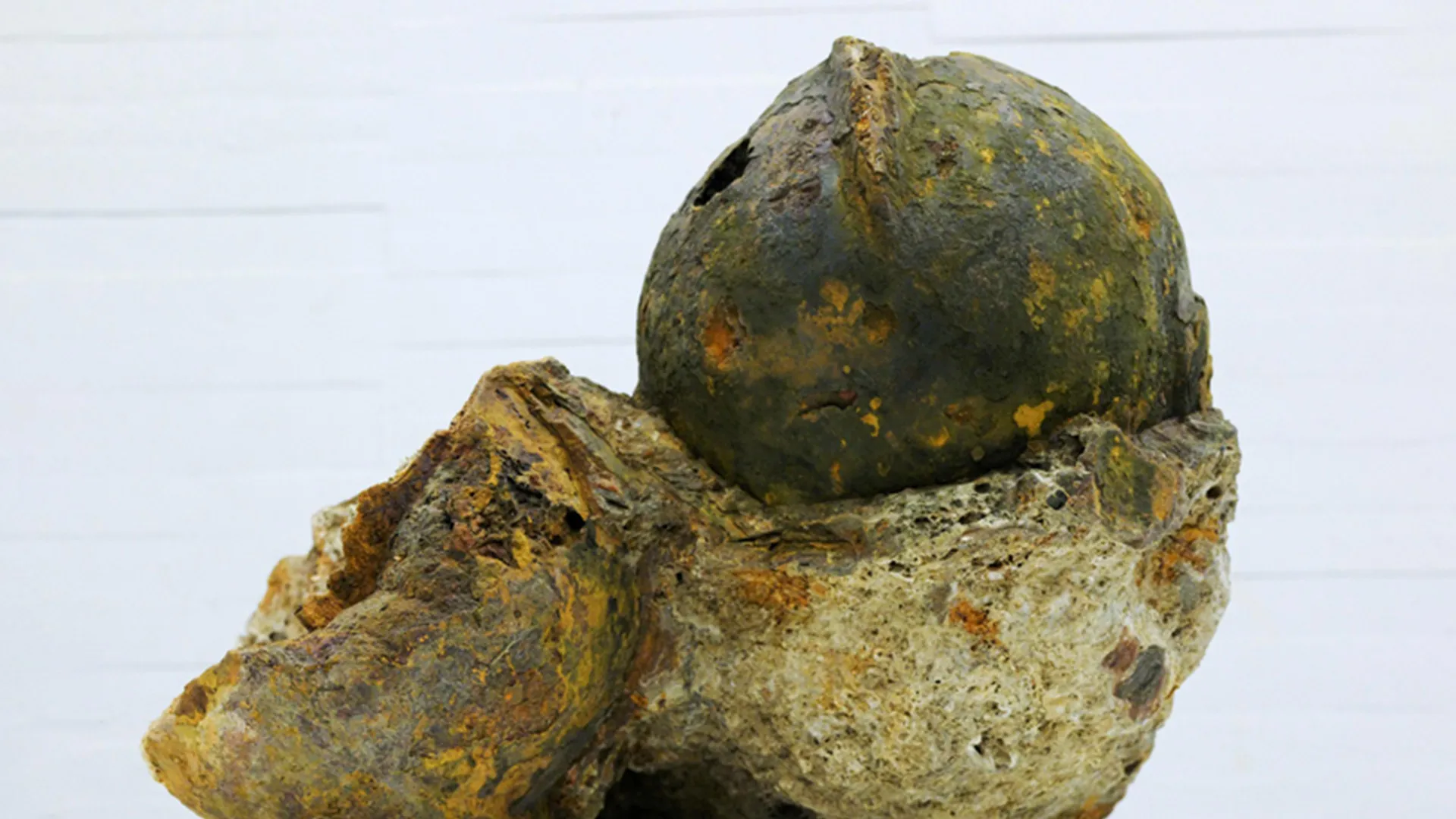
For more than 30 years, an incredible collection of helmets recovered from the sea off the coast of Spain was believed to date back to Roman times. A new study overturns that assumption, revealing that these artifacts are actually medieval and provide valuable insight into the movement of arms, trade, and military activity across the Mediterranean in the late Middle Ages.
The study, led by researchers from the University of Alicante (UA), reexamined 43 helmets discovered in 1990 at the underwater ruins of Piedras de la Barbada, near Benicarlo on Spain’s east coast. The findings were published in the journal Cambridge University Press. ancientindicating that the helmet was manufactured in the late 14th or early 15th century, completely overturning the long-standing Roman classification.
The research was led by Manuel Fraricciardi, a PhD student jointly supervised by the University of Alicante and the University of Salerno.
The largest repository of medieval helmets in the Western Mediterranean
The discovery itself happened by chance. Local fishermen pulled out two large chunks of metal, fused together by centuries of ocean corrosion, after catching them in their nets. Hidden inside the concrete blocks was an amazing iron helmet.
Although archaeologists believe the original shipment may have contained many more parts, the extant collection of 43 helmets already represents the largest hoard of medieval helmets ever discovered in the western Mediterranean.
The significance of the discovery goes far beyond the artifact itself, said Raimon Graels, a lecturer at the University of Alicante, co-director of Frariciardi’s doctoral project and co-author of the study.
“We are examining direct evidence of a large-scale arms trade,” he said. “Our findings reveal a much more complex network of exchange and communication than previously thought.”
The findings point to an active movement of military equipment between the coast of what is now the Valencian region and the major commercial centers of northern Italy, including Genoa, one of the most powerful trading centers at the time. Researchers say the size of the shipment indicates the weapons are being transported through an established commercial system linking different regions of the Mediterranean.
New analysis reveals medieval origins
One of the most important advances in this research was the use of an analytical method developed at the University of Alicante. Although this technique has been used successfully in other archaeological investigations, it had never before been applied to medieval weapons of this type.
This approach, combined with radiocarbon dating of cloth fragments preserved inside some of the helmets, allowed researchers to establish very precise dates for the artifacts.
Fraricciardi explained that initially identifying the helmet proved difficult.
“Initially, it was difficult to place them in a particular period, as they had characteristics reminiscent of both late Roman models and potentially medieval works inspired by the classical tradition,” he said.
The results became even more surprising when the researchers discovered that the helmet did not fit into any previously documented categories.
“When we started the research, it was incredible to find that there were virtually no known similarities,” Fraricciardi said.
While searching for comparisons, I found several depictions of similar helmets in 14th century English artwork, but no exact equivalent. Carbon-14 dating conclusively confirmed that the helmet belonged to a poorly documented transitional period of military technology with no direct descendants.
Lost cargo stored on the ocean floor
Researchers believe all 43 helmets were originally part of one cargo. The most likely explanation is that an accident occurred during loading and unloading and the ship fell into the water.
The site is only about 6 meters (20 feet) deep and is located next to an area that served as a pier.
Graels suggested that part of the cargo may have become buried under sand immediately after the accident, hampering recovery efforts at the time. As a result, the cargo remained hidden for centuries.
The helmet has survived in exceptional conditions thanks to a combination of sediments and mineral deposits that formed around it underwater. In some cases, these stones sealed the inner lining, preserving pieces of fabric that would normally have rotted long ago.
These textile fragments eventually became one of the most important pieces of evidence in reconstructing the history and chronology of the collection.
Piracy, war, and the demand for weapons
Researchers believe the cargo sank during a particularly volatile period in the Mediterranean’s history.
In the mid-14th century, Islamic piracy expanded along Valencia’s coastline, while increasing militarization increased the demand for protective equipment and weapons. In that environment, the helmet could have been intended for local paramilitary groups, units serving the Kingdom of Valencia, or armed groups responsible for defending the region’s maritime borders.
Far from being Roman relics, these helmets now provide valuable evidence of medieval trade, military logistics, and the movement of weapons in one of the world’s most important commercial regions.
