


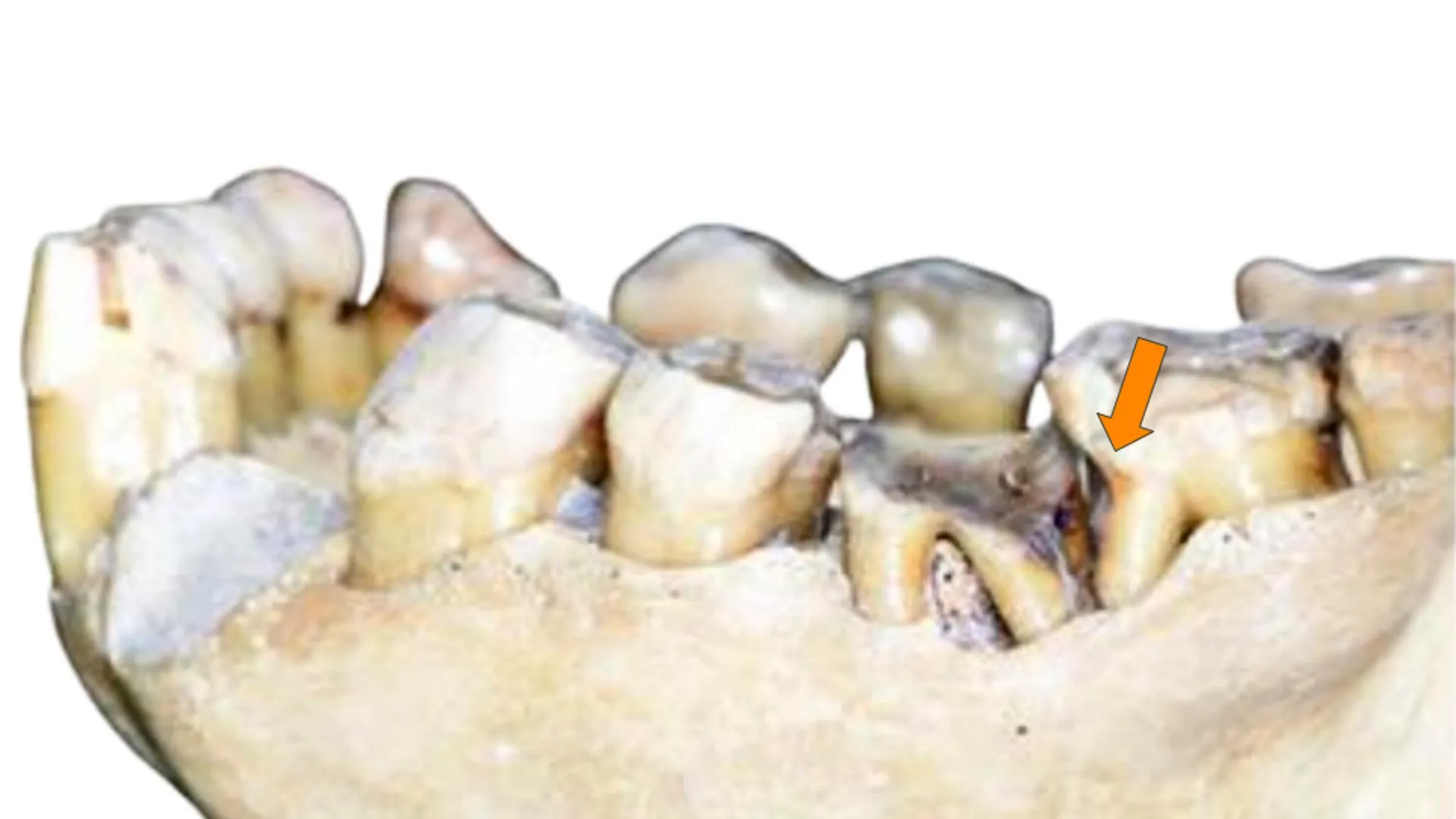
For decades, the tiny grooves in ancient human teeth were thought to be evidence of people intentionally using tools, such as cleaning teeth with sticks or fibers or soothing sore gums with makeshift “toothpicks.” Some researchers call this the oldest human habit.
However, our new discovery is American Journal of Biological Anthropologychallenge this long-held idea about human evolution. We found that these grooves appear naturally in primates in the wild, but there is little evidence that tooth grinding is the cause.
Even more surprising, researchers found no evidence of deep V-shaped gingival notches called abfraction lesions, a common modern dental disease, in more than 500 wild primates across 27 extant and fossil species.
Together, these discoveries can help reshape how we interpret the fossil record and ask new questions about the uniquely human influences on our teeth today.
Why teeth are important in human evolution
Teeth are the most durable parts of the skeleton and often survive long after other parts of the body have decayed. Anthropologists rely on them to reconstruct ancient diets, lifestyles, and health.
Even small marks can have important meanings. One recurring feature is the exposed roots of the teeth, especially the narrow grooves between the teeth. Since the early 20th century, these have been called “toothpick grooves” and interpreted as a sign of tool use and dental hygiene.
They have been reported throughout our recent evolutionary history, from 2 million-year-old fossils to Neanderthals. But until now, no one had actually investigated whether other primates also have them.
Another condition, abfraction, looks very different and results in a deep, wedge-shaped incision near the gum line. These are very common in modern dentistry and are often associated with teeth grinding, forceful brushing, or acidic drinks. Their absence in the fossil record has long puzzled researchers. Are other primates really immune to this disease?
what we did
To test these assumptions, we analyzed more than 500 teeth from 27 primate species, both extinct and extant. Samples included gorillas, orangutans, macaques, colobus monkeys, and fossilized apes.
Importantly, all specimens were taken from wild populations, meaning tooth wear may not have been affected by toothbrushes, soft drinks, or processed foods.
We looked for non-carious cervical lesions, i.e., tissue defects in the cervical region of the tooth that were not caused by dental caries. Even the smallest lesions were recorded using microscopy, 3D scanning, and tissue loss measurements.
what we found
Approximately 4% of people had lesions. Some looked similar to the typical “toothpick grooves” of fossil hominins, with fine parallel scars and a tapered shape.
Other teeth, especially the front teeth, are shallow and smooth, likely due to the acidic fruits that many primates consume in large quantities.
However, one person was conspicuously absent. No abfraction lesions were found. Despite studying species with very strict diets and powerful masticatory forces, not a single primate exhibited the wedge-shaped defect commonly seen in modern dental clinics.
What does this mean?
First, grooves resembling “toothpick” marks do not necessarily prove tool use. A similar pattern can occur with natural chewing, abrasive foods, or swallowed sand. In some cases, specialized behaviors, such as stripping plants with teeth, may also contribute. Therefore, caution should be taken in interpreting all fossil grooves as intentional toothpicks.
Second, the complete absence of abfraction lesions in primates strongly suggests that these are uniquely human problems coupled with modern habits. It is far more likely to be caused by aggressive tooth brushing, acidic drinks, and processed foods than by natural chewing forces.
This places abfraction alongside other dental problems, such as impacted wisdom teeth and misaligned teeth, which are rare in wild primates but are common in humans today. Together, these insights form a growing subfield known as evolutionary dentistry, which uses our evolutionary past to understand current dental problems.
Why is today important?
At first glance, the grooves in fossil teeth may seem trivial. However, they are important to both anthropology and dentistry.
When it comes to evolutionary science, it shows why we should look at our closest relatives before assuming a specific or unique cultural explanation. When it comes to modern health, it is emphasized that our diet and lifestyle have changed our teeth so much that they distinguish us from other primates.
By comparing human teeth with those of other primates, we can distinguish between what is universal (inevitable wear from chewing) and what is uniquely human, a result of modern diet, behavior, and dental treatments.
What’s next?
Future studies will be expanded to larger primate samples, investigate the association between eating and wearing in the wild, and apply advanced imaging to observe how lesions form. The aim is to refine interpretations of the past while finding new ways to prevent today’s dental diseases.
What looks like fossilized grooves in human teeth could also be a byproduct of daily chewing. It may likewise reflect other cultural or dietary habits that leave similar imprints. Untangling these possibilities will require much larger comparative datasets of lesions in wild primates, and only then can we begin to trace broader patterns and refine interpretations of the fossil record.
On the other hand, the absence of abfraction lesions in primates suggests that some of the most common dental problems are unique to humans. It’s a reminder that even something as mundane as a toothache, our evolutionary history etched in our teeth, is shaped as much by modern habits as by ancient biology.
