


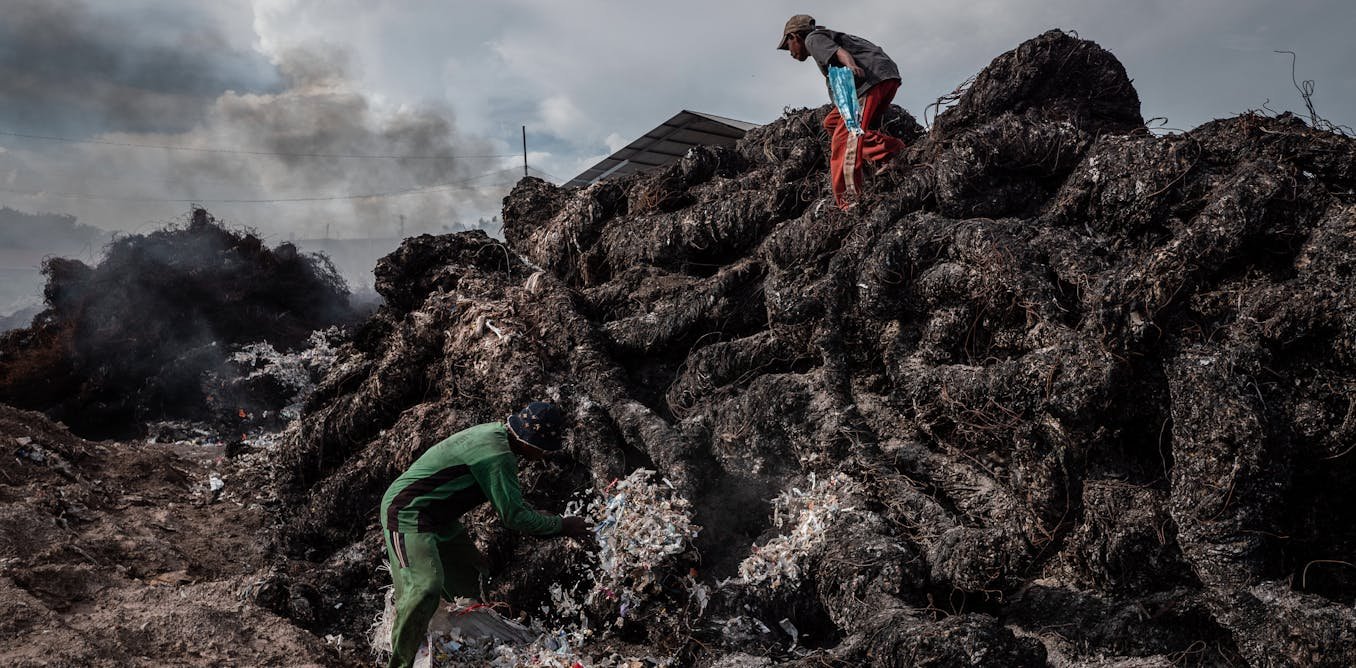
Imagine a pile of trash the size of Manhattan and taller than one and a half Empire State Buildings. This is the amount of plastic waste the world is projected to produce every year by 2050 if nothing is done to change course.
It’s easy to think of recycling as a solution, but the vast majority of plastic waste currently ends up in landfills or worse.
A large amount of plastic waste is shipped overseas. In new research, my colleagues and I analyzed what happens when plastic waste is shipped to low- and middle-income countries. Open burning is a common way to dispose of surplus waste there. The results showed a significant increase in toxic air pollution.
Combustion of plastic waste and health effects
Between 40% and 65% of all municipal solid waste is burned in the open in low- and middle-income countries, largely because 2 billion people around the world do not collect their municipal solid waste.
Wild burning occurs both intentionally and unintentionally. The latter is when open dumps containing organic waste spontaneously combust due to the heat generated as the waste degrades.
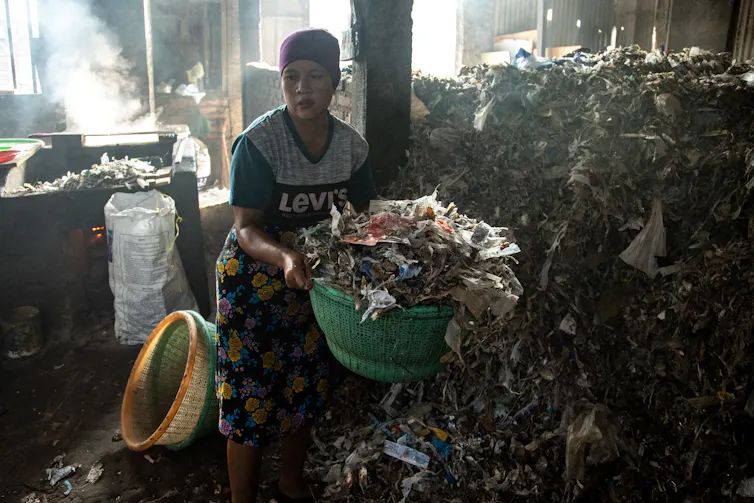
Workers carry baskets containing plastic waste, wood, and coconut shells to be used as fuel to fry tofu at a factory in Sidoarjo, Indonesia, in 2025. It is common to burn waste to reduce fuel costs, but studies have found that the tofu from these factories contains high concentrations of microplastics, leaving toxic ash in buildings and dangerous levels of air pollution.
Robertus Pudiant/Getty Images
When plastic burns, it releases particularly toxic air pollutants. Particulates can penetrate deep into a person’s body along with gases such as carbon monoxide, styrene gas, and hydrogen cyanide. They also release persistent organic pollutants such as polycyclic aromatic hydrocarbons and dioxins. These particles and gases are associated with a variety of health risks, from respiratory and cardiovascular diseases to cancer, reproductive and neurological disorders.
Ash from open burning can contaminate soil and groundwater with persistent organic pollutants, heavy metals, and other toxic substances, increasing people’s exposure to them through food and water.
Global plastic waste trade
Huge amounts of plastic waste are shipped around the world, and while some of it is recycled, much of it is simply landfilled or incinerated. According to the United Nations, 9.34 million tons of plastic waste will be imported in 2024.
The destination of this exported plastic waste is changing.
In 2018, China stopped importing plastic waste, dramatically reducing the total amount of plastic waste moving between countries, at least through official channels. From 1992 to 2016, China’s plastic waste imports accounted for 45% of global imports.
In 2018, the trend shifted to other countries, primarily Southeast Asia, but also elsewhere, such as Türkiye. In 2018, Indonesia became a net importer of plastic waste. Most of this waste comes from Western Europe, Australia and North America.
What happened to Indonesia’s air quality?
We used data from multiple monitoring systems, including satellite observations and cargo ship tracking signals, to understand where this plastic waste was imported and how much air pollution was released by the open burning of this waste.
As of 2020, the World Economic Forum and the Indonesian government estimate that 48% of Indonesia’s plastic waste is burned in the open.
Based on data from 2012-2017, researchers found that after China’s 2018-19 ban, particulate air pollution, a major health concern, increased by an average of 3.3% at Indonesia’s large open waste dump sites compared to business-as-usual expectations. An increase of up to 1.68 micrograms per cubic meter was confirmed.
Based on risk estimates from global studies of mortality associated with long-term exposure to outdoor particulate matter, this corresponds to an approximately 1.5%, 1.9%, and 3.5% increased risk of death from chronic obstructive pulmonary disease, lung cancer, and lower respiratory tract infections, respectively.
New constraints on plastic waste trade
Indonesia will restrict the import of non-hazardous waste to 15 specific ports in 2021, and completely ban the import of plastic waste in 2025.
In mid-2025, Malaysia followed suit, allowing plastic waste only from countries that have ratified the Basel Convention on the Control of Transboundary Movements of Hazardous Wastes and Their Disposal, which the United States has never ratified.
For these bans to be effective, these countries must also find ways to address the illegal transport of plastic waste and the importation of paper contaminated with plastic waste.
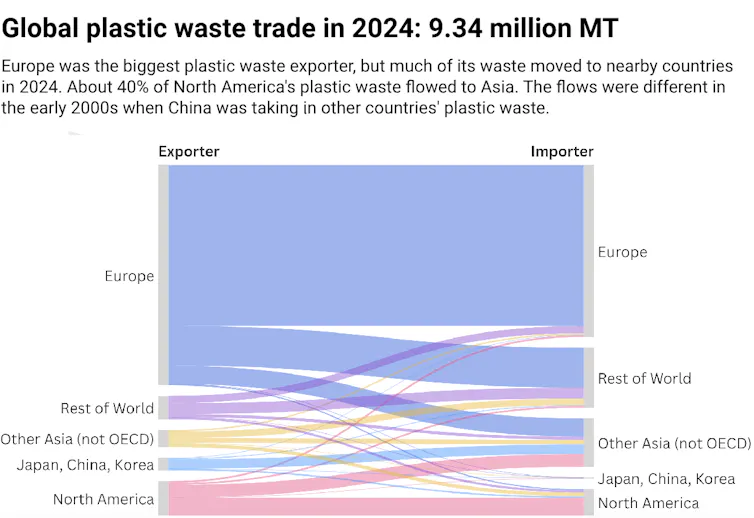
Destinations for exporting plastic waste in 2024. This graph does not include waste disposed of within the country where the plastic waste was produced.
Comrade UN, Ellen Considine, Created by Flourish, CC BY-ND
Meanwhile, negotiations for a legally binding international treaty on plastic waste, due to begin in 2022, have stalled. In mid-2024, the European Union passed new regulations on waste transport, banning the export of plastic waste to countries outside the Organization for Economic Co-operation and Development’s rich countries group from November 2026 until at least May 2029.
The effectiveness of these and future policies to reduce air pollution and other types of environmental degradation can be assessed using methods like ours.
How to reduce plastic waste
As of 2021, only 5% to 6% of plastic waste in the United States was recycled, according to estimates from the advocacy group Beyond Plastics and Bennington College. It is now even more difficult to export plastic waste to other countries where it can be ‘recycled’.
Part of the problem is a lack of processing power. The Plastics Recyclers Association estimates that current plastic recycling facilities in the U.S. and Canada can increase plastic recycling rates by at most 35% to 44%, depending on the type of plastic, for a total recycling rate of 7% to 9%.
Ultimately, solving this problem may require both reducing plastic usage and increasing recycling. Beyond consumer choice, we can reduce the need for new plastic by creating packaging reuse, or packaging and return systems that put the same materials back in their original condition.
Recycling experts are calling for harmonized design standards to streamline processing and provide higher-quality recycled plastics, as well as expanded producer responsibility fees and taxes to raise the cost of manufacturing non-recyclable products. This fee could provide the funding needed to expand recycling and other programs to reduce plastic waste generation.
Starting in 2021, seven states have enacted expanded producer responsibility laws focused on packaging: Maine, Oregon, California, Colorado, Minnesota, Washington, and Maryland. However, it takes time for the effects to appear. Colorado’s final implementation plan was approved in 2022, but it was not approved until the end of 2025. The first payments of the Extended Producer Responsibility Fee to the Colorado Department of Public Health and Environment are expected to begin in mid-2026.
Ultimately, by reducing and better managing our nation’s plastic waste, we can prevent a global health crisis.
