


Scientists have developed a predictive technique that can reveal the strength of the sun’s next cycle as much as seven years before it reaches its maximum.
The method focuses on the number of sunspots present during the newly identified “switch-off” phase of the solar cycle. At this point, the Sun’s harshest space weather appears to end abruptly. Researchers have already used this approach to make early estimates of solar cycle 26.
Early predictions suggest that Period 26 could be moderate, with around 100 to 120 sunspots. That means it could be comparable to, or even weaker than, the current solar cycle of 25. However, researchers won’t be able to make more accurate predictions for about two years, and both stronger and weaker results are theoretically possible.
The findings will be presented this week at the Royal Astronomical Society’s National Astronomical Conference in Birmingham.
Abnormal weather on the sun suddenly stops
Sandra Chapman, professor of physics and director of the Center for Fusion, Space and Astrophysics at the University of Warwick, said: “The sun does not sleep peacefully and then quietly wake up again.
“Instead, we found that the most extreme space weather abruptly switches at a specific point in each solar cycle. By identifying that point, we discovered a new way to predict how active the next solar cycle will be.”
Professor Chapman expects the Cycle 26 predictions to become even more accurate within about two years. By then, Solar Cycle 25 should have reached a newly identified “switch-off” point, allowing scientists to base their calculations on direct observations rather than predictions.
The sun moves in cycles of about 11 years. During that time, the polarity of its magnetic field reverses, and the number of visible sunspots increases and then decreases.
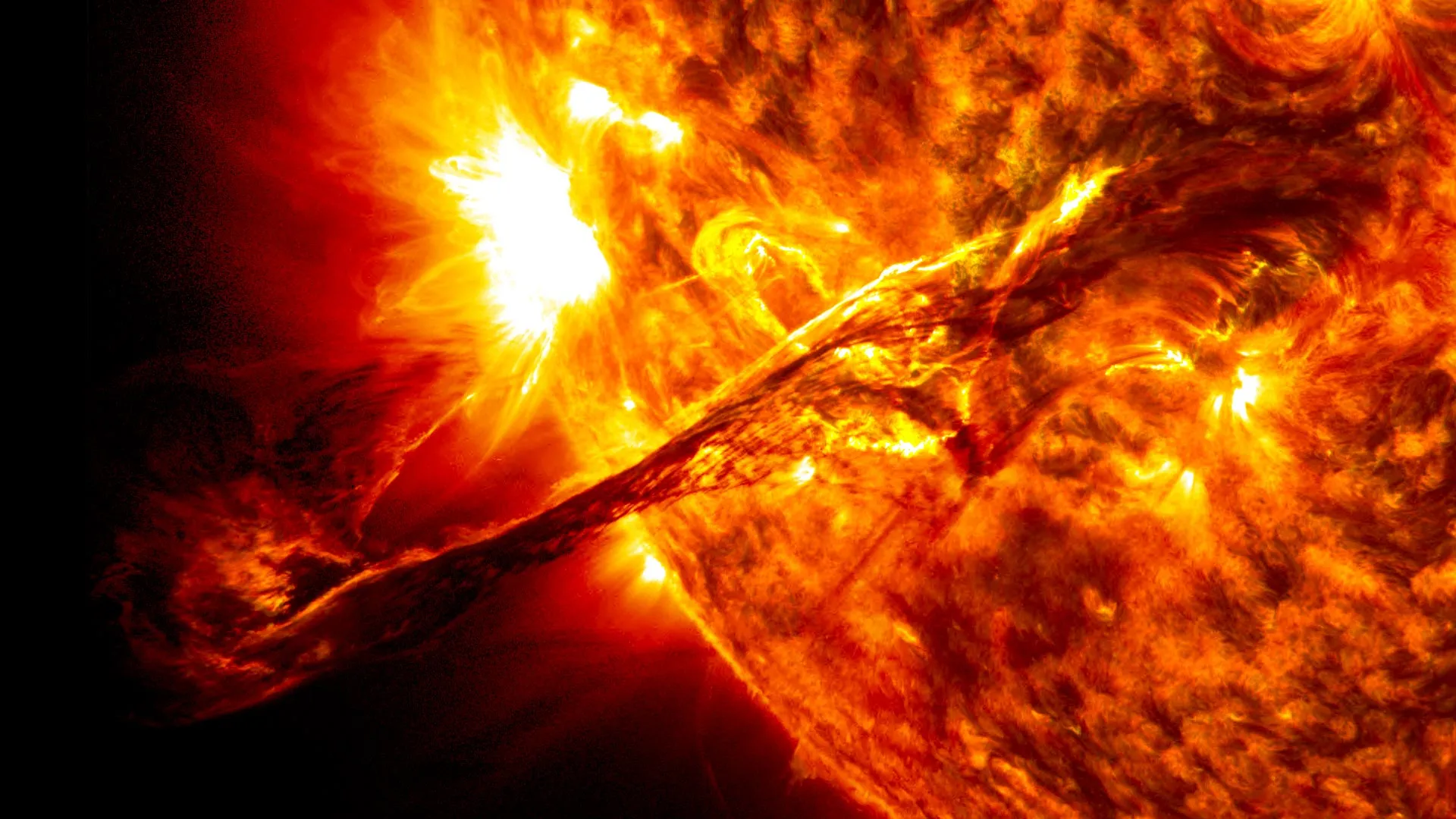
Sunspots are highly active magnetic regions on the surface of the Sun. It can trigger powerful solar flares and coronal mass ejections, sending energy and charged particles into space. This space weather can interfere with satellites, communications, navigation systems, and power grids on Earth.
Astronomers have been tracking sunspots for centuries, and they behave differently during each solar cycle. Some cycles may be longer or shorter than others, and their intensity may vary significantly. These differences make it difficult to predict the strength of future cycles.
New solar clock improves predictions
This new technology builds on Professor Chapman’s previous ‘solar clock’, a system that puts the sun’s irregular cycles into a standardized clock. The study showed that extreme weather in space does not slowly disappear when the cycle ends. Instead, it ends at a clearly defined stage.
Professor Chapman and colleagues found that the number of sunspots visible at this stage is closely related to the maximum number of sunspots reached during the next solar cycle.
This relationship creates a new way to estimate the strength of future cycles about six to seven years before they reach their peak. Existing prediction methods generally provide less advance notice because scientists must wait until the sun reaches solar minimum, the quietest part of the solar cycle.
The technique also indicates the specific stage at which the magnetic field responsible for the next cycle is expected to be established. Researchers hope this timing will help them better understand the solar dynamo, the process that creates and maintains the sun’s magnetic field.
Professor Chapman said: “We are about two years away from the current switch-off point for solar cycle 25. At the moment we need to estimate where that point will be, but once we get there we will be able to make more accurate predictions about solar cycle 26 using observations alone.”
“Still, we will have about seven years of warning about how strong this cycle is likely to be.”
Cycle 25 where the previous prediction was predicted correctly
This method previously showed that Solar Cycle 25 was more active than many previous predictions. This more intense activity has helped produce some of the more impressive auroral displays seen in recent years.
The UK experienced several historic solar storms in 2024 as Cycle 25 approached its solar maximum, the most active period. The most notable events occurred between May 10th and 13th.
A giant sunspot cloud near solar maximum has created the strongest magnetic storm to impact Earth in more than 20 years. The event caused bright and widespread aurora borealis to be seen across the UK, as far south as Devon and Cornwall.
In 2022, Professor Chapman was awarded the Royal Astronomical Society’s Chapman Medal. The award recognizes her pioneering research into the behavior of planetary magnetic fields and how those fields generate space weather.
Why solar storms disappear
The newly identified switch-off point also occurs when the active sunspot region moves below about 15 degrees of solar latitude.
During each solar cycle, sunspots form a “butterfly pattern.” They first appear at high latitudes and gradually move closer to the Sun’s equator as the cycle progresses.
The Sun has differential rotation, meaning it rotates at different speeds at different latitudes. However, below about 15 degrees of latitude, the difference in rotational speed becomes smaller. This creates a corotating region around the solar equator (the solar “jet stream”).
Professor Chapman believes that the most powerful coronal mass ejections are caused by differential rotation. When parts of the sun rotate at different speeds, the emerging magnetic fields twist and energy is stored. When an active sunspot region moves within 15 degrees of the equator, its twisting mechanism weakens and the main driver of extreme space weather is turned off.
To test this idea, Professor Chapman looked at the 27-day (average solar rotation) correlation of the aa index (Earth’s geomagnetic activity) and compared it with recorded space weather events.
After the switch-off point, the geomagnetic storm became less extreme and followed a 27-day pattern. This suggests that they were probably produced by co-rotating flows rather than coronal mass ejections.
