


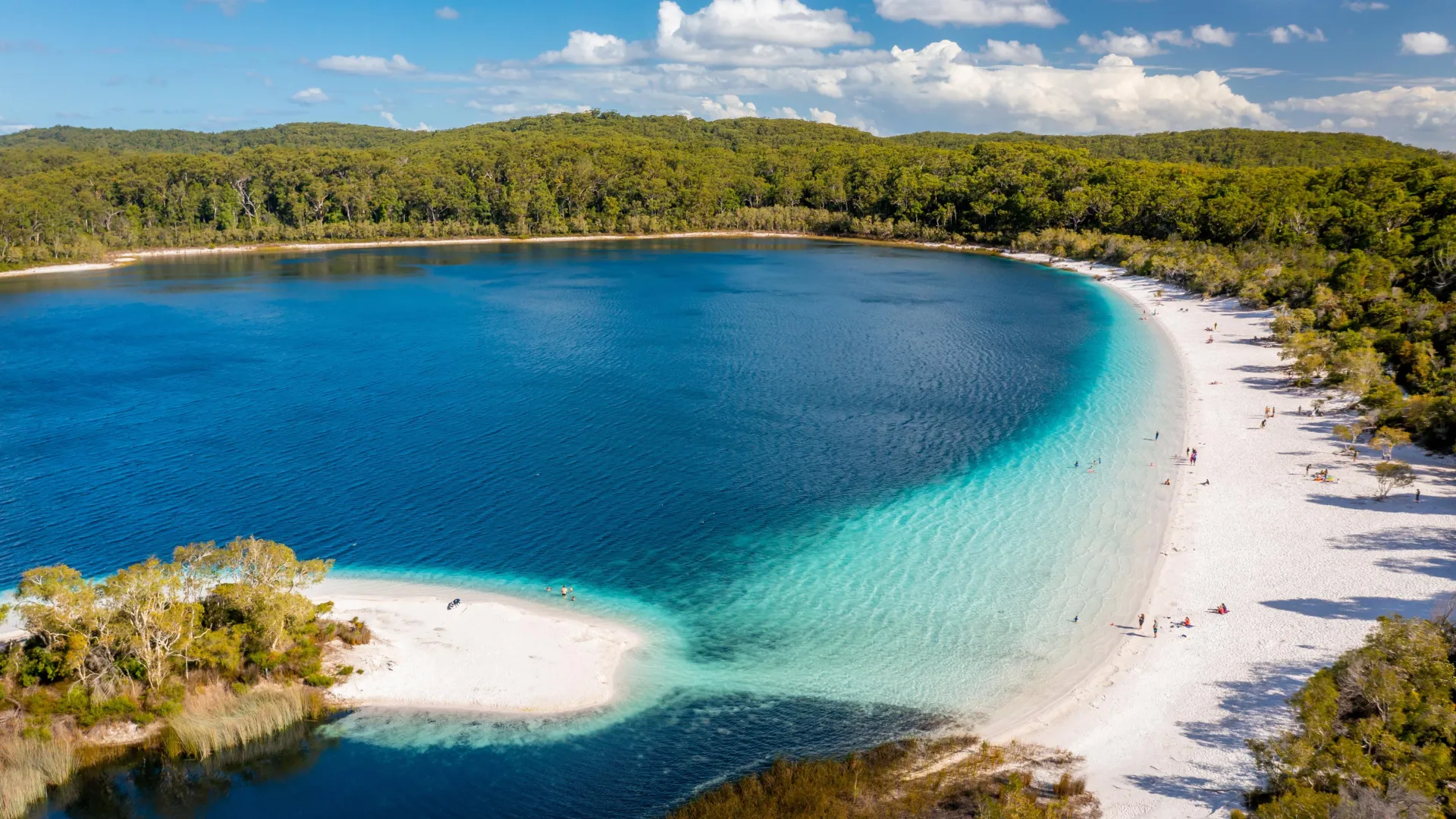
The world’s largest sand island, Kgari is famous for its impressive freshwater lake. But new research from the University of Adelaide suggests that even the island’s largest and deepest lakes could disappear under certain climate conditions.
By examining ancient layers of lake sediment, researchers found evidence that some lakes dried up about 7,500 years ago. This period, known as the Middle Holocene, arrived several thousand years after the last ice age and was generally wetter than today.
Dry ancient lake in a humid climate
“Our study shows that some of Kgari’s deepest lakes dried up around 7,500 years ago, long after the end of the last ice age and during a period of high rainfall,” said lead researcher Associate Professor John Tibby from the University of Adelaide.
Dry lakes are not uncommon in Australia, and prolonged periods of low rainfall can cause water levels to drop dramatically. What surprised the researchers was that the ancient drying phenomenon at Kgari appears to have occurred during a relatively wet period.
“There are many lakes in Australia that have dried up because there wasn’t enough rainfall to sustain them during the Millennium Drought,” Associate Professor Tibby said. His research was published in Quaternary Science.
“Lake Kgari, which we studied, has existed for between 35,000 and 55,000 years, but the drying phenomenon we identified occurred unexpectedly during periods of heavy rainfall.”
The findings suggest that the survival of these lakes may depend on more than just the amount of rainfall that falls over the wider area. Where the rain comes from, how the wind transports moisture, and which parts of the landscape receive water can also be important.
Wind patterns may have changed the direction of the rain
Co-author Dr Harald Hofmann from the Commonwealth Scientific and Industrial Research Organization (CSIRO) said ancient wind patterns could explain why heavy rains were unable to replenish the lake at Kgari.
Researchers believe southeasterly trade winds may have directed the rain towards nearby Minjeriba instead of Kgari. Trade winds are persistent winds that blow over a wide area and can have a significant impact on where clouds form and where rain falls.
“Previous studies have shown that heavy rains also occurred in Minjeriba during this period, but due to the southeast trade winds that were occurring at the time, rainfall from the south only entered the Minjeriba lake and not the Kgari lake,” he says.
“This discovery highlights the urgent need to know more about Kgari’s beautiful lakes. The climate is predicted to become drier, but rainfall is becoming more intense, so we have no idea whether these lakes are at risk of drying up.”
This uncertainty is especially important because future, more powerful storms do not necessarily mean more water will be available in the lake. Torrential rain can fall in the wrong places, run off too quickly, and fail to recharge the systems that maintain the lake.
Lost Sediments Reveal Lost Chapters
Researchers identified the ancient aridity phenomenon by studying sediment cores taken from some of Kgari’s oldest lakes. Over time, materials such as pollen, sand, plant debris, and organic matter settle to the lake floor, building a layered record of past environmental conditions.
“Lake sediments are like a diary, recording what happens in and around the lake,” says Professor Tibby.
“Pollen from lakes and plants around lakes can tell us about the type of vegetation in the area, and high sand levels may indicate more erosion into the lake.
“Our study found that some of Kgari’s oldest lakes were depleted of sediment between 7,500 and 5,500 years ago. This indicates that the lake area was not covered by water, meaning there was no lake.”
The absence of sediment for about 2,000 years means that parts of the lake’s basin are no longer covered by water. Without standing water, normal layers of lake sediment cannot accumulate.
Kugali’s Sacred Eye
For Kgari’s traditional owners, the Butula people, the lake has cultural and spiritual significance that goes far beyond its environmental value. They are known as “Kugali eyes”.
Study co-author and Buturaman Conway Burns said protecting the lake was essential to preserving its beauty, meaning and connection to the country for future generations.
“Kugali is the name of the dreaming spirit who formed this island, and her eyes are more than just water, they are windows to eternity,” Burns says.
“When you stand in front of Lake Kgari, you don’t just see the reflection of the sky and the forest; you see the spirit of the country staring back at you. Her eyes hold ritual, memory, and the whispers of the Creator. They carry the voices of our departed ancestors and loved ones, guiding us with forgiveness, wisdom, and reflection.”
“These waters are sacred and secret. They are not ours to own, they are ours to protect. Because we are her children, we are entrusted with a heartfelt and eternal responsibility: to preserve her beauty, her spirit, her voice whispering through the streams and her eyes so that future generations can feel the same connection and respect.”
