


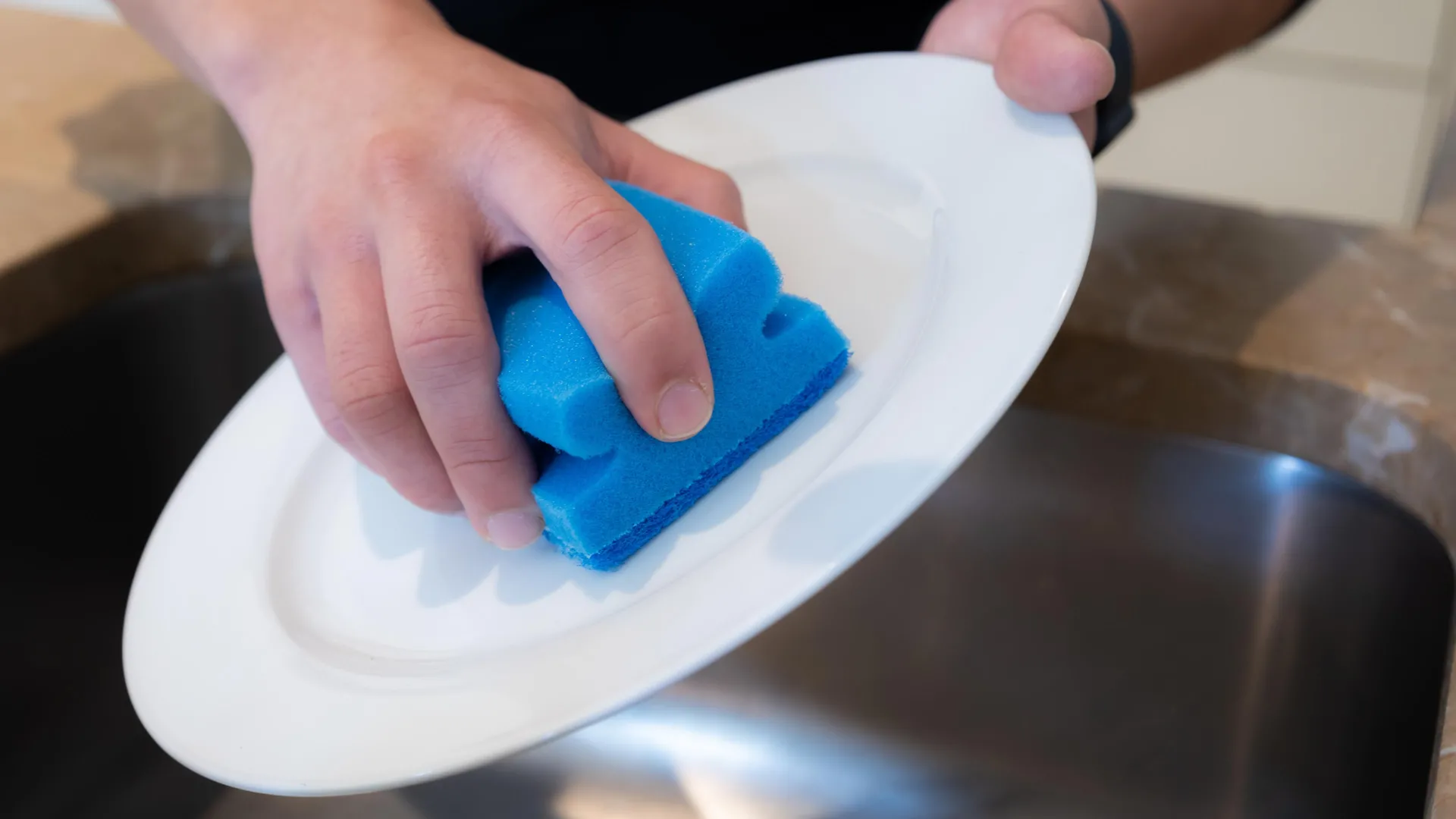
Kitchen sponges are a staple in most households, but they can also be an overlooked source of microplastic pollution. A new study led by researchers at the University of Bonn investigated how many tiny plastic particles are released from sponges during daily dishwashing and what impact those particles have on the environment.
The results showed that kitchen sponges emit measurable amounts of microplastics over time. But researchers have discovered that the biggest environmental burden associated with hand-washing dishes isn’t the plastic particles themselves. Rather, water use accounts for the bulk of the overall impact.
Kitchen sponges as a source of microplastics
Kitchen sponges are used every day in millions of households, but their role as a source of microplastics has received relatively little attention. The research team set out to measure the amount of plastic released as the sponge wears out during normal use and assess the environmental impact through life cycle assessment (LCA).
To collect real-world data, this study combined clinical testing and citizen science. Households in Germany and North America volunteered to use one of three types of sponges as part of their regular dishwashing routine and documented how to use the sponges.
Researchers weighed each sponge before and after use to see how much material was lost over time. They also conducted controlled laboratory experiments using an automated testing system known as “SpongeBot” that replicates the mechanical stress a sponge is subjected to during dishwashing.
How much microplastic is released from a sponge?
The study found that all sponges tested lost material during use, resulting in the release of microplastics. Depending on the type of sponge, annual emissions range from about 0.68 grams to 4.21 grams of microplastics per person.
Sponges with lower plastic content emit significantly fewer particles than sponges with higher plastic content.
Citizen science played an important role in this project, as participants used sponges in real home environments. This allowed researchers to understand realistic dishwashing habits and usage patterns, giving them a more accurate estimate than could be obtained from laboratory tests alone.
Water consumption has the biggest impact on the environment
Although the amount of microplastics released by individual sponges may seem small, when scaled up the total is much higher. The researchers estimated that if a certain type of sponge was used in every German household, annual emissions could reach 355 tonnes of microplastics.
Although wastewater treatment plants capture most of these particles, tons can still end up in rivers, lakes, oceans, and soil each year.
Still, the study found that microplastics were not the main cause of environmental damage. Environmental assessments have found that approximately 85 to 97 percent of the total impact of manual dishwashing is due to water consumption. Compared to water use, microplastic emissions account for a much smaller share of overall ecosystem damage.
How consumers can reduce their environmental footprint
Researchers have identified several practical steps consumers can take to reduce the environmental impact of dishwashing.
- Reducing the amount of water you use when washing dishes maximizes environmental benefits.
- Choose sponges with low plastic content to reduce microplastic release.
- Extending the lifespan of the sponge reduces overall resource consumption, so it continues to be used for a long time.
Research team and publications
The study involved researchers from the Institute of Biobiology (BIOB) at the University of Bonn, the Fraunhofer Institute for Environment, Safety and Energy Technology UMSICHT, and Leiden University.
The survey results are environmental progress in paper From the sink to the sea: Microplastic emissions from kitchen sponges and their potential environmental impact Written by Leandra Herrmann, Christina Galafton, Peter T. Schleif, Alexander Blanke, and Nils Tonemann.
