


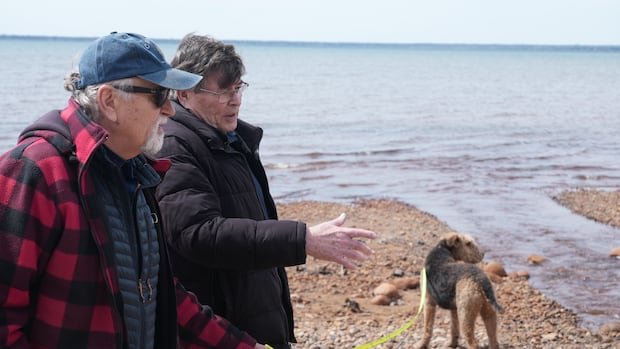
Peter Gagnon wonders if his grandchildren should swim in the St. Mary’s River near Sault Ste. Marie, Ont., due to decades of chemical spills from the airport.
“I started this because I thought about my grandchildren, right? They went into that water and exposed them to harmful chemicals.”
Gagnon and her neighbor Rick Gertschor are concerned about per- and polyfluoroalkyl substances (PFAS) contamination in the city’s Pointe-des-Chênes area.
PFAS are a family of more than 10,000 man-made chemicals that persist in the environment and are highly resistant to heat, water, and oil.
Different types of PFAS, also known as “forever chemicals” due to their properties, are found in a variety of items, including certain types of cosmetics, takeout containers, nonstick pots, and waterproof clothing.
Health Canada says some animal and human studies have shown that exposure to certain PFAS is associated with reproductive, developmental, endocrine, hepatic, renal, immunological effects and other health issues.
The International Agency for Research on Cancer has classified one specific type of PFAS, perfluorooctanoic acid (PFOA), as possibly carcinogenic to humans.
 Residents are advised not to eat fish caught in the Pointe-des-Chênes stream, which flows out of Sault Ste. Mary’s Airport to St. Mary’s River. (Alex Flood/CBC)
Issues across Canada
For decades, airports across Canada have conducted firefighter training that includes the use of foam containing PFAS.
“They built a shell like an airplane, sprayed gas all over it and ignited it,” Gartshore said. “Then they will bring out the extinguishing agent and put out the fire.”
PFAS in firefighting foam seeped into the ground. Because the chemicals do not easily break down, they accumulated over time and entered the groundwater of communities across Canada.
In North Bay, Ontario, PFAS from the airport’s firefighter training range ended up in Trout Lake, the source of the city’s municipal drinking water.
A 2025 test conducted by the Ontario Ministry of Environment measured 58 nanograms of PFAS per liter of water in Trout Lake. This amount is equivalent to a few drops in an Olympic-sized swimming pool, but exceeds Health Canada’s drinking water guidelines of 30 nanograms per liter.
Health Canada’s guidelines only cover a total of 25 specific PFASs and are believed to be aimed at reducing potential health risks associated with ingesting the chemicals.
Now, the Department of Defense (DND), which trained firefighters at the North Bay airport, is investing $120 million to remediate the site and prevent any more PFAS from entering the lake.
A proposed class action lawsuit in North Bay seeks $100 million in damages related to loss of property value due to proximity of PFAS contamination to homes near the airport.
Certified class actions have also been filed in Mississippi Mills, Ontario, and Torbay, Florida, seeking damages for diminished property values near PFAS-contaminated areas.
Sue’s pollution
Marie, Transport Canada in Sault Ste., built a firefighter training area in 1964 on the southwest side of the airport grounds. Until 1992, firefighters were trained in locations where extinguishing agents containing PFAS were used.
In an email to CBC News, the City of Sault Ste. Murray confirmed that a supply well at the Pointe-des-Chênes campground south of the airport contained benzene, which was used to ignite the training range.
“By the spring of 2008, benzene concentrations exceeding Ontario drinking water standards were detected in both raw solution and water samples taken from the Point-des-Chênes on-site water treatment plant,” the report said.
The city continued to monitor water and groundwater samples in the area from 2008 to 2015. In 2015, Ontario’s Ministry of Environment and Climate Change confirmed to the city that PFAS were also present in the well and surrounding groundwater.
Through an access to information request, CBC obtained 3,200 pages of documents from Transport Canada regarding PFAS monitoring near Sault Ste. Marie airport. The package includes 10 environmental monitoring reports from 2011 to 2024.
CBC used artificial intelligence (AI) to analyze the documents and cross-reference the results with the documents themselves.
According to a 2011 report by Dillon Consulting Limited, groundwater sampling conducted at two monitoring wells at the airport in January of that year exceeded Health Canada’s drinking water guidance values for PFAS at the time.
In 2015, BluMetric Environmental measured PFAS levels in groundwater at a campground in Pointe-des-Chênes, south of the airport, “exceeding screening limits for the applicable site.”
 In 2022, Transport Canada installed an advanced supplemental water treatment system to filter PFAS from tap water at the Pointe des Cheyne campground. This system has proven successful in reducing PFAS in treated water below laboratory detection limits. (Alex Flood/CBC)
The Sault Ste Marie Lions Club leased the land from the city and operated the campground from 1985 to 2021. The City Council voted to close the campground in 2021 due to persistent water quality issues related to benzene and PFAS contamination.
In 2016, Transport Canada installed a granular activated carbon filtration system in the park to treat well water. Although it was successful in filtering benzene, reports at the time found that it was not able to effectively reduce PFAS concentrations.
Six years later, Transport Canada installed an advanced supplemental water treatment system at the park. This system has proven effective in reducing PFAS in treated water below laboratory detection limits.
The city is currently looking for a new tenant to lease the land, as the well water is considered safe for consumption.
 Gagnon and Gertsshore are concerned about PFAS concentrations in the Point des Cheines stream (seen here), which drains from the Sault Ste. Marie Airport to St. Mary’s River. (Alex Flood/CBC)
Private wells affected
In addition to the former Pointe-des-Chênes campground, some homes near the airport draw water from private wells contaminated with PFAS.
A company called Arcadis Canada tested 28 private wells for PFAS in 2023, according to documents obtained by CBC. Seven of the homes had detectable PFAS levels, with one home having a concentration of 255 nanograms per liter, well above Health Canada’s drinking water guidelines of 30 nanograms per liter.
In 2024, Arcadis continued its testing program and collected raw water samples from nine private wells. PFAS were detected in seven of those cases. In one home, the combined concentration of 25 PFASs reached 460 nanograms per liter.
In another home, the concentration was 33 nanograms per liter. The remaining properties had concentrations below Health Canada guidelines.
Transport Canada redacted the addresses of affected properties in the document to protect the privacy of homeowners. Therefore, CBC cannot confirm whether the same seven facilities tested positive for PFAS in both years. Federal authorities have since installed PFAS filtration systems in homes with levels that exceed Health Canada’s drinking water guidelines.
 An “eternal chemical” has leaked from a stream and found its way into the St. Mary’s River in Pointe-des-Chênes, leaving some locals questioning whether it is safe to swim there. (Alex Flood/CBC)
City doesn’t matter
In an email to CBC News in Sault Ste., Marie spokeswoman Tessa Vecchio said the city is not concerned about the safety of the city’s drinking water system because “the issue is specific to groundwater around the affected airport.”
Sault Ste. Marie gets its drinking water from Lake Superior and six deep wells, located about five miles northwest of the airport.
For Gagnon and Gertsshore, airport pollution is part of a larger problem.
“There are local issues on the ground, there are underlying issues in the region, and there are global issues,” Gartshore said.
PFAS are bioaccumulative, meaning that the chemicals accumulate in living organisms’ tissues over time.
Airports are an example, but exposure to PFAS from local sources is in addition to exposure from everyday items like nonstick pans and fast food packaging.
“Our children, our grandchildren, are going to be dealing with this problem because all over the world, this problem continues to accumulate and accumulate and accumulate,” Gartshore said.
