


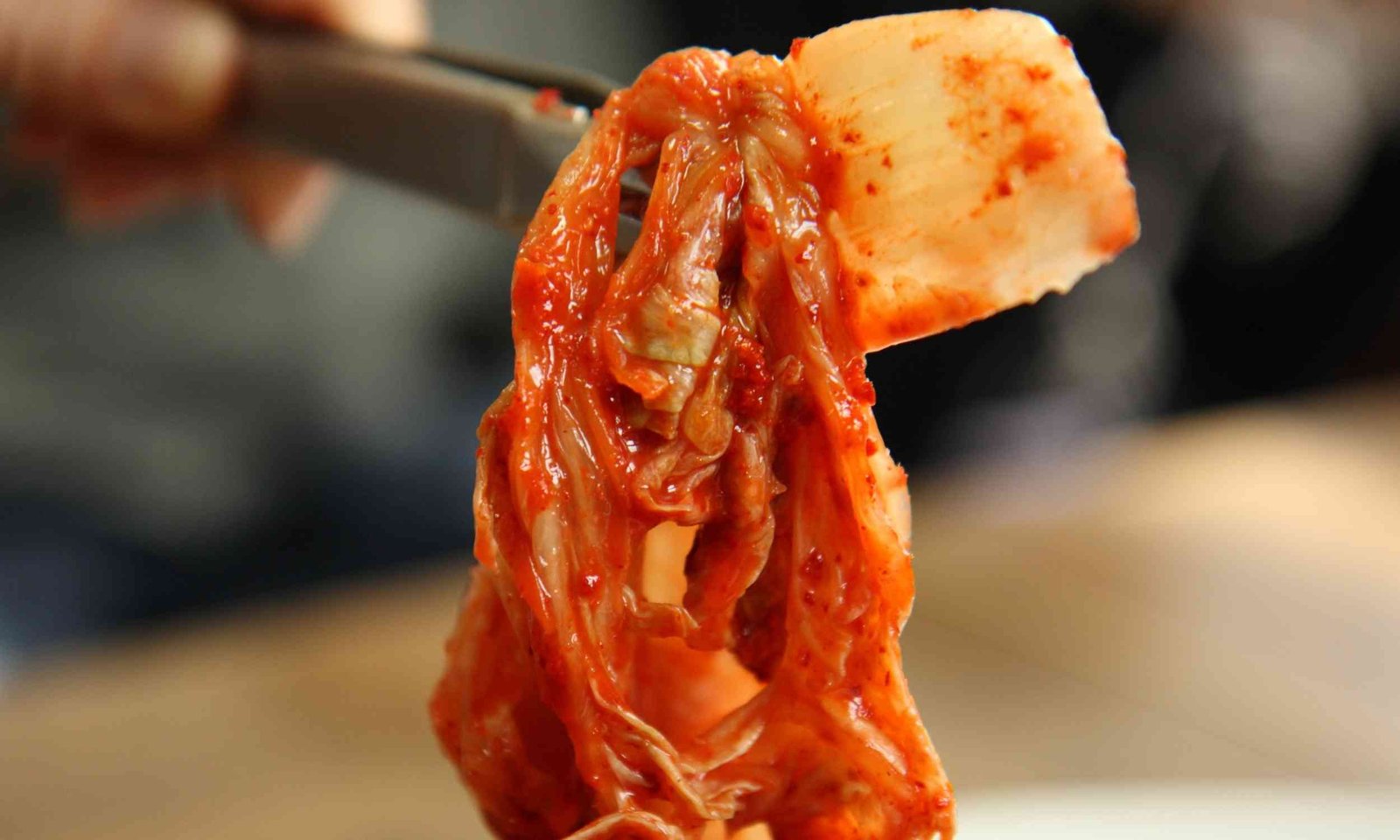
Researchers have discovered that bacteria isolated from kimchi can bind to nanoplastics in the intestines and transport them out of the body.
This discovery reframes microorganisms in fermented foods as a potential tool for limiting the amount of plastic that remains in humans.
intestinal examination

In a liquid that mimics the human intestine, the kimchi microorganisms retained particles that were primarily released by other bacteria.
Dr. Se Hee Lee and colleagues at the World Kimchi Institute (WiKim) discovered 57% of the particles.
After reaching 85% in a standard test, Lee’s group observed a comparison strain drop to 3% under the same gut-like conditions.
With the collapse of comparative strains, the kimchi microbe looked like a serious option in the gut, rather than just a curiosity.
Why does plastic stick to kimchi?
Bacteria found in large quantities in fermented foods such as kimchi. Leuconostoc mesenteroidesrelied on biosorption, a surface binding process that captures contaminants before they pass deep into tissues.
Chemical groups on the outer layer of the bacteria appeared to help the plastic stick, so the contact remained stable.
Before simulating digestion, kimchi-derived bacteria were already bound to 87% of the particles, slightly more than 85% for the comparison strain.
Performance across varying temperature, acidity, and particle loading suggested that the efficacy was sufficient to merit animal studies.
Mouse plastic and kimchi
The researchers tested the strain in germ-free mice raised without normal gut microbes, without interference from other gut microbes.
Male and female mice given kimchi-derived bacteria produced more than twice as much nanoplastic in their feces as untreated controls.
More particles remaining in the waste suggest that more plastic was trapped in the gut before entering the body. The mouse data did not prove an effect on humans, but showed that the idea could work in live animals.
Why size matters
Nanoplastics, which are pieces of plastic smaller than about 0.00004 inches, can cross biological barriers, so researchers are concerned that they may persist.
Human autopsy studies have found much higher concentrations of plastic in brain samples than in liver and kidney samples.
High levels of plastics in brain tissue have not yet been proven to be harmful per se, and big questions remain about dosage, timing, and risks.
The uncertainty about toxicity is why we must be very careful in finding safe ways to keep particles in the intestine.
How exposure occurs
People don’t need to eat plastic directly because small pieces are already present in food, water, and air.
Sunlight, friction, heat, and time continue to break down larger pieces, steadily increasing the number of particles people swallow.
The intestines are first important because this is where these particles meet the digestive, mucus, and cells that line the body.
Edible microorganisms appeared attractive for use in the intestine because of their potential to intercept contaminants at the point of entry rather than after they have spread widely.
Why is kimchi important?
Because kimchi contains lactic acid bacteria, microorganisms that promote fermentation and acidity, researchers have a large supply of food-safe candidates.
Unlike many environmental bacteria, the kimchi microbe comes from food people have been eating for generations, which has changed the real stakes.
The long history of eating fermented food microorganisms has allowed researchers to avoid building gut strategies around strains that may carry risks to the microorganisms themselves.
This result suggested that common fermented foods may contain useful microorganisms that have functions other than flavor and preservation.
Limitations of this result
Polystyrene served as a test plastic, so no one yet knew whether the same strain would bind to all common polymers.
Human digestion is also trickier than laboratory fluids, due to the mix of food, enzymes, bile, and countless resident microorganisms.
Longer studies should test the actual microbial community and see if binding alters absorption, inflammation, or normal gut ecology.
Without human trials or long-term follow-up, the study, while promising, was more preliminary than a direct answer to plastic exposure.
Plastic pollution and kimchi
Plastic pollution is now simultaneously impacting food science and gut biology, making this discovery important beyond a single fermented dish.
“Plastic pollution is becoming increasingly recognized not only as an environmental problem but also as a public health concern. Our findings suggest that microorganisms derived from traditional fermented foods may represent a new biological approach to address this emerging challenge,” said Lee.
This interpretation was consistent with the evidence, as the particles were trapped in the intestines before their movement through the body occurred.
What happens next?
The strains tested here were isolated and carefully measured, so no one should treat a single serving of kimchi as evidence of plastic removal.
The doses administered in the lab and in mouse studies do not ultimately reflect the amounts found in the normal diet.
Screening fermented foods for stronger binders now appears to be a practical next step, followed by careful human studies.
Screening approaches have the potential to turn familiar microorganisms into targeting tools for contaminants that people already ingest in their daily lives.
While most plastic research focuses on contamination after it reaches the oceans, soil, and organs, this study stayed in the gut.
By showing that certain food microorganisms can be retained in areas where they begin to be exposed to nanoplastics, this study offers a modest and concrete preventative measure.
This research biological resource technology.
—–
Like what you read? Subscribe to our newsletter for fascinating articles, exclusive content and the latest updates.
Check out EarthSnap, a free app from Eric Ralls and Earth.com.
—–
