


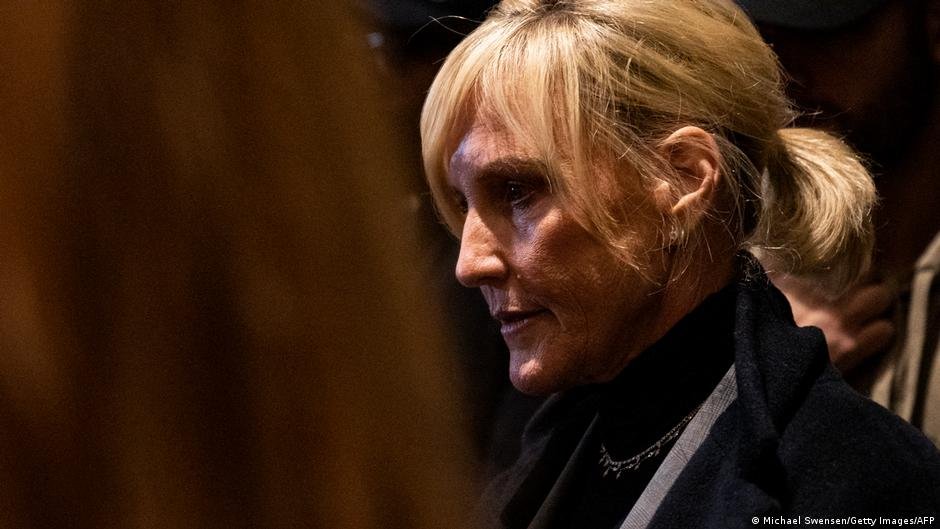
Prominent American activist Erin Brockovich has joined the global resistance movement against the mass proliferation of data centers.
The 65-year-old environmental activist shot to fame in the Hollywood movie that bears her name, played by Julia Roberts. Now, she has founded an online platform, Brockovich Data Center. The platform collects information about the planning and construction of new data centers in the United States and marks their locations on a map.
“This map captures the real-world footprint of the tribe, revealing patterns of growth, conflict, and uncertainty,” Brockovich wrote. She has received thousands of tips since launching the platform in April. She aims to give the American public a voice and an overview of where AI data centers are located because “the public should not be the last to know.”
Erin Brockovich highlights the fact that data centers consume large amounts of water and energy Image: Arvin Temkar/Atlanta Journal-Constitution/AP Photo/picture Alliance
Why are you against data centers?
Data centers have been around in one form or another for decades. But in recent years, big technology companies have significantly accelerated the construction of new companies around the world. In addition to powering AI, the demand for cloud services and platforms is also rapidly increasing.
Critics like Brockovich emphasize above all that data centers require large amounts of energy and water to power servers and cool equipment. According to AlgorithmWatch, a non-governmental organization based in Berlin and Zurich, a single data center can consume as much energy as a small town.
In countries such as India, data center construction can lead to severe water shortages. People living near the data center in India told DW that since the data center was built, they have only had water for a few hours a day.
Water supply near Delhi is tightening due to India’s AI expansion
To view this video, please enable JavaScript and consider upgrading to a web browser that supports HTML5 video.
Additionally, the hardware in these centers wears out very quickly and generates a large amount of e-waste. On his website, Brockovich also talks about noise pollution, which affects both people and animals.
Data centers do not necessarily bring economic benefits to the region in which they are built. Investors may spend billions of dollars on construction, but few local jobs will be created. Data centers often span tens of thousands of square meters but employ only a few dozen people on-site.
Where are most data centers built?
There are currently approximately 5,400 data centers in the United States, far more than any other country in the world. According to the Euronews portal, Germany will be in second place in 2025, followed by the UK, China, Canada, France, Australia, the Netherlands and Russia.
More data centers are planned to be built around the world, usually in more rural locations. In addition to the United States, thousands of new centers will be built in various parts of East Asia. China, Japan, South Korea and Taiwan are all ready, according to the German Trade and Investment Agency. The United Arab Emirates, Saudi Arabia and Qatar are also expanding their data centers. In Germany, the Frankfurt metropolitan area is the main focus for new development.
Which data center is blocked?
Brockovich’s platform doesn’t just show where new construction is planned. It also records a moratorium, a pause to allow time to study the impact of a project. “While these moratoriums vary in duration and scope, they share a common goal: to not delay construction further than planned,” the website says.
AI and its environmental impact
To view this video, please enable JavaScript and consider upgrading to a web browser that supports HTML5 video.
The platform reports suspensions in the U.S. states of North Carolina, Pennsylvania, Maryland, Florida, Texas, and Maine. However, it is not always successful. In April, the Maine Legislature imposed a moratorium on the construction of new data centers that require more than 20 megawatts of power, but Governor Janet Mills used a veto to prevent the decision from becoming law.
There have also been protests in other parts of the world, including Ireland and the Netherlands. In 2024, environmental groups in Chile successfully protested against the construction of data centers for AI applications. Brazil also sees itself as a new data center hotspot, but resistance is growing, especially in the northeast.
A similar development can be observed in Germany. Just last month, Spiegel The magazine reported that US company EdgeConnex has abandoned plans to build a gas power plant to power its data centers. EdgeConnex had no intention of forcing the project against the will of local residents or the city council, the company said.
Solar panels powering a data center in the desert near Las Vegas Image: Ty ONeil/AP Photo/Photo Alliance
However, the NGO Algorithm Watch points out that in many cases there is no consultation at the local level and those affected only find out when it is too late. In Spain, for example, some mayors say they were not informed about construction plans in their area and only learned about them from local newspaper reports. Erin Brockovich’s interactive map should prevent this from happening in the future, at least in the United States.
This article has been translated from German.
