


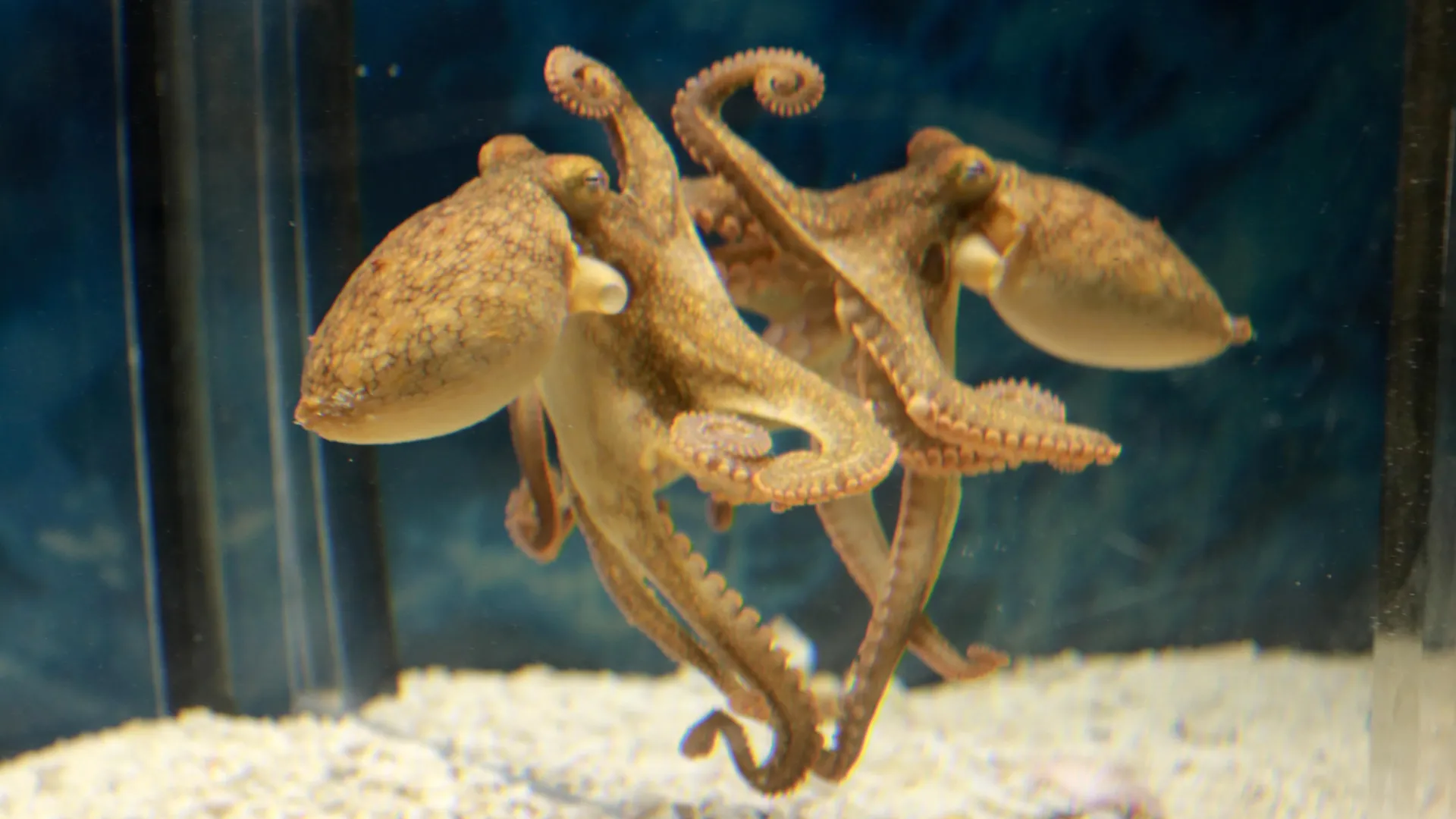
Octopuses have long been known for their amazing intelligence. A famous example is Inky the octopus, which escaped from the New Zealand National Aquarium in 2016 by slipping through a drainpipe and returning to the ocean.
Now, researchers at Dartmouth College have discovered another surprising ability. New research published in current biology Octopuses have learned how to use mirrors to find hidden food out of direct view, showing advanced spatial thinking, researchers discovered.
“Our findings are the first to show that invertebrates can use mirrors to understand their environment and locate prey,” says lead author Mary Kieserer (Guarini ’25). He conducted his research as a doctoral student in the Department of Psychological and Brain Sciences at Dartmouth College and is currently a postdoctoral fellow at the University of Friborg in Switzerland. “This is a skill that has only been documented in vertebrates, such as some mammals and some birds.”
Octopus learns how to use a mirror
The research team conducted a study using three two-spotted octopuses from California (Octopus bimacroides) is housed at Dartmouth’s Octopus Research Institute.
Their goal was to determine whether animals could use mirrors to locate food sources that were hidden from view. Rather than attacking the reflected image, the octopus needed to figure out where the stimulus actually was and move toward it.
The animals were first given time to get used to mirrors placed in their habitat. The researchers then trained them to understand the relationship between their reflections and the real world. At this stage, a live crab was placed inside a glass jar and positioned so that the octopus could only see it through a mirror. To reach the crab, the animal had to turn 90 degrees and turn around a corner.
“We don’t enter this world knowing how to use a mirror; we learn how to use a mirror,” says senior author Peter Tse, a cognitive neuroscientist and professor of psychology and brain sciences at Dartmouth College. Just as new drivers learn how to use their rearview mirrors to track other vehicles, “an octopus can also learn how to use its mirrors to guess where things are in the world.”
spatial cognition test
Octopuses have chemical receptors that allow them to smell and taste through touch, which could have affected the results if real prey had been used during the test. To get around this problem, the researchers instead used images of virtual crabs.
In the experiment, each octopus was placed inside a starting box with an open front and top. A mirror was placed directly in front of the animal. An image of a virtual crab appeared behind the octopus, to the left or right, but was only visible through a mirror.
To get the reward, the octopus had to know where the image actually was and move toward that location. Instead of approaching the mirror itself, the animals turned and headed to the correct side, where they received the reward of a live crab. Some octopuses even climbed over the sides of the box to reach the position of the projected image, rather than swimming around it.
The animals chose the correct side about 73% of the time.
Using head-on observations, the researchers tracked the point between the octopus’ eyes on its mantle, the part of its body that corresponds to its head. They also measured the routes the animals took in search of rewards. The octopus didn’t always choose the shortest path, but as the trials progressed, it got to the right spot faster.
Clues about the evolution of intelligence
Researchers say the discovery could provide new insights into how intelligence evolves.
“Octopuses are one of the most evolutionarily distant animals from humans. Our last common ancestor was an insect that lived between 350 and 500 million years ago,” Kieserer said. “Given that such distant organisms have independently evolved the means to use mirrors as a tool to process spatial cognition, this suggests that the underlying cognitive processes may be subject to convergent evolution, and that different species may evolve similar neural solutions to the same challenges.”
The environments that octopuses live in, such as coral reefs and the ocean floor, are often very complex and full of obstacles.
“Octopuses are similar to cats; they sneak up on their prey and pounce on it, but they want to attack as quickly as possible to avoid being eaten,” Tse said.
Researchers believe this species’ hunting strategy may benefit from an internal understanding of its surrounding environment.
“Hunters are very effective when they can mentally map their territory and know where they are in relation to the environment,” Tse said. “Our study suggests that octopuses may also have internal maps, which are internal representations of space.”
The researchers stress that further research is needed to determine whether octopuses really maintain such mental maps. Still, this study adds another noteworthy skill to the growing list of abilities that make octopuses one of the ocean’s most fascinating animals.
