

Close Menu

    Subscribe to Updates

    Get the latest creative news from FooBar about art, design and business.

    What's Hot

    Hippocrates AI launches two new tools for patients and nurses

    April 20, 2026

    How minorities look younger when their lack of traditional values ​​is recognized

    April 20, 2026

    Smoldering CAR-T trial in multiple myeloma raises long-term hopes

    April 20, 2026
    Facebook X (Twitter) Instagram
    Facebook X (Twitter) Instagram
    Health Magazine
    • Home
    • Environmental Health
    • Health Technology
    • Medical Research
    • Mental Health
    • Nutrition Science
    • Pharma
    • Public Health
    • Discover
      • Daily Health Tips
      • Financial Health & Stability
      • Holistic Health & Wellness
      • Mental Health
      • Nutrition & Dietary Trends
      • Professional & Personal Growth
    • Our Mission
    Health Magazine
    Home » News » Scientists may be overestimating the amount of microplastics in the environment – ​​lab gloves are the culprit
    Environmental Health

    Scientists may be overestimating the amount of microplastics in the environment – ​​lab gloves are the culprit

    healthadminBy healthadminMarch 26, 2026No Comments5 Mins Read
    Scientists may be overestimating the amount of microplastics in the environment – ​​lab gloves are the culprit
    Share
    Facebook Twitter Reddit Telegram Pinterest Email


    Every day it seems like new research is discovering tiny plastic particles called microplastics in places they shouldn’t be: in our bodies, in our food, water, and air.

    However, finding and identifying microplastics is extremely difficult, especially given their small size. A single microplastic can be as large as a ladybug or as small as one-eighth of a red blood cell.

    Additionally, because these plastics are virtually ubiquitous, it can be difficult for researchers to avoid unintentionally contaminating samples. As a result, much of this research may overestimate the number of microplastics.

    In a new study published in March 2026, our team found that using certain methods to measure environmental microplastics can contaminate results, even when established protocols are followed.

    Microplastics are small plastics that are emitted from plastic waste. They exist in the environment, waterways, and even in humans.

    the study

    We are chemists at the University of Michigan and work in a collaborative team. We set out to understand how much microplastics people in Michigan are breathing in when they’re outdoors, and whether it depends on where they live.

    When preparing the samples, we followed all standard protocols while conducting the study. We avoided the use of plastic in the lab, wore non-plastic clothing, and also used a special chamber to reduce potential contamination from the lab air.

    Despite these precautions, the number of plastics in the air was found to be more than 1,000 times higher than previously reported. I knew these numbers weren’t right, but what happened?

    Culprit: Lab gloves

    After a long journey to identifying the source of the contamination, we discovered that the use of lab gloves, which the scientific community recommends as a best practice, can cause particles to stick to the surface of the sample. In this case, it’s a small metal sheet used to collect deposited material from the air. Furthermore, this particle led to an overestimation of microplastic abundance in our study.

    Here’s how: Particles identified as stearates are used to ensure that the gloves release cleanly from the mold during the manufacturing process. Using gloves to handle lab equipment transfers particles to anything you come in contact with. Stearates are similar to soap molecules, and while they may not be good for you if you eat a lot of them, they are not harmful to the environment like microplastics.

    Although stearate is not itself a microplastic, it is structurally similar to polyethylene, the most common type of plastic in the environment. This structural similarity makes it difficult to tell them apart using the most common tools scientists use to determine whether a particle is plastic.

    Researchers use vibrational spectroscopy to identify microplastics. This requires measuring how particles interact with light to produce what scientists call chemical fingerprints.

    Polyethylene and stearate have very similar structures and therefore interact with light in similar ways.

    As a result, at least in some cases, particles from gloves can be incorrectly identified as microplastics. As more researchers rely on automated methods to speed up analysis, glove residues are increasingly being mistaken for microplastics, potentially over-reporting microplastics in the environment.

    How widespread is this contamination?

    To find out how prevalent this contamination is, we looked at different types of gloves. We mimicked the contact of seven types of gloves when handling laboratory equipment and counted the number of microplastics that would be incorrectly attributed to the environment if we followed the most common approach.

    We found that gloves can contribute more than 7,000 particles per square millimeter that are misidentified as microplastics. This finding means that researchers may be unconsciously overestimating the amount of microplastics in the environment when handling samples with gloves.

    More worryingly, the particles were found to be less than 5 μm in size. Microplastics in this size range can easily enter cells and have a significant impact on human and ecosystem health. The use of laboratory gloves inflates the number of microplastics in this size range, potentially jeopardizing research that influences future policy and regulation.
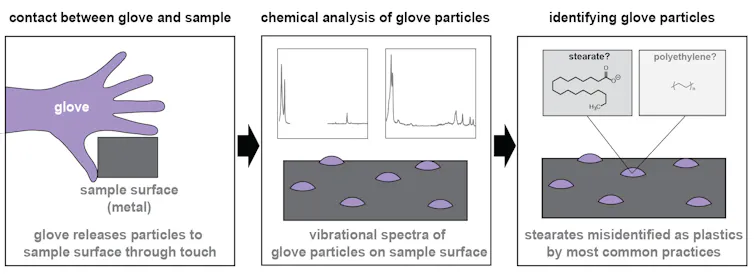
    Diagram showing particles flying off the glove due to contact. Signals similar to microplastics are generated during scientific analysis.

    How handling samples with gloved hands leads to overestimation of plastics.
    Madeline Clough

    move forward

    To avoid contamination, scientists recommend avoiding the use of gloves while conducting research on microplastics. If that is not possible, for example in the case of biological samples where researchers must wear gloves to protect themselves, we recommend gloves made without stearate, such as those designed for electronics manufacturing. To recover old datasets that may have been contaminated, we developed a method that helps distinguish chemical fingerprints.

    Science is an iterative process. Emerging research areas involving environmental microplastics are posing new challenges to the scientific community. As we address these new challenges, we will encounter difficulties such as unforeseen contamination.

    Although we had to discard the initial data set, we hope that the lessons learned about glove contamination will be passed on to other scientists. Additionally, we plan to continue our research on microplastic pollution in Michigan’s air, but this time without gloves.

    It’s important to note that even if the abundance of microplastics in the environment is lower than researchers originally thought, any amount of microplastics can be problematic given their negative impact on human health and ecosystems.


    Source link

    Visited 2 times, 1 visit(s) today
    Share. Facebook Twitter Pinterest LinkedIn Telegram Reddit Email
    Previous ArticleHigh meat intake may protect against cognitive decline in people with certain Alzheimer’s genes
    Next Article Missed deadline to name new CDC director
    healthadmin

    Related Posts

    Malawi government suspends coal miner’s license over river pollution

    April 20, 2026

    Kenyan women challenge fishing taboos as climate change threatens Lake Victoria | Women’s News

    April 20, 2026

    Fuel-eating microbes, chemicals and fire: Race to find new ways to contain Arctic oil spill | Arctic

    April 20, 2026

    Wildfires make soil toxic – Highlands News

    April 20, 2026

    Zambia forced to clean up town shut down due to lead mine poisoning

    April 19, 2026

    Australian coal mine emissions are rising. Is this what major policies to reduce climate pollution are supposed to look like? |Greenhouse gas emissions

    April 18, 2026
    Add A Comment
    Leave A Reply Cancel Reply

    Categories

    • Daily Health Tips
    • Discover
    • Environmental Health
    • Exercise & Fitness
    • Featured
    • Featured Videos
    • Financial Health & Stability
    • Fitness
    • Fitness Updates
    • Health
    • Health Technology
    • Healthy Aging
    • Healthy Living
    • Holistic Healing
    • Holistic Health & Wellness
    • Medical Research
    • Medical Research & Insights
    • Mental Health
    • Mental Wellness
    • Natural Remedies
    • New Workouts
    • Nutrition
    • Nutrition & Dietary Trends
    • Nutrition & Superfoods
    • Nutrition Science
    • Pharma
    • Preventive Healthcare
    • Professional & Personal Growth
    • Public Health
    • Public Health & Awareness
    • Selected
    • Sleep & Recovery
    • Top Programs
    • Weight Management
    • Workouts
    Popular Posts
    • the-pros-and-cons-of-paleo-dietsThe Pros and Cons of Paleo Diets: What Science Really Says April 16, 2025
    • Improve Mental Health10 Science-Backed Practices to Improve Mental Health… March 11, 2025
    • How Healthy Living Is Transforming Modern Wellness TrendsHow Healthy Living Is Transforming Modern Wellness… December 3, 2025
    • Kankakee_expansion.jpgCSL releases details of $1.5 billion U.S.… March 10, 2026
    • urlhttps3A2F2Fcalifornia-times-brightspot.s3.amazonaws.com2Fc32Fcd2F988500d440f2a55515940909.jpegA ‘reckless’ scrapyard with a history of… October 24, 2025
    • Healthy Living: Expert Tips to Improve Your Health in 2026Healthy Living: Expert Tips to Improve Your Health in 2026 November 16, 2025

    Demo
    Stay In Touch
    • Facebook
    • Twitter
    • Pinterest
    • Instagram
    • YouTube
    • Vimeo
    Don't Miss

    Hippocrates AI launches two new tools for patients and nurses

    By healthadminApril 20, 2026

    Hippocratic AI on Thursday announced two new artificial intelligence tools aimed at improving access to…

    How minorities look younger when their lack of traditional values ​​is recognized

    April 20, 2026

    Smoldering CAR-T trial in multiple myeloma raises long-term hopes

    April 20, 2026

    Genentech shifts marketing focus for Hemlibra to patient stories

    April 20, 2026

    Subscribe to Updates

    Get the latest creative news from SmartMag about art & design.

    HealthxMagazine
    HealthxMagazine

    At HealthX Magazine, we are dedicated to empowering entrepreneurs, doctors, chiropractors, healthcare professionals, personal trainers, executives, thought leaders, and anyone striving for optimal health.

    Our Picks

    Genentech shifts marketing focus for Hemlibra to patient stories

    April 20, 2026

    Does listening to real crimes make you a more creative criminal?

    April 20, 2026

    Biogen partners with Durham Bulls, bullish on America

    April 20, 2026
    New Comments
      Facebook X (Twitter) Instagram Pinterest
      • Home
      • Privacy Policy
      • Our Mission
      © 2026 ThemeSphere. Designed by ThemeSphere.

      Type above and press Enter to search. Press Esc to cancel.