


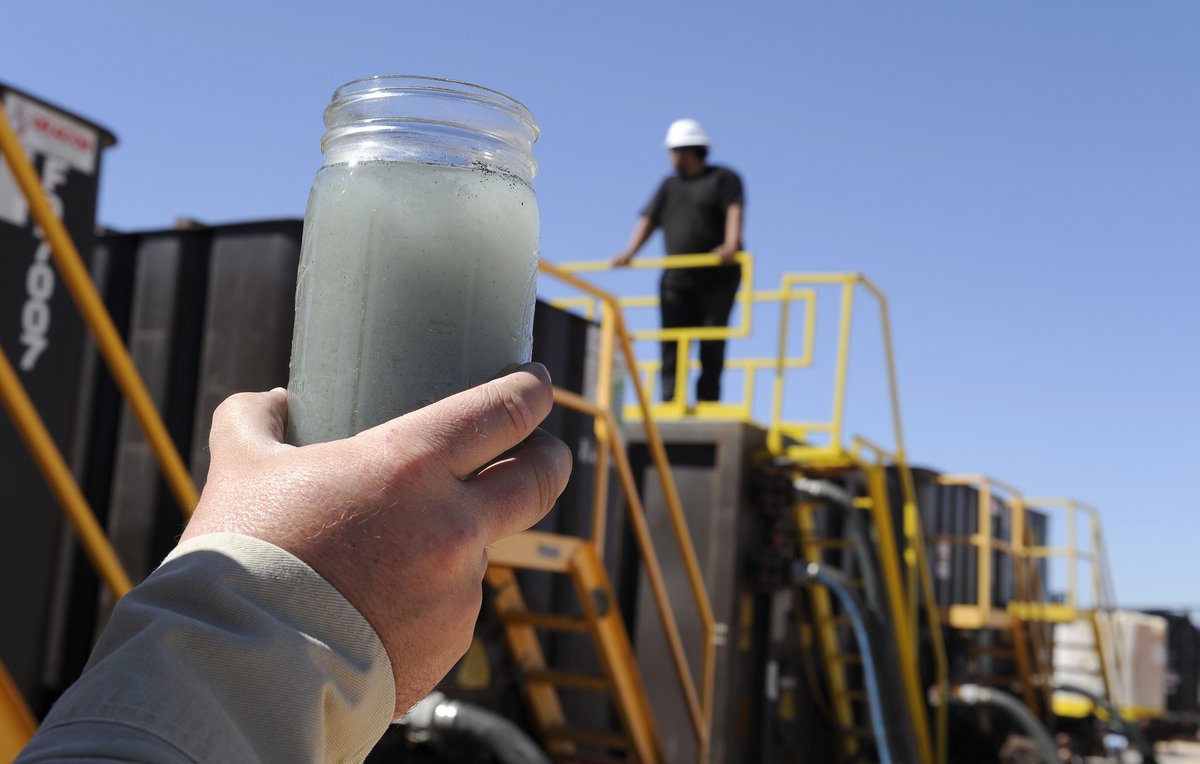
The two largest oil-producing states are at a crossroads as they try to solve one of the industry’s most vexing problems: cleaning up the billions of gallons of salty and oily wastewater that are produced with crude oil.
Academic researchers in Texas and New Mexico say technology developed in recent years could allow companies to purify waste, known as produced water, so it can be released into surface waters such as rivers or repurposed for uses such as irrigating crops.
But state regulators remain wary of the idea.
The Texas Commission on Environmental Quality, which regulates the state’s water, said it wanted to address “knowledge gaps” before issuing permits to treat oilfield waste, noting that it takes more than a year for companies to reach full treatment capacity after they receive a permit. The New Mexico Water Quality Control Commission is considering applications from oil industry and oil state groups, but the commission has already rejected the proposals twice.
Zach Stoll, assistant director of the New Mexico Water Research Consortium at New Mexico State University, said the lack of new state regulations is slowing development as Texas and New Mexico battle drought and look for long-term water sources.
“Without that, it’s difficult to scale and invest hundreds of millions of dollars to build facilities,” he said.
The Texas Environmental Commission is reviewing three active permit applications to dispose of treated produced water from the Pecos River and other surface waters. The commission is also preparing to issue regulations regarding surface use of treated water.
In New Mexico, the Water Quality Control Commission could decide in May whether to move forward with a rule that would allow 13 of the state’s 33 counties to reuse produced water.
“Creating a science-based regulatory framework for the reuse of produced water is critical to protecting our state’s freshwater resources for generations of New Mexicans,” Drew Goretzka, a spokesperson for the New Mexico Department of the Environment, said in an email. “NMED is committed to ensuring that the petition reflects these priorities and successfully moves forward with the Water Quality Control Board.”
The Texas Commission, known as TCEQ, provided slides from Commissioner Brooke Pope’s recent presentation on produced water showing a schedule of proposed regulations. But the agency declined interview requests and did not respond to detailed questions from POLITICO’s E&E News.
Environmentalists say oilfield wastewater is a big and complex problem and are urging oil countries to take action slowly. The total amount of water produced has surged in recent years amid a drilling boom linked to the use of fracking, a process that mixes water, sand, chemicals and high pressure to extract more oil and gas from places like the Permian Basin.
The Permian, which underlies parts of Texas and New Mexico, produces more than 6 million barrels of oil per day, according to federal data. But more wastewater is generated, three to five times as much, according to TCEQ, and some experts say the number is much higher.
That’s billions of gallons of waste per day. This fluid can contain more salt than seawater and is often contaminated with drilling chemicals, petroleum and other hydrocarbons, heavy metals, and sometimes radioactive materials.
Salinity and contaminant levels often vary from location to location and can change over the life of a well, making them difficult to treat. Researchers also don’t always know the safe levels of some chemicals in wastewater.
“Waste streams are so variable that it’s basically impossible to have a one-size-fits-all treatment,” said Colin Cox, a lawyer with the Center for Biological Diversity.
It’s also not clear whether the results of industry pilot programs can be replicated at scale, said Ted Orsch, a researcher at watchdog group FieldNotes.
Salts in produced water can wreak havoc on treatment equipment. And even if large companies can operate safely at scale, the oil industry tends to attract small operators looking to compete by cutting costs. So instead of overseeing a few large operations, state regulators must oversee dozens of small processing facilities.
“Then all of a sudden the whole thing starts to fall apart, because now instead of one or two large discharge permits, you have these very diffuse networks all over the place. Good luck with that,” Auch said.
“Benefits many people”
Historically, the industry has injected produced water into deep disposal wells. But as the Permian Basin and other oil fields age, the technology is becoming more expensive. Disposal wells have also been linked to a series of earthquakes. As operators moved to different geological formations, they had to deal with produced water leaking from shallower formations, sometimes causing geysers of salt water across the ranch.
The Texas Railroad Commission, which regulates oil production, is considering new steps to deal with aging wells that have begun leaking produced water through shallow injections and often clog.
In fiscal year 2025, state officials maintained an average of 19 wells leaking produced water to the surface each day. That number has increased to 29 per day this year, according to a Railroad Commission presentation posted online by Sara Stogner, district attorney for West Texas’ 143rd Judicial District.
“The growing pace, complexity and costs of emergencies are outpacing response capacity and resources,” the commission said in a presentation.
“We look forward to future dialogue with affected stakeholders as we continue to pursue improvements,” the commission said in a statement to E&E News.
The Texas Oil and Gas Association has not commented on the matter. But the company has touted efforts to find ways to use the industry’s wastewater.
“Today’s oil and natural gas companies are technology companies, and treating, reusing, and recycling produced water for beneficial use in the oilfield and beyond is becoming more commonplace thanks to this industry’s commitment to innovation,” Association President Todd Staples said in a 2021 statement, praising the state’s move to establish the Texas Produced Water Consortium at Texas Tech University.
Both Texas and New Mexico have launched state-funded research projects to find cost-effective ways to clean and recycle wastewater rather than disposing of it. Researchers from New Mexico State University and Texas Tech University have been working closely with private companies running test programs in the Permian Basin.
Pilots typically use a combination of technologies such as chemical pretreatment, evaporation, and activated carbon filtration. Pei Shu, research director for the New Mexico Produced Water Consortium, said the results were promising and showed that plants can cope with fluctuations in water quality.
Xu said treated produced water could be another way to supplement water supplies in arid regions, similar to desalinated water from municipal wastewater treatment plants and other recycled water.
“Freshwater can be used in local communities, but this water can also be used for industrial purposes, data centers, power plants and other industrial uses,” she said.
Processing costs are currently higher than other disposal methods, at $1.50 per barrel compared to 80 cents for injection, said Shane Walker, director of the Texas Water Consortium at Texas Tech University. But the cost of the shots is rising, he said, and the cost of the treatment could come down if companies can do it on a large scale.
“That’s a significant amount of water,” he said. “We have demonstrated that treatment technology can deliver clean water as a product, and it could really benefit many people.”
