


Abandoned vehicles rot on the side of the road. Children’s toys, remnants of household appliances, dishes and a faded sign in Russian warning about radiation levels are scattered in front of the apartment. The building was empty, windows broken and doors forced open.
Forty years ago, the Ukrainian city of Pripyat, also known as Atomgrad, was the pride of the Soviet nuclear industry. The future looked promising. Pripyat is just 3 kilometers (2 miles) from the Chernobyl nuclear power plant, where the leadership of the Soviet Union (USSR) at the time was planning to build the largest nuclear power plant of its kind. There were 12 nuclear reactors in total, and Pripyat was home to workers and their families.
Decaying cars line the streets of Pripyat, a city abandoned after the 1986 nuclear disaster Image: Alexandra Indyukhova/DW
The city had existed for only 16 years when reactor 4 exploded on April 26, 1986. Pripyat consisted of 160 buildings, 13,500 apartments, 15 kindergartens, and 5 schools.
“I didn’t know what the outcome would be.”
Forty years have passed since then, and the building is in ruins. It is overgrown with trees, shrubs, and vines. Volodymyr Vorobey guides a DW reporter into the undergrowth.
“This is our house on Lesya Ukrainka Street, number 18A. I lived on the first floor with my parents and brother,” says the 58-year-old. The stairwell is large, with large doors, wide stairs, and hallways.
The door to Vorobey’s former apartment is left open. He went straight into the bedroom and picked up the record from the trash on the floor. It reminds him of the music his family used to listen to back then. He also remembers how much he missed his trendy new sneakers, which he had left behind in his wardrobe when he evacuated.
Remnants of everyday life remain untouched since the sudden evacuation Image: Alexandra Indyukhova/DW
We go out onto the balcony. “That was my chair, with a padded foam seat. There was a lamp here…I read a lot of books here. I kept preserved food under this cover. It was very practical,” says Vorobey.
In the hallway of a dark apartment, we switch on the flashlight on our mobile phones. Vorobei found some shoes and said, “Those are mine. I received them at technical school.”
A discarded shoe lies in the hallway of a deserted apartment.Image: Alexandra Indyukhova/DW
A sign with the names of all the neighbors still hangs at the entrance to the block. Vorobei doesn’t know what happened to them after they were evacuated. He never saw any of them again.
Vorobei was 18 years old in April 1986. He worked as an electrician in a state-owned company and was laying electrical wires in reactor block 4, which exploded the day before the accident.
Vorobey didn’t hear the explosion and tried to go to work the next morning as usual, but the bus never came. He and a friend walked to the power plant and when they got there they saw an abandoned building.
“At that time we didn’t know what was happening, exactly where and what was happening. It wasn’t smoke that hit us, it was heat. It was like a river of heat rising into the sky,” Vorobey said. “A man rode by on his bike and said it was dangerous to be here, so we went home.”
Vorobey returns to his old home in Pripyat, revisiting the apartment he left as a teenager. Image: Alexandra Indyukhova/DW
It was only in the evening that I heard about the accident and the impending evacuation from my brother, who worked at the power plant. “At first I thought it would only take a few days,” Vorobey recalls. His family left Pripyat on the evening of April 26th on a crowded train. “From the car window, I could see the ruins of Unit 4. At the time, I wasn’t thinking about that. I didn’t know what the consequences of this accident would be, or if I would never be able to return home.”
“Atom should be a worker, not a soldier.”
Walk through the center of Pripyat to the Prometheus cinema. This is where Volodymyr Vorobey often played with his friends. A fallen beam is blocking the entrance to the movie theater’s main stage. On the wall of the front room hangs faded portraits of long-forgotten Communist Party officials.
Soviet-era signs can still be seen around the abandoned town, especially in the old cinema Image: Alexandra Indyukhova/DW
Soviet symbols are everywhere in the center of Pripyat. The coat of arms of Soviet Ukraine still adorns the roofs of two apartment buildings, and another giant metal letter spells out: “Atoms should be workers, not soldiers.”
Vorobey said that the entire Soviet Union’s nuclear energy was based on this idea. In the training given to workers in universities, research institutes and power plants, everyone was always told that Soviet nuclear energy was the safest in the world. No one could imagine that a nuclear reactor would explode.
“We were told that a radiation accident was impossible. Precautions were being taken to prepare for every eventuality, everything was carefully calculated. We never thought that an accident could happen,” Vorobey says.
This is also why the majority of the residents of Pripyat and Chernobyl, including power plant workers, knew nothing about the real dangers to health and the environment. They certainly didn’t know about the extent of radioactive contamination, Vorobey said.
“Those who knew something rarely passed on information. It was still Soviet times. One careless word could cost you your career.”
Is a culture of obedience a contributing factor?
Vorobei believes that the Chernobyl disaster might not have happened if the Soviet Union’s authoritarian leadership style had not been introduced into the nuclear industry. Furthermore, a similar accident at the Leningrad nuclear power plant in 1975 was also covered up.
The “new safe confinement” dome over reactor 4, completed in 2019, was damaged by a Russian drone in 2025 Image: Kyrylo Chubotin/Ukrinform/ABACA/picture Alliance
A year after the disaster, Vorobei was called up for military service. Then he studied engineering and moved to Slavutychi. This city was built to replace Pripyat. From there he commuted to the Chernobyl power plant every day, working his way up from mechanic to foreman. He served as Head of Thermal Automation and Instrumentation for 11 years.
Chernobyl has not produced electricity since 2000, but decommissioning of the power plant continues to this day. Currently, facilities have been installed on site to allow the safe removal of radioactive fuel and disposal of radioactive waste. A new protective shield, a new safe containment, was installed over the exploded reactor 4 and the concrete “sarcophagus” hastily constructed in 1986 to contain it.
Just six years after its completion, the protective cover was damaged in a Russian drone attack in February 2025 and is now said to have lost its primary containment function.
“History might have taken a different path.”
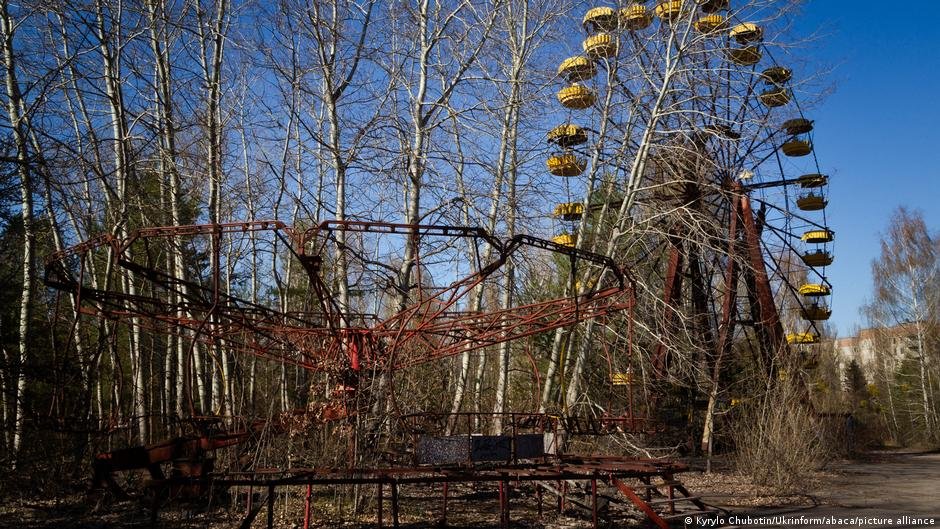
Before Russia’s full-scale invasion of Ukraine began in February 2022, tourists were able to visit Pripyat’s Ferris Wheel, a symbol of the deserted city beloved around the world, on organized tours of the exclusion zone. The official opening was scheduled for May 1, 1986, International Workers’ Day, so it was never operational.
“Don’t believe me that no one took part in it. Vocational school students, including myself, were used as subjects. That’s why I took part in it,” Vorobey says with a laugh.
The now-ruined city of Pripyat was founded in 1970 to house workers from the Chernobyl nuclear power plant. Image: Vladimir Samokhotsky/TASS/Photo Alliance
He admitted he still doesn’t know how much radiation he was exposed to in 1986. “I can apply for a certificate to prove it, but I don’t want that.” How much did the nuclear accident change his life? At 18, he says, he still didn’t have a concrete plan. But looking back on the event 40 years later, it seems to him “as if everyone was heading in one direction at the time, and then all of a sudden they turned around and went down a different path.”
That’s why, he says, “if the Chernobyl accident had not happened, the world and the history of Ukraine might have taken a different direction.”
This article was originally written in Ukrainian.
Editor: Wesley Dockery
