


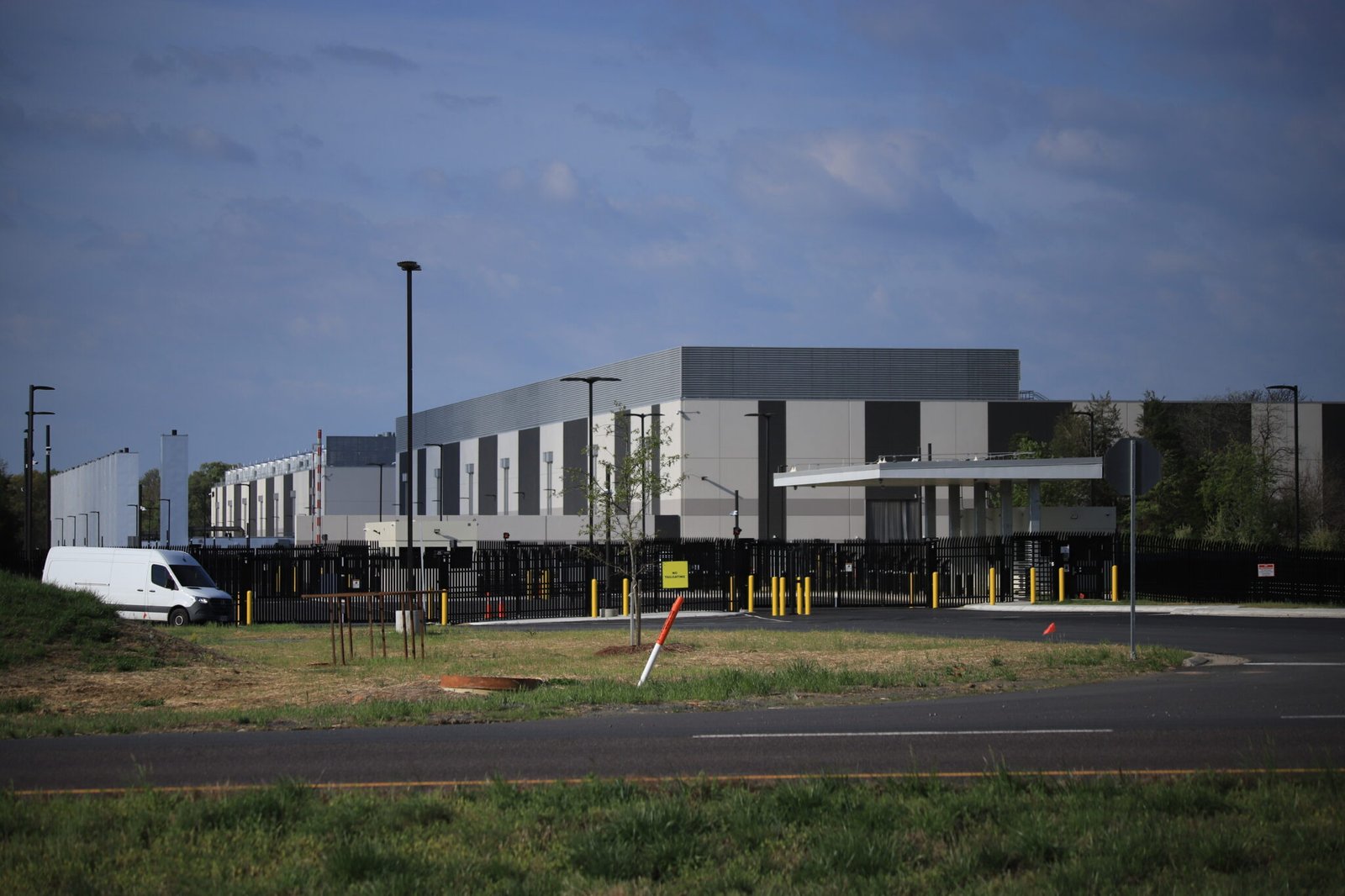
A provision in the two-year state budget finalized by the Legislature on Monday imposes a new tax on data centers, Virginia’s most energy-intensive industry.
Virginia General Assembly approves Spanberger’s budget amendment, ending months of gridlock
The spending plan maintains sales and use tax exemptions for data centers, the focus of a lengthy legislative battle over the past several months. But the new tax represents the state’s first major effort to recoup millions of dollars from the industry, especially for energy use, and address residents’ concerns about the rapidly increasing number of facilities.
“We have more data centers than anywhere else in the entire world, and I think the entire country is looking to us to make policy decisions on this. We’ve taken the first step this year in terms of generating more revenue,” said Sen. Scott Surovell, D-Fairfax.
energy consumption tax
Data centers will now have to pay a $0.011 tax for every kilowatt-hour of electricity they use. The state can collect up to $600 million a year, for a total of $1.2 billion over two years.
Any amount collected in excess of the limit will be refunded to the data center at the end of each fiscal year.
According to the 2024 Joint Legislative Audit and Review Committee. Reports on data centersThe industry used about 5,050 megawatts of electricity that year, based on Dominion Energy and the Mecklenburg and Rappahannock Electric Cooperative of Northern Virginia’s August 2023 peak load forecast.
Dominion reported that it had 70,000 MW of large-load energy requests in its queue at the end of 2025.
The state sales and use tax exemption will save data centers an estimated $1.9 billion annually, a number that significantly exceeds the anticipated revenue from the new energy excise tax.
The task force will consider ways to phase out the tax credits and other ways to make data centers pay their fair share, a position that Sen. L. Louise Lucas (D-Portsmouth), the chair of the Senate Finance Committee, and other lawmakers have advocated for months.
The working group plans to submit a report to the General Assembly in November to help lawmakers craft legislation for the January session. Lucas emphasized that the debate over the sales tax exemption is far from over.
water shortage area
Data centers will now be required to try to limit their water usage, another new budget requirement.
Data centers without closed-loop cooling systems use millions of gallons of water per year. The Department of Environmental Quality plans to identify areas with cooling water shortages where using potable water to cool computers could jeopardize local water quality and availability.
These shortage areas must be identified by July 2027. By 2032, data centers located in deficit areas or the Eastern Virginia Groundwater Management District, which covers all areas east of Interstate 95, will be required to demonstrate that they are minimizing the use of water for cooling purposes.
They are required to use the best available water efficiency technologies, such as air cooling, closed-loop systems, recycled water, rainwater reuse, non-potable reclaimed water use, or other department-approved methods.
Gov. Abigail Spanberger on Friday proposed amendments to the data center water usage measure, changing language to indicate data centers use less water for cooling due to evaporative cooling, partially in conjunction with other DEQ-approved methods.
Previous version budget It was passed by the House and Senate last week. No evaporative cooling was allowed in the depletion region.
Some lawmakers felt the governor’s adjustments were too subjective and left open the possibility that data centers could continue to use evaporative cooling.
Sen. Danica Rome (D-Prince William) said Spanberger’s language, which states data centers “must demonstrate to the Department’s satisfaction that they have minimized the use of water of any kind for cooling purposes,” is not clear enough and does not set out specific limits on water use.
“My concern here always goes back to sufficient legal measures, because at the moment we have a plan and we have taken the minimum measures, but from my perspective, what we don’t have is sufficient requirements,” Roem said Monday on Capitol Hill.
Data centers in these regions can only use direct evaporative cooling in combination with one of the other technologies. However, although closed-loop systems use less water, they use more energy than non-closed-loop systems.
Appropriations Committee member Sen. Richard Stewart (R-King. George) said allowing evaporative cooling at all is not the way to save water, even when combined with water-efficient methods. Senators pressured their colleagues to veto the amendment, but it ultimately passed.
“How can we be conservative with water if we’re going to let 50% of it evaporate into the atmosphere?” Stuart asked. “This was one of the most important conservation measures we got in the conference report. We didn’t get anything in electricity… We got a promise to do something in the future. And now they’re trying to take this away from us.”
The Department of Environmental Quality has until October 15 of this year to conduct a study on how existing data centers in groundwater management areas can be retrofitted with air cooling, use 100% recycled water/rainwater, or switch to closed-loop systems.
noise level
The new budget also requires DEQ to regulate noise levels in data centers for the first time.
By 2029, the ministry needs to discover exactly how quiet data centers are and make it the industry standard from 2030. Noise emanating from facilities like warehouses is a growing concern for people living in areas where data centers are proposed.
Once these regulations go into effect, establishments that violate noise ordinances will be subject to fines of $32,500 per day.
Get your morning headlines.
Subscribe
