


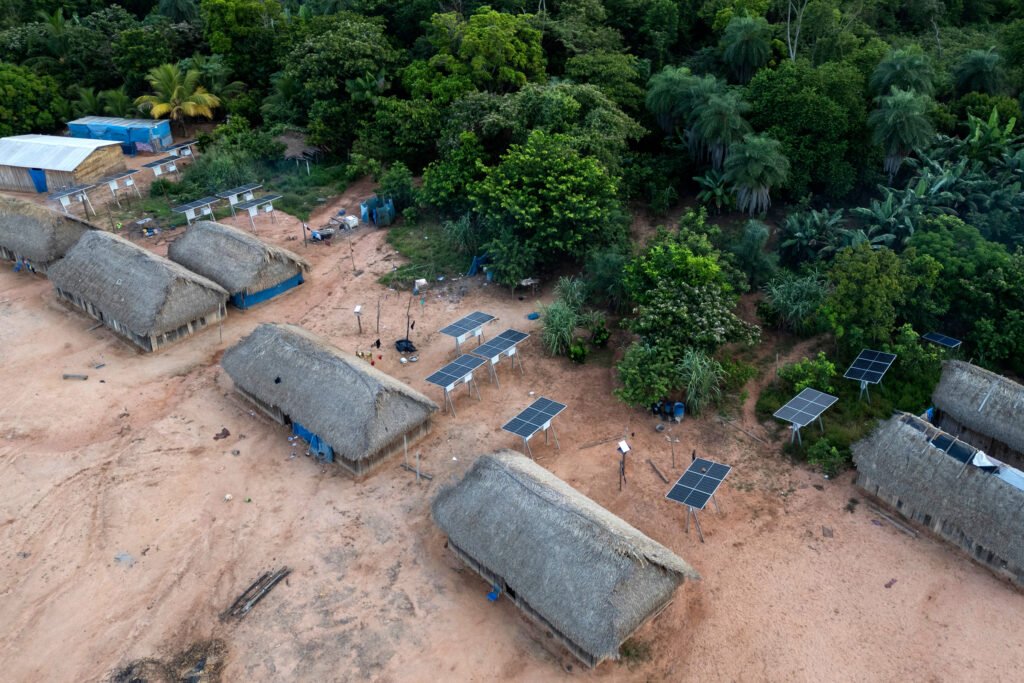
Multiple donors and international organizations announced commitments to climate finance efforts for developing countries during London Climate Action Week, demonstrating an increased focus on emerging countries that are far from meeting their needs.
London’s signature climate event, which concluded on Sunday, was an opportunity for environmental diplomacy. Business and political leaders announced hundreds of millions of dollars in investments, with a panel highlighting fair international funding for countries least responsible for the climate crisis, but most affected.
Bloomberg Philanthropies, for example, has pledged $285 million to support the expansion of clean energy infrastructure across the developing world and take on the deep-pocketed oil lobby.
Patricia Espinosa, former executive director of the United Nations Framework Convention on Climate Change, said in a statement published by Bloomberg that the funding is aimed at filling financial gaps in planning and implementation.
“The emerging countries that are driving global energy demand are also the countries most likely to be powered by renewable energy,” Espinosa said. “Many of them have set ambitious clean energy goals, but there is no single blueprint for how the transition will happen. They will need to be tailored to the realities of countries, businesses and citizens. What they share is the need for an effective environment and infrastructure to translate those goals into large-scale deployment.”
But Raimund Schwarze, an environmental economist at Germany’s Helmholtz Center for Environmental Research, said the combination of private and public investment only scratches the surface of what is needed. The United Nations’ 2024 and 2025 international climate summits have set a goal of $1.3 trillion per year flowing to developing countries for climate mitigation and adaptation by 2035.
According to a November 2025 report published by the London School of Economics and Political Science, this amount should be split between private investment banks and multilateral development banks.
But as the United States withdraws from international aid, development finance is “drying up” because international institutions like the World Bank aren’t making up the difference, Schwarze added.
Some groups at London Climate Action Week sought to change this by hosting roundtables on solar power development, green industrialization and public investment in developing countries. And in the week before the conference, an internationally supported capital pool known as the Climate Investment Fund pledged $250 million each to Brazil and Mexico, which officials said would trigger more than $5 billion in private financing.
Chuks Okereke, director of the Climate and Development Center at the Alex Ekwueme Federal University in Ndufu Arike, Nigeria, said developing countries often struggle to attract investor interest because they do not have a “pipeline of bankable projects” that demonstrate credibility and viability.
It’s a vicious cycle, he says. “One of the reasons they need funding in the first place is that they don’t have the capacity, and that lack of capacity is impacting their ability to prepare projects.”
Okereke added that aid should come in the form of grants rather than loans, which could push countries into debt. However, according to Oxfam International, loans will account for nearly 70% of international climate finance by 2024.
The new partnership aims, in part, to address this. UN-sponsored energy organization Sustainable Energy for All (SEforALL) and the non-profit Global Climate Finance Center signed an agreement during London Climate Action Week to build capacity for sustainable projects in emerging countries and make them more attractive to investors.
Tamojit Chatterjee, a senior executive at SEforALL, said: “The financial needs for the transition are huge and cannot be carried out by the public sector alone.” “The private sector needs to come in at scale, and the job of the public sector is to create an enabling environment for the private sector to come in and scale things up.”
SEforAll’s Director of Partnerships and Development Michael Merin said the partnership would help “translate global ambition into concrete action” and create a path to “financing investments that are largely lacking in regions like sub-Saharan Africa”.
Schwartz said the burden of meeting investment targets will ultimately fall on multilateral development banks.
“This movement from billions to trillions of dollars will be driven primarily by the efforts of multilateral development banks,” Schwartz said.
Okereke added that developing countries rely on “mixed finance,” which combines various banks, private investors and direct international aid.
Chatterjee believes that economic growth in renewable energy will combine with political interests to drive climate change investment.
“This is a good moment because the technology policy, political will, business model innovation and investment aspects are all in place,” he said.
About this story
As you may have noticed, this article, like all news we publish, is free to read. That’s because Inside Climate News is a 501c3 nonprofit organization. We don’t charge subscription fees, keep our news behind paywalls, or fill our website with ads. We provide climate and environmental news free to you and anyone who wants it.
That’s not all. We also share our news for free with dozens of other news organizations across the country. Many of them cannot afford to do environmental journalism themselves. We’ve established bureaus across the country to report on local news, partner with local newsrooms and co-publish stories to ensure this important work is shared as widely as possible.
The two of us started ICN in 2007. Six years later, we won the Pulitzer Prize for national reporting and now run the nation’s oldest and largest dedicated climate newsroom. We tell the story in its entirety. We hold polluters accountable. We expose environmental injustice. We debunk misinformation. We explore solutions and inspire action.
Donations from readers like you fund all aspects of our work. If you haven’t already, will you support our ongoing work, our coverage of the biggest crises facing our planet, and help us reach more readers in more places?
Please make a tax-deductible donation. Any of those things make a difference.
thank you,

I drove Stella
fellow
Ajani Stella is a Dow Jones reporter for Inside Climate News, based in New York City. She previously interned at amNewYork, covering politics, housing, and crime. His reporting experience also includes immigration, labor, and higher education policy issues. Ajani is currently a third-year student at Georgetown University and the editor-in-chief of the student newspaper, The Hoya.
