


Some U.S. lawmakers are rushing to introduce legislation that would reverse the impact of a U.S. Supreme Court decision handed down last week that overturned longstanding precedent restricting consumer lawsuits against pesticide companies.
Democratic Rep. Chellie Pingree of Maine and Republican Rep. Thomas Massie of Kentucky on Monday introduced amendments to the federal Insecticide, Fungicide, and Rodenticide Act (FIFRA), the key law regulating pesticides. The FIFRA amendments would allow people exposed to pesticides known to cause health problems to once again sue companies for failing to warn them about the health risks.
The Supreme Court’s decision most directly benefited Bayer and Syngenta, global agrochemical companies currently facing thousands of lawsuits brought by users of their herbicide products, but other agrochemical companies have also benefited from the protections provided in the court’s decision.
“People are very angry,” Pingree said in an interview. “People want to see us take action. And I no longer want to sit on the sidelines and say, ‘Well, you can’t beat a chemical company.’ … I think people expect more from us than that.”
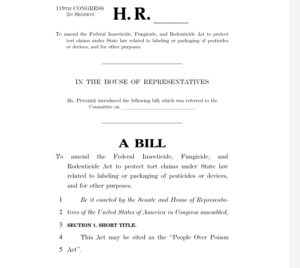
The proposed amendments, known as the People Over Poison Act, provide that language in FIFRA “shall not be construed to prohibit or limit claims relating to the labeling or packaging of pesticides or devices under the tort laws of any state.”
 This parallels New Jersey Democratic Sen. Cory Booker’s promise last week to introduce an amendment to the Farm Bill currently pending in the Senate that would also undo the effects of the Supreme Court ruling.
Republican U.S. Rep. Anna Paulina Luna also said last week that she would introduce legislation that would strip liability protections from pesticide companies.
The Supreme Court’s decision came on appeal brought by Bayer, owner of Monsanto and maker of glyphosate-based herbicides such as Roundup. More than 100,000 people have sued Monsanto alleging the herbicide causes cancer, and Bayer has paid out more than $11 billion in settlements and jury verdicts since taking over Monsanto in 2018.
Bayer asked the Supreme Court to rule that the language in FIFRA preempts key claims in the lawsuit that the company failed to warn users of cancer risks. Bayer argued to the Supreme Court that studies linking its products to cancer are invalid and that under FIFRA only the Environmental Protection Agency (EPA) can require cancer warnings on product labels. Bayer argues that the company cannot be held liable for failing to issue a warning because the EPA does not require such a warning. The Supreme Court agreed in a 7-2 decision, effectively barring these types of claims in current and future litigation.
Syngenta has also been affected, currently facing thousands of lawsuits for failing to warn users of the risk of Parkinson’s disease in scientific studies associated with exposure to paraquat herbicides and other products, such as Syngenta’s Gramoxone.
The Trump administration supported Beyer before the Supreme Court, arguing alongside Beyer’s lawyers before the justices at a hearing in April. The court’s decision represents a new interpretation of this language within FIFRA, in contrast to previous Supreme Court decisions and numerous lower court and appellate court findings on this issue.
In introducing the new law, Pingree noted that the Supreme Court’s decision will protect manufacturers of thousands of pesticides from failure to warn claims related to pesticides widely used in fields, parks, playgrounds, golf courses, and more.
“There is widespread concern that the current administration lacks regulation and that the public is giving away free food to chemical companies, and … more and more Americans are worried about cancer rates and what toxic substances are in our food,” Pingree said.
It’s unclear how much support the amendment will garner, but Pingree said he expects support from the Make America Healthy Again (MAHA) movement.
MAHA leaders expressed outrage at the Supreme Court’s decision and called on Congress to take action.
“If federal law is currently interpreted in a way that shields manufacturers from liability when their products harm people, Congress must immediately change the law. This is one of the most important moments for corporate accountability in a generation,” said Bani Hari, food activist, author, and one of the grassroots leaders of the MAHA coalition.
“If Congress fails to act, it will send a message that powerful companies can avoid responsibility while Americans get sick from harmful chemicals. That is unacceptable,” Hari said. “Congress must move quickly to restore the rights people believed they had and ensure accountability under the law.”
Kelly Ryerson, another prominent voice in the MAHA movement, said the coalition would fight to change the law.
“The grassroots supporters of MAHA stand ready to support any legislation to reverse the SCOTUS decision. We will not accept this outrageous decision from the court and will do everything in our power to prevent this decision from sticking,” she said.
Featured image by Ian Hutchinson on Unsplash.
-
Carrie Gillum is editor-in-chief of The New Lede and a veteran investigative journalist with more than 30 years of experience covering U.S. news, including 17 years (1998-2015) as a senior correspondent for Reuters International. She is the author of Whitewashing: A Story of Herbicides, Cancer, and the Corruption of Science, which exposed the agricultural corruption of the Monsanto corporation. The book won the coveted Rachel Carson Book Award from the Association of Environmental Journalists in 2018. Her second book, the narrative law thriller The Monsanto Documents, was released on March 2, 2021.
She also contributed chapters to a textbook on environmental journalism and a book on pesticide use in Africa.
Mr. Gillum testified about his research as an invited expert before the European Parliament in 2017 and was a featured speaker at the World Democracy Forum in Strasbourg, France in 2019. He has also been a keynote speaker and panel speaker at events and universities in North America, Australia, the Netherlands, Brussels, and France.
Gillam is a regular contributor to the Guardian. Her work has also appeared in The New York Times, Huffington Post, Time, and other outlets.
In 2022, Gillum helped launch The New Lede as a journalism initiative of the Environmental Working Group.
Gillum is a member of the Association of Environmental Journalists.
