


On a quiet street in Monterey Park, California, a green and white “Yes to NDC” sign stood on a front lawn as volunteers went door to door, drumming up support from residents to vote in favor of banning new data centers in the area.
They clarified the wording on the ballot in English, Spanish, and Chinese, and distributed multilingual flyers warning of the impact of AI-related data center development on increased power demand, industrial infrastructure, and the environment.
Less than a month later, on June 2, Monterey Park voters overwhelmingly approved the ban in the San Gabriel Valley, east of Los Angeles, with 86.4% in favor and 13.6% opposed, according to county election results.
Public opposition to data centers is growing, particularly in the United States, as artificial intelligence (AI) and the technology hubs needed to support it create competition for power, water, and land in the communities where they are located. Industry advocates argue that while data centers provide economic benefits, they don’t necessarily lead to higher electricity bills for households.
 A front yard sign urges Monterey Park residents to vote “Yes on NDC Measures” (data center ban) in the San Gabriel Valley, Los Angeles County, May 9, 2026. (Photo by Kristen Mayor)
A front yard sign urges Monterey Park residents to vote “Yes on NDC Measures” (data center ban) in the San Gabriel Valley, Los Angeles County, May 9, 2026. (Photo by Kristen Mayor)
Monterey Park’s results make it the first city in the United States to enact a citywide ban on data centers through a voter-approved ballot measure.
Already have an account? Click here to log in →
Climate Home News is broadcast in Bonn and is one of the few news outlets covering the negotiations shaping COP31 in November.
Register for free and continue reading →
It takes less than a minute.
On a quiet street in Monterey Park, California, a green and white “Yes to NDC” sign stood on a front lawn as volunteers went door to door, drumming up support from residents to vote in favor of banning new data centers in the area.
They clarified the wording on the ballot in English, Spanish, and Chinese, and distributed multilingual flyers warning of the impact of AI-related data center development on increased power demand, industrial infrastructure, and the environment.
Less than a month later, on June 2, Monterey Park voters overwhelmingly approved the ban in the San Gabriel Valley, east of Los Angeles, with 86.4% in favor and 13.6% opposed, according to county election results.
Public opposition to data centers is growing, particularly in the United States, as artificial intelligence (AI) and the technology hubs needed to support it create competition for power, water, and land in the communities where they are located. Industry advocates argue that while data centers provide economic benefits, they don’t necessarily lead to higher electricity bills for households.
A front yard sign urges Monterey Park residents to vote “Yes on NDC Measures” (data center ban) in the San Gabriel Valley, Los Angeles County, May 9, 2026. (Photo by Kristen Mayor)
A front yard sign urges Monterey Park residents to vote “Yes on NDC Measures” (data center ban) in the San Gabriel Valley, Los Angeles County, May 9, 2026. (Photo by Kristen Mayor)
Monterey Park’s results make it the first city in the United States to enact a citywide ban on data centers through a voter-approved ballot measure.
“This week, our city is celebrating the outcome of the Major NDC landslide,” Monterey Park Mayor Elizabeth Yang said in a phone interview.
Yang said on social media that the city’s response was the result of sustained citizen organizing and public participation. “We want to fulfill our obligation to listen to our residents,” Yang told Climate Home News.
Community campaign takes shape
The vote comes after months of public testimony, neighborhood outreach and organizing surrounding a proposed data center project on Saturn Street in Monterey Park. Here, developers planned to replace an existing commercial office building with a nearly 50-megawatt data center aimed at meeting the growing demand for AI computing.
Supporters of Measure No Data Centers (Measure NDC) argued that moving this center and other similar centers away from communities would help protect air quality, drinking water resources, public health, and local infrastructure.
According to real estate information platform CoStar News, the backers of the Saturn Street project, Degico Infrastructure REIT and HMC Capital’s Stratocap, had already withdrawn their planning application on April 3 amid growing local opposition and regulatory uncertainty, including the city’s decision to ban the data center from going before voters.
Then, on April 20, the Monterey Park City Council adopted an ordinance banning all data centers within city limits.
Explainer: Will AI data centers make or break the energy transition?
Company representatives later said they would consider future “productive land uses supported by the broader community.” Potential alternatives being publicly discussed include housing, but no formal proposals have been submitted.
Reuters reported in May that Australian company Digico Infrastructure was considering “monetization options” for its two Los Angeles locations after pushing back against the Monterey Park proposal. Digico is also selling its Chicago data center for $750 million to pay down debt and fund the development of another site in Sydney.
DigiCo and HMC Capital did not respond to requests for comment for this article.
Potential local benefits of data centers
Industry lobby groups argue that data centers can provide economic benefits to host communities. Data centers generate tax revenue, support construction and technology jobs, and provide the infrastructure needed for cloud computing, scientific research and AI development, according to the U.S.-based Data Center Coalition, which represents major operators and developers.
The industry also disputes claims that data centers necessarily raise household electricity bills. A recent report commissioned by the coalition by energy consulting firm Energy+Environmental Economics (E3) found no historical evidence that data centers were driving up household electricity bills under existing utility tariffs. The report argued that factors such as inflation, grid modernization costs, fluctuations in natural gas prices, and investments in wildfire resiliency play a major role in rising electricity prices.
Under certain regulatory frameworks, large users can lower rates for other customers by contributing more revenue to the utility than the cost of service, E3 said. In a previous analysis of Amazon’s data centers, the consulting firm found that payments from the facilities exceeded the incremental costs incurred by utilities. The report also noted that as demand for data centers grows, regulators across the United States are increasingly adopting specialized pricing structures.
 Aerial view of Alibaba Zhejiang Cloud Computing Renhe Data Center in Hangzhou, China, April 11, 2024 (Photo by Costfoto/NurPhoto)
Aerial view of Alibaba Zhejiang Cloud Computing Renhe Data Center in Hangzhou, China, April 11, 2024 (Photo by Costfoto/NurPhoto)
Huge carbon, water and land footprint
The concerns raised at Monterey Park reflect discussions about the environmental and infrastructure demands of AI that are being heard in many countries around the world, from Europe to North America to Asia.
This month, a United Nations report estimated that data centers needed for AI around the world could consume 945 terawatt-hours of electricity annually by 2030. This is approximately twice France’s electricity consumption in 2025.
The team calculates that carbon emissions would need to be offset by growing some 6.7 billion trees over 10 years, water emissions would be equivalent to the annual domestic needs of 1.3 billion people in sub-Saharan Africa, and land emissions would be more than 14,500 square kilometers, roughly twice the size of the Jakarta metropolitan area.
The International Energy Agency (IEA) revealed in its 2026 report, “Energy and AI: Key Questions,” that electricity consumption from AI-focused data centers increased by approximately 50% in 2025 alone.
The group cited concerns about environmental sustainability, electricity affordability, infrastructure strain and democratic participation in land-use decisions, and warned that “social acceptability is also a major issue as local communities oppose data center plans.”
Global data center power consumption by sensitivity case, 2020-2035
 The left axis shows terawatt hours. (IEA: License CC BY 4.0)
The left axis shows terawatt hours. (IEA: License CC BY 4.0)
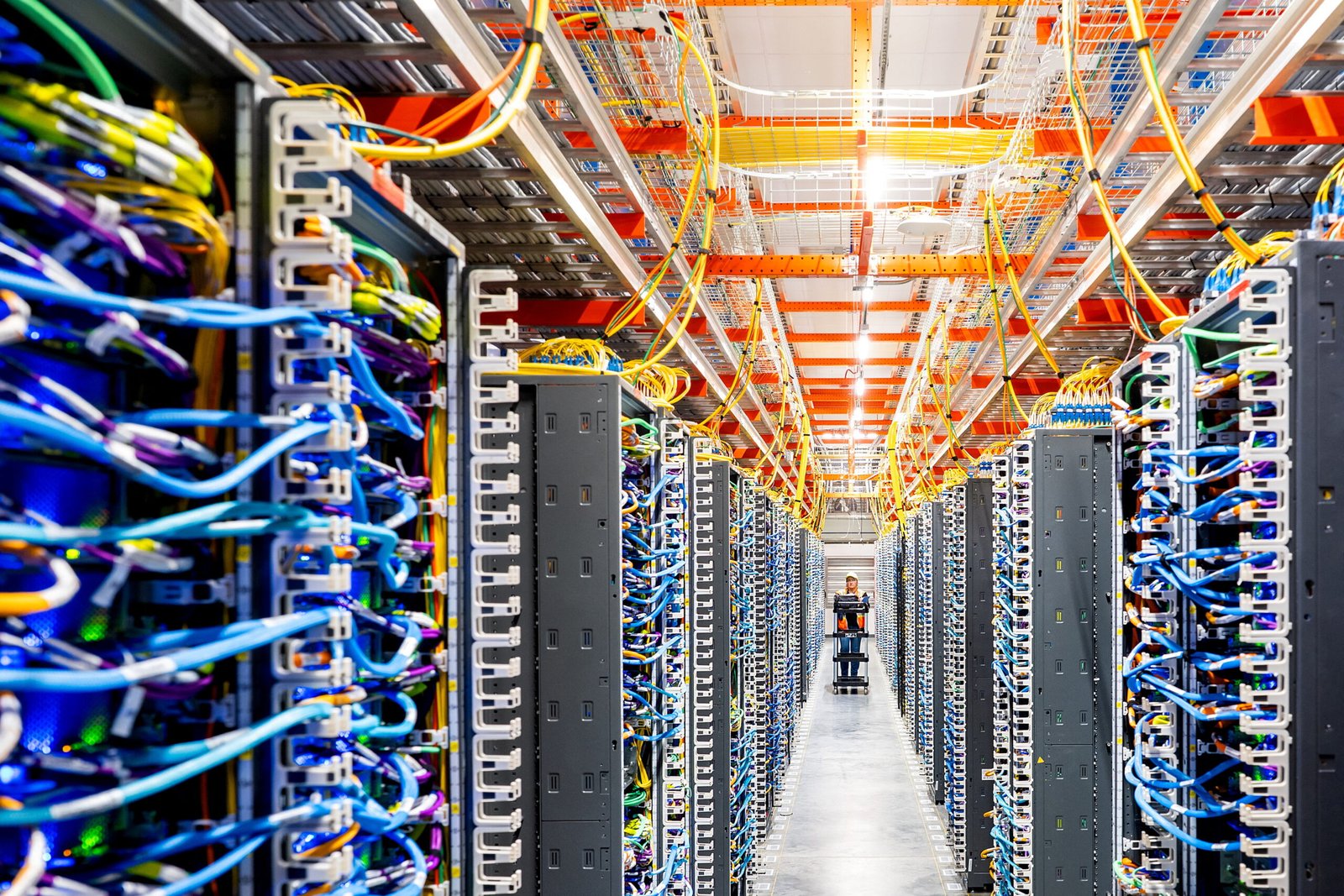
AI-centric facilities consume significantly more power than traditional data centers and often require extensive support infrastructure, including cooling systems, industrial electrical equipment, diesel-powered backup generators, and extensive energy storage systems.
The IEA also noted that operators are increasingly considering on-site natural gas generation and battery infrastructure to maintain electrical reliability as AI workloads grow.
Local concerns about industrial infrastructure
East San Gabriel Valley community organizer Samuel Brown Vasquez said his doubts about the proposed data center in Monterey Park were sparked by broader debate over industrial development in the area.
Brown cited community opposition to City of Industry’s proposal to bring a battery energy storage facility and potentially a data center to the former Puente Hills Mall site, with residents raising concerns about pollution, fire hazards and the impact of new industrial infrastructure on nearby residential neighborhoods and schools.
Many saw the campaign as part of a larger conversation about how communities should respond to the rapid expansion of AI-related infrastructure across Southern California.
Power-hungry AI data centers likely to drive demand for fossil fuels
According to the nonprofit Data Center Watch, about $64 billion worth of data center projects across the country were delayed or canceled between May 2024 and March 2025 amid growing local opposition.
Mayor Yang hopes Monterey Park’s experience will inspire other communities to take a more active role in decisions regarding AI-related infrastructure. “We hope that other cities will follow suit and ban data centers with proposed ballot measures,” he said, adding that the success of these efforts in other cities will depend on how local officials respond to residents’ concerns.
 “Yes on Measure NDC” campaign materials, May 2026 (Photo: Kristen Mayol)

“Yes on Measure NDC” campaign materials, May 2026 (Photo: Kristen Mayol)
A new United Nations report this month called on governments and businesses to proactively address the environmental impact of AI to ensure the technology develops sustainably and its benefits are shared equitably.
Kaveh Madani, director of the United Nations University Institute for Water, Environment and Health, who led the report’s research team, said AI “is a technological transformation that will improve the lives of billions of people around the world.” But it must be used “responsibly”, he added.
“There is a narrow window to ensure that the foundations of the technological revolution of our time develop within global limits, and those who benefit include the communities that provide the minerals essential to the advancement of AI, and those that host its infrastructure and e-waste,” he said.
This article was developed, reported, and produced under the Covering Climate Now (CCNow) climate journalism student mentorship. CCNow connects USC student journalists with CCNow’s global network of professional newsrooms. Participants receive training, editorial guidance, and the opportunity to collaborate with partner publications to report and publish original climate stories, while being paid professional freelance rates.
