





summary
- The North Bay Parry Sound District Health Department has officially suspended water quality testing at public beaches.
- Instead of testing, the health department is updating public signage to warn swimmers of the dangers of poor water quality, such as heavy rain, murky water and large flocks of birds.
- Researchers and advocates say coastal water monitoring is important, especially as climate change increases the need to cool down in the water and makes it more dangerous due to algae blooms and pathogens.
Kevin Marois didn’t know that the health unit that spans North Bay and Parry Sound, Ont., had stopped testing water at local swimming spots.
“I don’t think it’s a good decision,” Marois told The Narwhal after learning about it on a hot June day at North Bay’s Shabogesic Beach. “The main concern is the lack of information on water quality,” he said as he got out of the water. “And we know there are issues with water quality during the summer.”
The health department’s region experienced six harmful algal blooms in 2025 and more than a dozen in 2024.
After announcing the plan earlier this year, the North Bay-Parry Sound District Health Department officially halted water quality testing at public beaches as of this summer.
Instead, public signage has been put up to warn beachgoers to assess the risks of recent heavy rains, visibly cloudy water or the presence of large numbers of birds in the water, anything that could change water quality and make swimming unsafe due to high levels of E. coli or harmful algae, the health department said.
Despite the updated signage, people who study water safety at Canadian beaches say the suspension of testing could impact people’s ability to make informed decisions about safe swimming this summer.
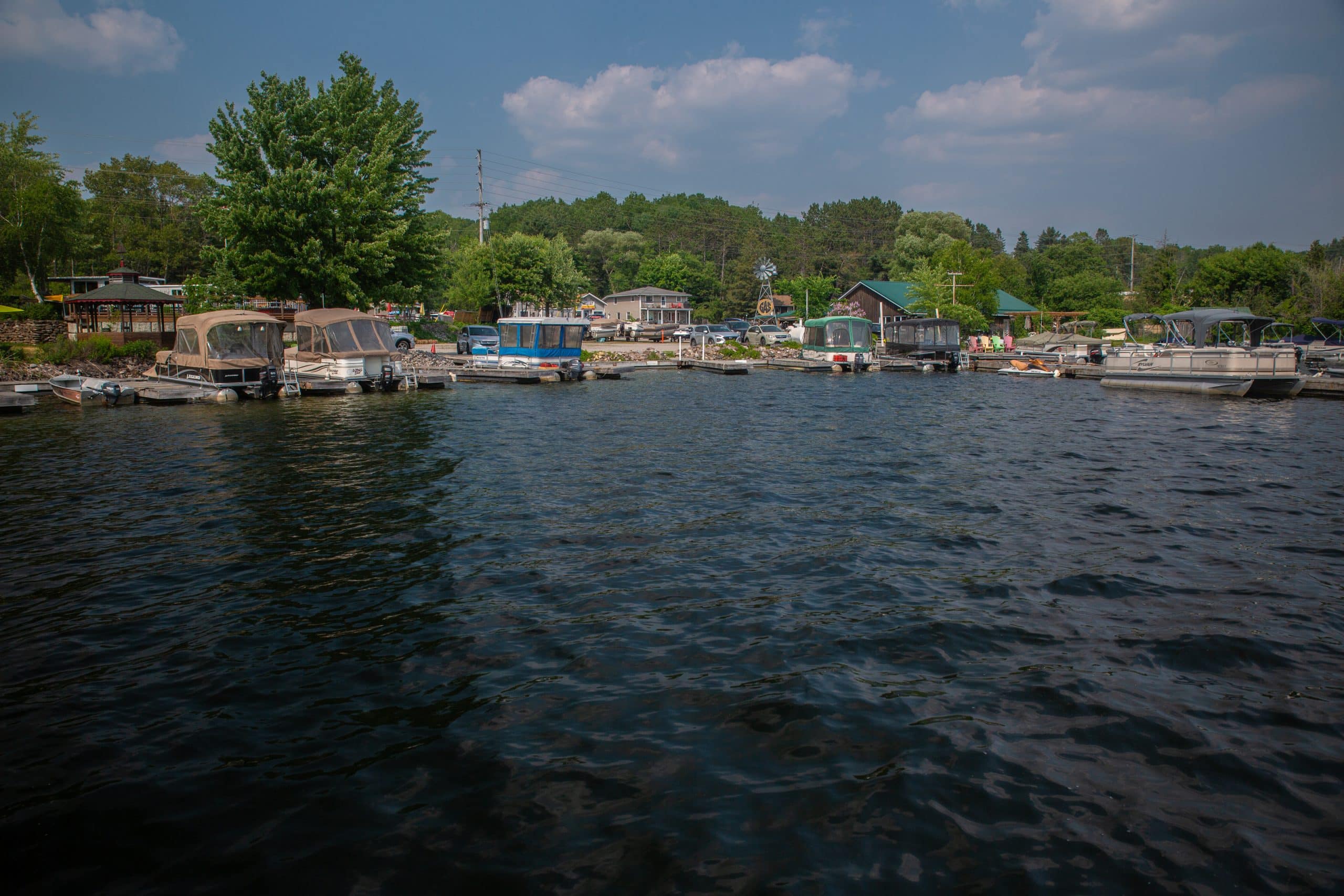 The beach at Trout Lake is popular with North Bay swimmers. Water quality testing will no longer be conducted by local public health departments. Photo: Vanessa Tignanelli / Narwhal
Meanwhile, researchers argue that Canada’s warming climate, with more severe summer heatwaves, means that swimming water for people to cool off is more important than ever.
“We’re seeing changing weather patterns, urban heat island effects, the emergence of heat domes, and a tremendous need for cooling space in communities,” said Gregory Ford, vice president and Lake Ontario Water Manager for Swim Drink Fish, an environmental nonprofit that advocates for safe and accessible waters. Its name comes from the No Swimming, No Fishing, No Drinking signs often posted along Canada’s coastline.
Ford explained that rising temperatures and extreme weather events (part of climate change, primarily caused by the burning of fossil fuels) are also contributing to more harmful algae blooms and an increase in other pathogens that impact the health of water and the people who use it.
Dig deeper into this topic
Health officials say water testing is resource-intensive and takes too long.
The North Bay Health Department, which also covers Kearney, Nipissing and South River, sent a letter to member municipalities in March 2026 saying sampling the region’s 60 public beaches would take too many resources and test results would take three to four days, limiting their usefulness when water quality changes rapidly. The health department also maintained that the risk of illness from water play in the area is low. Water tests were only conducted about three times during the summer.
Last year, the Sudbury Public Health Unit and District Health Unit, an area that includes Manitoulin Island and French River, also suspended routine water sampling. This is one of a number of cuts made after the medical officer of health said funding was not keeping pace with inflation.
“Obviously, the pressure on local governments and public health departments is increasing…so we understand that compromises have to be made, but not when it comes to things that impact public health,” Ford said. “This is a trend that we see in times of economic stress and strain… Unfortunately, when these downsizing starts to happen, the public knows less about their water, and frankly, that’s the most important part.”
 Swimmers said they were concerned about the lack of testing at Lake Nipissing’s popular beaches. Photo: Leah Borts-Kuperman / Narwhal
Swim Drink Fish aggregates data from all of North America’s swimming spots into an app called Swim Guide. But these useful third-party tools rely on local data collected by public health departments.
“It’s really important for municipalities to provide historical data, even if they’re not sampling today. They should make publicly available data and information collected over at least the last five years, the last 10 years, so people can make some informed decisions about where they spend their time,” Ford said. Nor was it provided by the North Bay Parry Acoustic Health Department.
There are options to protect beachgoers, but they cannot replace testing: expert
A recent Toronto Metropolitan University study that surveyed 4,085 beachgoers at seven Canadian beaches between 2023 and 2025 found that about 2.6 per cent of swimmers reported becoming ill, with children and older adults at higher risk of “recreational water illnesses” such as stomach problems, ear and eye infections, and rashes.
Ian Young, principal investigator of the Canadian Beach Cohort Study, which tracks recreational water diseases across Canada, said that despite the low risk, “it’s important to have a robust surveillance plan in place to give people confidence in beaches.”
He noted that other methods are being used across the country to address the slow and unreliable nature of current tests. For example, at Bluffer’s Park Beach in Scarborough, Ontario, the City of Toronto implemented a bird management program that included removing food sources and training dogs to fly the geese after finding that a significant amount of E. coli in the beach water was caused by birds.
 The North Bay Parry Sound District Health Unit is warning beachgoers to assess the risks of high numbers of birds in the water, recent heavy rains, and visibly murky water, all of which can alter water quality and make swimming unsafe due to high concentrations of E. coli and harmful algae. Photo: Leah Borts-Kuperman / Narwhal
Swim Drink Fish’s Ford considered another solution. Municipalities such as Kingston and Hamilton are trialling new technology to alert residents in real time if sewers or sewer bypasses are overflowing and contaminating coastal waters. However, he said this does not replace the need for monitoring.
“We’re a step away in terms of solutions, and the best solution is to continue to monitor these beaches on an ongoing basis,” Ford said. “Sometimes resources can be scarce. This is a public health benefit, a tourism benefit, and also an individual health and wellness benefit. So this should be a priority for the public health sector, but it’s disappointing to see decisions like this being made.”
To reduce risk, the North Bay Health Department recommends swimmers wash or sanitize their hands before eating after swimming, towel drying thoroughly to prevent itching, check for hazards before entering the water, and avoid getting water in the mouth.
But North Bay resident Ashley Brooker, standing on the shores of Lake Nipissing, said she still doesn’t feel good about the testing changes. “I’m a risk-taker, but that doesn’t mean I want to risk getting sick or getting infected with something,” she said. “Safety is important. If you’re going to put tax money into something, you should get those resources back.”
