


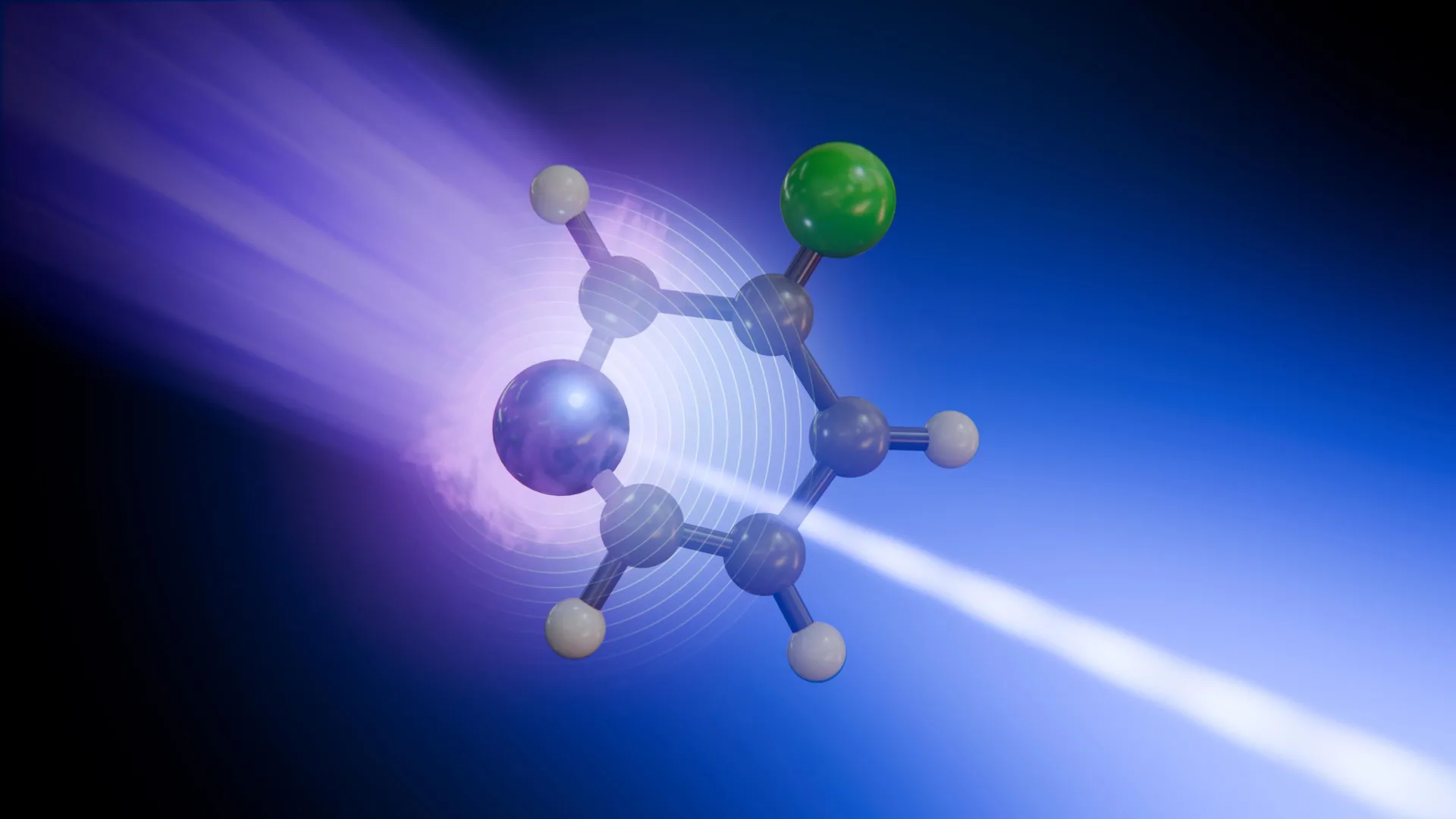
Scientists observed how energy moves through molecules immediately after absorbing light and found that individual atoms can register very different parts of the change.
The researchers used high-speed X-ray flashes produced by Europe’s XFEL to track changes in specific atoms as molecules release and redistribute absorbed energy. Their results show that atoms can become more sensitive to the movement of neighboring atoms when exposed to light.
This technology allows scientists to study extremely fast chemical reactions at the atomic scale in real time. It could ultimately improve our understanding of how DNA tolerates exposure to light, how energy moves through materials designed to collect light, and how other fundamental light-driven processes occur.
Tracing energy through molecules
The researchers studied 3-fluoropyridine, a small cyclic molecule containing both nitrogen and fluorine atoms.
When a molecule absorbs energy from a short ultraviolet laser pulse, its electrons are placed in a higher energy state. The molecule then quickly bends out of its normally flat structure.
As it changes shape, it passes through what scientists call conical intersections. This intersection is a short-lived but important intersection where the movements of electrons and atomic nuclei are strongly linked. These intersections play an important role in many light-induced reactions because they allow energy to be rapidly transferred between electronic and structural motion.
After passing through this region, the molecule returns to its ground state. Excess electronic energy is converted into vibrations that propagate through the molecular structure.
Different atoms reveal different changes
The conversion of energy produced different signals at different locations within the molecule. The fluorine atom served as a relatively clear indicator of how the vibrations of the molecule relax over time.
Nitrogen atoms tell a more complex story. Because it played a more direct role in the original electronic excitation, its signal reflected both the redistribution of electrons and the structural change of the molecule.
“We now know that not all atomic sites are telling the same story in the signals we get from the X-ray pulses,” says study co-author Antonio Picon from Madrid’s Institute of Scientific and Materials Research (ICMM-CSIC). “Some atoms report where the charge goes, while others reveal how the entire molecule vibrates.”
Reconstruction of picosecond conversion
To capture this process, the research team used time-resolved X-ray photoelectron spectroscopy (tr-XPS) at the European XFEL’s Small Quantum Systems Instrument (SQS).
First, an ultraviolet laser pulse delivered energy to the molecules. Carefully timed pulses of soft X-rays were then used to remove deeply bound electrons from the nitrogen or fluorine atoms, ionizing them.
The researchers repeated the measurements using X-ray pulses that arrived at various delays after the initial laser pulse. By recording the energy of the emitted electrons, they reconstructed how the chemical environment surrounding each atom changes over just a few picoseconds (trillionths of a second).
They then used advanced computer simulations and theoretical models to interpret the experimental signals and link them to the underlying electronic and structural changes.
A new perspective on ultrafast photochemistry
The findings show how the ultrashort, high-brightness X-ray pulses available at Europe’s XFEL can isolate some of the fastest interconnected movements in matter.
Although the experiments focused on one relatively simple molecule, the same approach could potentially be applied to increasingly complex systems. Possible targets include functional organic molecules, building blocks of biomolecules, and materials designed to capture or transfer energy from light.
“Europe’s XFEL was built to allow us to observe where chemical changes begin, at specific atomic sites, and on natural time scales,” said Daniel Rivas, a former instrument scientist and current visiting scientist at SQS and co-author of the study. “The combination of multisite sensitivity and femtosecond resolution opens new windows into the microscopic mechanisms governing photochemistry.”
