


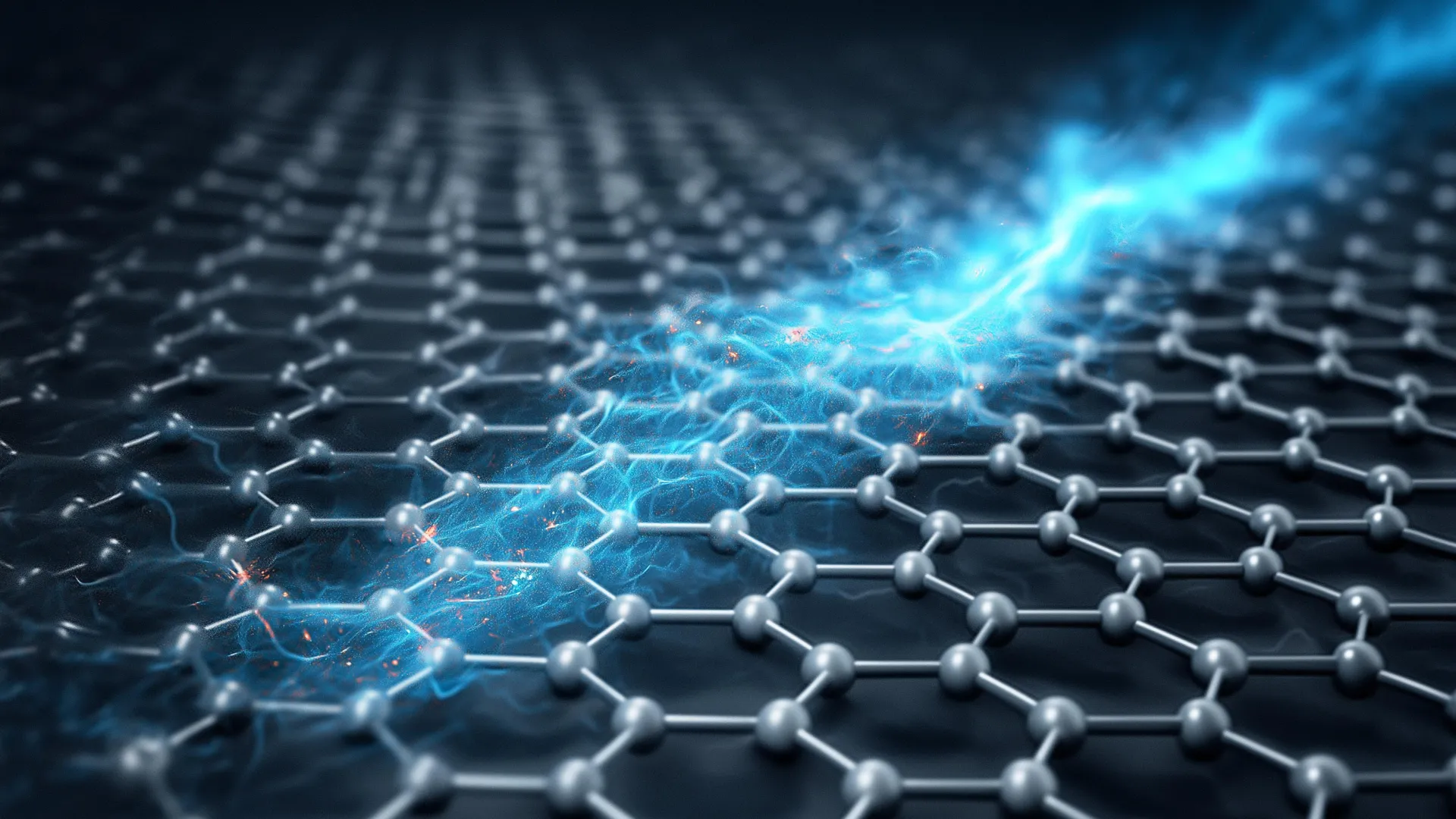
Researchers have found evidence that superconductivity can be controlled by changing the environment around a material. This is a breakthrough that could ultimately lead to more efficient electronics and powerful quantum technologies.
Superconductivity allows certain materials to carry electricity with zero energy loss when cooled below a critical temperature. Although scientists have been studying this phenomenon for decades, many of its underlying mechanisms remain poorly understood. Gaining deeper insight into how superconductivity forms could help researchers design better materials and improve future electronic and quantum devices.
Twisted graphene reveals unusual behavior
The research, led by Cheung Ning (Genie) Lau, a physics professor at The Ohio State University, focused on a specially engineered material known as twisted bilayer graphene. This material is made by stacking two sheets of carbon, one sheet slightly rotated relative to the other.
The researchers combined the graphene structure with strontium titanate, a synthetic diamond-like material. This setup allowed scientists to observe and influence how electrons interact within the system.
Electronic interactions play a major role in determining properties such as magnetism and chemical bonding. In superconductors, electrons pair up in a special way, allowing electricity to flow without resistance. The researchers discovered that by adjusting the environment around the materials, they can strengthen or weaken their interactions, effectively turning superconductivity on or off.
“Normally, electrons repel each other, but in superconductors, electrons form pairs. This pair formation is key to the superconductor’s ability to conduct electricity without dissipating,” Lau said. “Our evidence suggests that electrons themselves are unexpectedly important for changes in matter, depending on their sensitivity to the surrounding environment.”
Discovery challenges conventional superconductor theory
Researchers were surprised by one discovery. Increasing certain adjustments within the material made the superconductivity weaker instead of stronger.
That behavior is different from what scientists typically observe in traditional superconductors, where reducing the repulsion between electrons enhances superconductivity. The unexpected results highlight that unusual materials like twisted bilayer graphene can behave very differently from traditional superconductors.
“If we can transmit electricity without energy loss, it will be very important for the technologies used in our daily lives,” Lau said. “Although fundamental questions still need answers, this work provides a path to a fundamentally new type of physical mechanism.”
The discovery could help researchers move closer to one of the field’s biggest goals: developing superconductors that operate at much higher temperatures, even room temperature. Achieving this milestone could dramatically change electronics, communication systems, and power transmission technology.
The potential for more efficient electronics
The survey results are natural physicswe propose a simpler method to control the conditions necessary for the generation of superconductivity.
Many high-temperature superconductors currently face limitations that reduce their performance. Researchers believe that manipulating the surrounding environment of these materials may provide new ways to improve the functionality and efficiency of future electronics.
Lead author Xueshi Gao, a physics doctoral student at The Ohio State University, said the research team hopes the results will be useful for a variety of experiments and materials systems in the field.
“The mechanism of superconductivity in the twisted bilayer graphene system we used is still not well understood,” Gao said. “However, our results shed light so that people can better understand the concept when applying it in future research.”
Researchers plan further experiments
Scientists caution that this study is an early step in understanding a broader range of complex electronic interactions. Future research will investigate other types of interactions and investigate additional physical questions raised by the study.
“A lot of people on the ground are very excited about this result because we are showing capabilities that we have never shown before,” Lau said.
Other co-authors from Ohio State University include Aatmaj Rajesh, Emilio Codecido, Daria Sharifi, Zheneng Zhang, Youwei Liu, and Marc Bockrath. Collaborators included Alejandro Jimeno-Pozo, Pierre Pantaleon, and Paco Guinea from Spain’s Imdea Nanoscience.
This research was supported by the Department of Energy and the National Science Foundation.
