


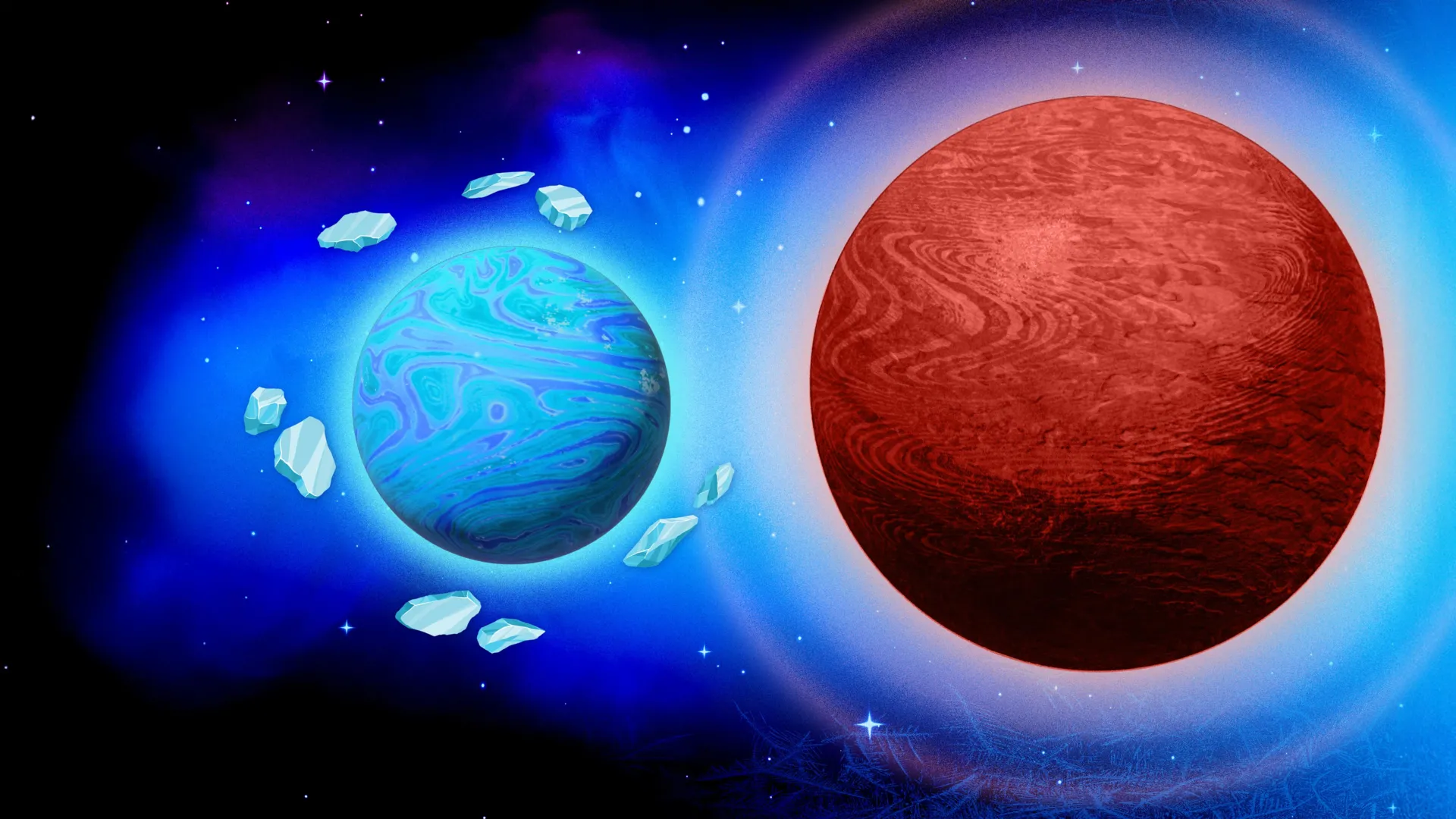
On the other side of the Milky Way, about 190 light-years from Earth, astronomers have identified a very unusual combination of planets. A giant hot Jupiter, a type of giant planet that is usually found alone, shares its system with a small mini-Neptune that orbits even closer to its star. This unusual configuration has puzzled scientists since it was first discovered in 2020.
Now, MIT researchers have taken a closer look at the inner planet’s atmosphere and discovered new clues that help explain how this strange system formed.
JWST reveals heavy, watery atmosphere
In a study published in Astrophysics Journal Letterthe team used NASA’s James Webb Space Telescope (JWST) to analyze the atmosphere of mini-Neptune. This is the first time scientists have measured the atmospheric composition of mini-Neptune, which lies inside the orbit of hot Jupiter.
Observations show that the planet’s atmosphere is surprisingly dense, filled with heavier molecules such as water vapor, carbon dioxide, sulfur dioxide, and trace amounts of methane. This kind of atmosphere is unlikely if planets form near stars and are usually dominated by light gas.
Rather, the new discovery suggests an entirely different origin.
Planets are likely to have formed far away from their stars
According to the researchers, both mini-Neptune and hot Jupiter likely formed in cooler regions of early disks of gas and dust, far away from their stars. In that environment, icy substances and volatile compounds could accumulate more easily, allowing the planet to build a thicker, heavier atmosphere.
Over time, the two planets likely moved inward together, moving closer to the star while maintaining their atmospheres and unusual orbital configurations.
The results provide the first clear evidence that mini-Neptunes can form beyond a star’s “frost line” (the distance at which water becomes cold enough to freeze into ice).
“This is the first time we’ve observed the atmosphere of a planet inside the orbit of hot Jupiter,” says Saugata Bharat, a postdoctoral fellow at the Kavli Institute for Astrophysics and Space Studies at the Massachusetts Institute of Technology and lead author of the study. “These measurements show that this mini-Neptune actually formed beyond the frost line, confirming that this formation pathway indeed exists.”
The research team includes scientists from institutions around the world, including MIT, the Harvard-Smithsonian Center for Astrophysics, the University of South Queensland, the University of Texas at Austin, and Lund University.
A rare and mysterious planetary system
Mini-Neptune is smaller than Neptune and consists mostly of gas surrounding a rocky core. Although they don’t exist in our solar system, they are actually the most common type of planet in the Milky Way galaxy.
The unusual system was identified in 2020 by then-MIT Torres postdoctoral fellow Chelsea X. Huang, now a faculty member at the University of South Queensland. Mini-Neptune was discovered orbiting alongside hot Jupiter, something astronomers rarely get to see.
Using data from NASA’s Transiting Exoplanet Survey Satellite (TESS), the team studied a star called TOI-1130 and detected both planets. Mini-Neptune orbits once every four days, while hot Jupiter takes eight days.
“This was a system like no other,” Huang says. “Hot Jupiters are ‘solitary’, meaning they have no companion star in their orbit. They are so massive and their gravity so strong that anything in their orbit scatters. But somehow, in this hot Jupiter, the inner companion survives. And the question arises how such systems form.”
The timing of observation was an issue.
This discovery led researchers to use JWST to examine the planet in more detail, focusing on the inner world known as TOI-1130b.
However, observing the planet was not easy. Unlike most planets, which follow a predictable orbital schedule, this planet is in what scientists call a “mean motion resonance.” Each planet’s gravity causes the orbits of the other planets to change slightly, making their movements less regular and less predictable.
To overcome this, a team led by Judith Coase at Lund University compiled previous observations and created a model that accurately determines when planets pass in front of their stars in a way that JWST can observe.
“That was a difficult prediction, so we had to be right,” Barratt said.
A detailed look at planetary chemistry
When the timing was right, JWST acquired detailed data across multiple wavelengths of light.
“The advantage of JWST is that instead of looking at just one color, you can look at different colors or wavelengths,” Barat explains. “And the specific wavelengths that a planet absorbs can tell you a lot about the composition of its atmosphere.”
The data revealed strong traces of water, carbon dioxide, and sulfur dioxide, along with small amounts of methane. These heavier molecules are in contrast to the lighter hydrogen and helium typically expected in planets that form near stars.
This discovery challenges previous assumptions and supports the idea that TOI-1130b formed far outside before migrating inward.
Evidence of planetary movement
The planet probably collects its atmosphere in cold regions above the frost line, where water freezes on top of the dust and forms ice particles. As the young planet moved inward, the ice would have evaporated, leaving behind the thick atmosphere we see today.
Barratt said the presence of these heavy molecules supports the idea that both planets likely formed in the outer regions of the system and moved inward together, maintaining their atmospheres.
“This system represents one of the most unusual structures astronomers have ever discovered,” Barratt said. “Observations of TOI-1130b provide the first hint that such mini-Neptunes, which form across the water-ice boundary, actually exist in nature.”
This research was supported in part by NASA.
