


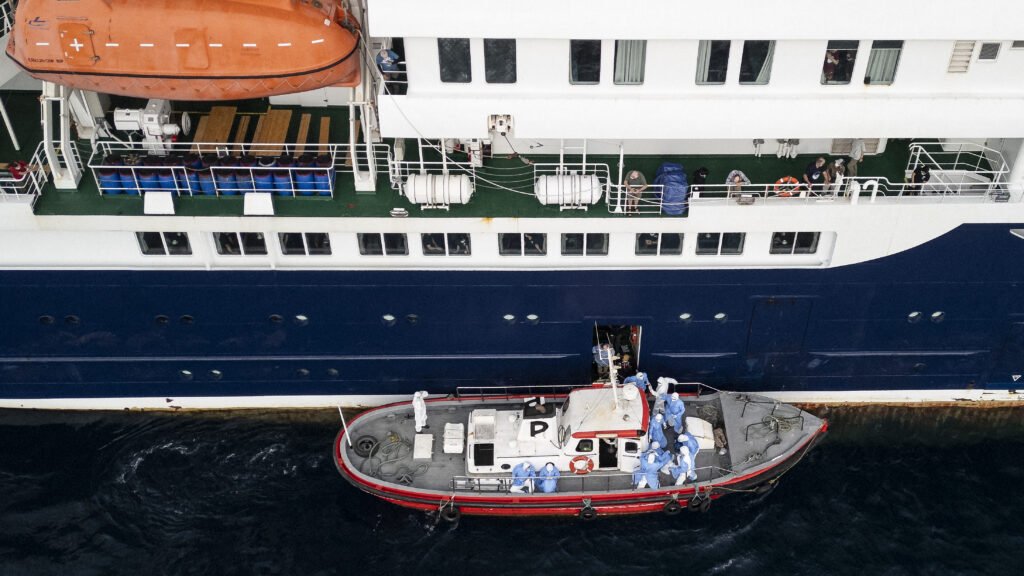
The cruise ship MV Hondius, which has attracted worldwide attention, is underway due to an apparent outbreak of human-to-human hantavirus infection. At the request of World Health Organization Director-General Tedros Adhanom Ghebreyesus, Spain agreed to let the ship dock off the coast of Tenerife in the Canary Islands. The ship is scheduled to arrive on Sunday.
This outbreak, the first suspected hantavirus infection on a cruise ship, is an evolving situation. Hantaviruses also have a long incubation period, so it can take several weeks to resolve. And it could be months before scientists can conclude how the virus got on the ship, whether all subsequent cases were people infected through contact with other people, or whether rodents on board (which are known to carry hantavirus) played a role.
The WHO held a press conference on the situation on Thursday. Here are five key takeaways.
Plans are underway to remove remaining passengers and crew from the ship
WHO official Maria van Kerkhove told a news conference that there were no sick people on board the ship at this time. Three people in poor health, including the ship’s doctor, were evacuated to the Netherlands.
Efforts are underway to assess the health status of the remaining passengers and crew and possible contact with known cases. There are currently approximately 145 people on board from 23 countries.
WHO and the home countries of the passengers and crew are working on a plan to get these people off the ship and safely home.
hantavirus
Learn more about hantavirus cruise ship outbreak
“We are working with all countries of nationality of the passengers to discuss plans for the safe return of these patients,” said Van Kerkhof, the agency’s acting head of epidemic and pandemic management.
Tedros hinted that people on board were under stress, saying he spoke to the captain early Thursday and was informed that the atmosphere on board the MV Hondius had improved since the ship sailed again.
Evidence is growing that the epidemic started before the voyage began
The current hypothesis is that the first two infected people in this outbreak, a couple who boarded the ship in Argentina, were infected before the cruise began.
The incubation period for hantavirus infection is long. It can take up to six weeks after being infected with the virus for symptoms to develop. Therefore, the idea that the couple may have been infected before their departure is plausible.
Mr Tedros said the couple had gone bird watching before boarding the boat. The trip took them through parts of Chile, Uruguay and Argentina, and “included visits to areas where rat species known to carry the Andean virus are present.”
The Andes virus responsible for this outbreak is the only hantavirus known to have the ability to spread from person to person. Still, recorded sending events were rare.
Tedros said the WHO was working with the Argentine government to better understand the couple’s movements before they boarded the ship.
The United States and Argentina, which recently withdrew from the WHO, are cooperating with the organization.
Both the United States and Argentina have informed the WHO that they are withdrawing from the World Health Organization. However, WHO officials stressed that both countries are cooperating with international efforts to investigate the source of the outbreak and safely repatriate people from the ship.
“In terms of cooperation with the United States and its institutions, things are going very well,” said Abdi Mahmoud, head of WHO’s health emergency alert and response operations. “There is a flow of information and there is transparent and honest information sharing.”


Sign up for daily summary
Get all the health and medical news you need today in one email
Part of the exchange of information takes place through the International Health Regulations, a treaty aimed at protecting the world from disease outbreaks that can cross borders. The United States remains a party to the IHR.
Anais Legand, WHO’s technical lead on viral hemorrhagic fevers, said they had an excellent working relationship with their counterparts at the Centers for Disease Control and Prevention. “We have very positive and regular interactions almost every day.”
Tedros said the WHO continues to share information with the United States and receives information through IHR channels. He said he hoped the United States and Argentina would reconsider their withdrawal from the World Health Organization.
“The virus doesn’t care about our politics or our borders,” he said. “The greatest immunity we have is unity.”
Setting aside, there is no evidence of new disease dynamics at work here.
Andes virus has been confirmed to be transmitted from person to person on rare occasions. The largest known outbreak occurred in Epuen, Argentina, in 2018-2019. There were 34 people infected, of whom 11 died. It is thought that four generations of infection passed before the epidemic was brought under control.
The investigation into the outbreak is still in its early stages, but experts believe the only new thing here so far is the fact that the outbreak occurred on board the ship.
“There’s no indication that anything more unusual has happened so far, but the fact that it happened on a cruise ship with people of different nationalities on board is clearly something we’ve never seen before,” Legan said.
Mahmud said that, although the circumstances were slightly different, the situation on board the ship in some ways mirrored that of other cases of human-to-human transmission of the Andean virus, pointing to the Epuen outbreak, where the infection was believed to have spread at a large, crowded birthday party.
“So we are currently in a similar situation with clusters in closed spaces with close contact,” Mahmud said.
Legand said laboratories in South Africa, Switzerland and Senegal are working to generate complete genetic sequences of the virus taken from confirmed cases to see if anything has changed or provide any clues about how it was transmitted.
There is a high possibility that many suspected infected people will continue to appear in the future.
Every day, it seems, there are reports of possible cases being admitted to hospitals for observation and evaluation in different parts of the world. A flight attendant who worked on the plane that transported one confirmed infected person. (It is not yet clear whether this person was infected.) A Swiss man was on board early in the voyage but disembarked before it was discovered he was infected. (He is a confirmed case.)
Given the number of people on board the ship for part or all of its voyage, the multiple ports it called at, and the fact that there were people from at least 28 countries on board, from St. Kitts and Nevis to Denmark, New Zealand and Ukraine, it is likely that many people have had or will have some contact with those aboard the MV Hondius. Potential contacts are being told to be on the lookout for symptoms for several weeks. Similar symptoms may be seen during the early stages of infection. It is associated with many other respiratory diseases. Cases like the Swiss man’s case may also be confirmed. Some people don’t, and probably many people don’t either. But it is public health’s job to follow up on all these possible cases, Van Kerkhove said.
