


More than a dozen wildfires broke out across Southern California last month, spewing smoke and particulate matter into the air. Los Angeles public health officials issued a multi-day air quality advisory for the county, warning of “possible direct smoke effects” and advising anyone who can see or smell smoke to “avoid unnecessary outdoor exposure and limit physical activity.”
The red zone on the map included Los Angeles Stadium (also known as SoFi Stadium), one of the venues for soccer’s marquee World Cup event, which begins Thursday. Eight games will be held in Los Angeles from June 12th to July 10th, with tens of thousands of fans and large numbers of players expected to be in attendance.
If dry, hot conditions persist, more fires could break out and smoke could once again fill the stadium. Similar risks exist for many of the other 15 World Cup host cities. But despite the documented health effects of smoke exposure, soccer’s international governing body FIFA does not appear to have a plan in place if air quality worsens.
“FIFA is basically doing very little,” said Nicholas Watanabe, a sports and entertainment management professor at the University of South Carolina. “They’re even behind the minor leagues in North America.”
National Women’s Soccer League (NWSL). Canadian Football League. The NCAA, which oversees college sports, all have at least some guidelines outlining what to do if the air quality index reaches certain thresholds. Other leagues, from Major League Baseball to the Women’s National Basketball Association, have postponed games due to wildfire smoke, particularly in June 2023, when plumes spread across Canada and North America.
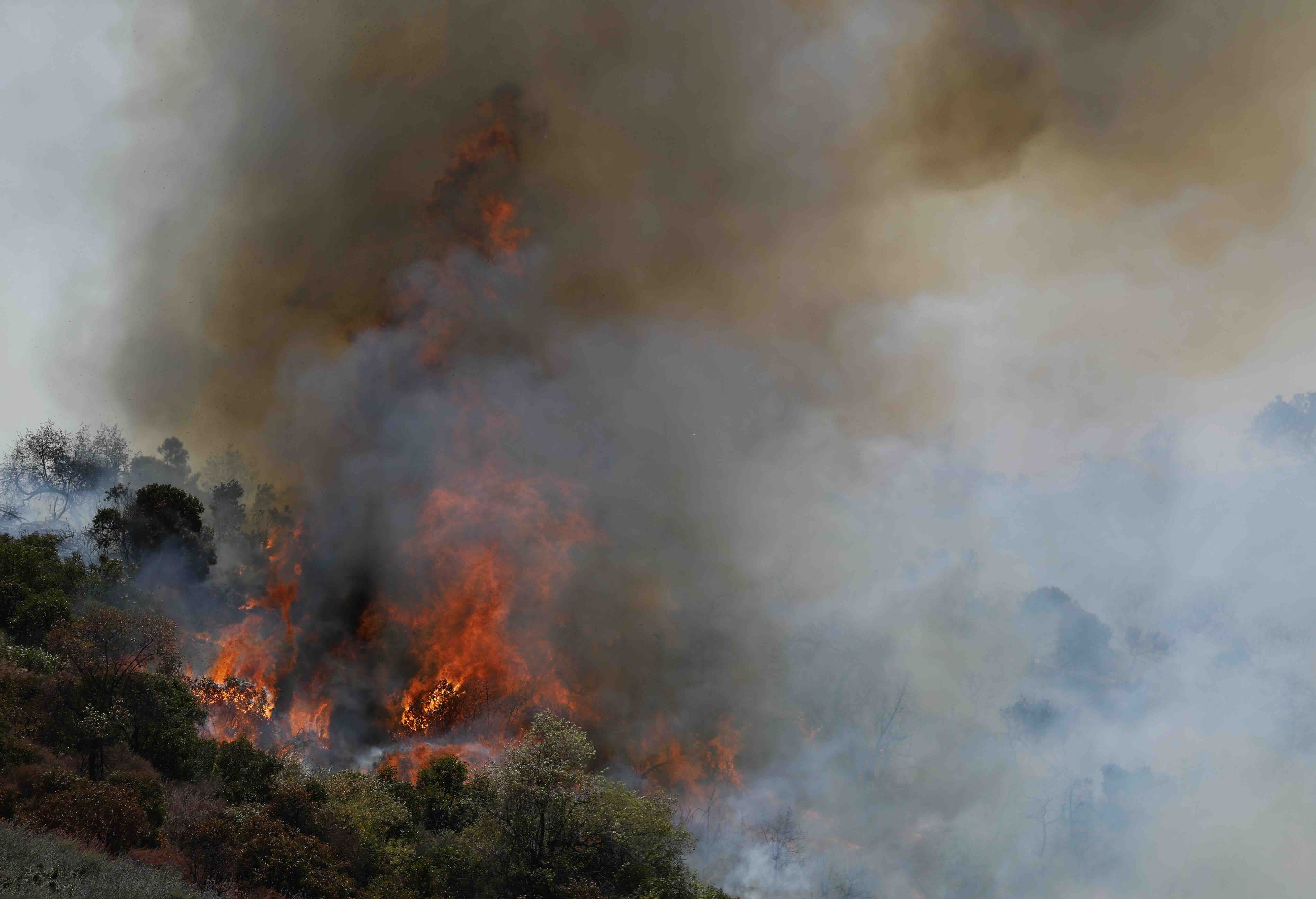 In May 2026, the Sandy Fire burned through heavy brush and sent smoke into the air as it passed through California’s Simi Valley.
Justin Sullivan/Getty Images
The Air Quality Index (AQI), a measure of common pollutants in the air, ranges from 0 to 300+, with 101 starting at an “unhealthy” level and “very unhealthy” and “hazardous” warnings after that. Experts say wildfire smoke often causes spikes and can be harmful to both players and fans. “You may feel a burning sensation in your throat, a cough, or a headache,” said Mary Johnson, an environmental health researcher at Harvard University’s T.H. Chan School of Public Health. Some groups may be particularly sensitive, including children, the elderly, and people with respiratory conditions such as asthma.
“Climate-related risks will be assessed as part of the overall tournament planning and managed in close collaboration with host cities, stadium authorities and national authorities,” FIFA said in a statement to Grist. It detailed extensive protocols related to the heatwave, including mandatory hydration for players (while fans are not allowed to bring refillable water bottles into the stadium), but did not address air quality. He mentioned “preparatory training for the entire tournament” in preparation for bad weather, but did not provide details. The organization did not respond to subsequent questions and declined multiple requests for an interview.
For now, FIFA appears to be betting on clear air. The gamble could very well pay off, but wildfire smoke is an increasingly common feature of North American summers, raising questions about whether organizers are prepared for conditions that are no longer uncommon. “It’s kind of ridiculous that there’s nothing for the world’s biggest sporting event,” Watanabe said of even the minimum AQI standard for canceling games. “We’re only one step away from very big concerns: wildfires in the Pacific Northwest.”
All indicators point to a dangerous fire season in 2026. The National Interagency Fire Center predicts wildfire risk will increase across much of the West this summer as a warm winter ends and a record-breaking El Niño event potentially arrives. Canadian authorities have made similar predictions. Smoke can be blown thousands of miles, putting virtually all FIFA sites at potential risk.
“There are very few places in North America that are immune to these effects,” said Dominique Krakowski, a geographer who studies wildfires at Clark University. He noted that the warning time for smoke outbreaks may only be a few hours. “It would make sense for FIFA to introduce air quality standards that would be considered in advance and trigger decisions on whether or not to play.”
John Quindley, a physiology professor at the University of Montana, said a lack of planning likely won’t mean “people will die prematurely,” but he thinks organizers should be prepared. He said there were things FIFA could do to reduce the risk from bushfire smoke, ranging from playing at times when air quality tends to be better to postponing or relocating matches. “You need decision trees and algorithms built into the process,” he said, likening air quality events to thunderstorms. “People certainly call the game lightning bolt, and no one disputes that.”
When the AQI reaches 101, the air is deemed “unhealthy for sensitive groups” and the NWSL begins adding hydration breaks for players. Once a number reaches 180, which is in the “unhealthy” range for anyone, the league will start considering rescheduling games. If the AQI exceeds a “very unhealthy” 200, cancellation or postponement will be mandatory. The league did not respond to a request to confirm whether the policy, which The New York Times reported in 2023, remains in place. However, this is in line with USA Soccer guidelines. The NFL’s 2022-2023 Game Operations Manual also states that the league is “prepared to relocate games if there is conclusive evidence that the AQI consistently exceeds 200 for a significant period of time, including the days the game is played at the affected stadium.” If the AQI exceeds 300, the NCAA requires organizers to move the event indoors or cancel it.
Watanabe said some of the World Cup venues are sealed and have state-of-the-art filtration systems installed to help reduce air quality deterioration. That includes Mercedes-Benz Stadium in Atlanta, a city already suffering from poor air quality due to wildfire smoke this year. But many other regions, including Los Angeles, Seattle and Vancouver, which have historically been prone to wildfire smoke, also cannot be shut down. Grist contacted local organizing committees, host city public health officials, the U.S. Soccer National Players Association and the White House World Cup Task Force. Of the few answers, most questions were redirected to FIFA.
“There is no specific AQI level that will trigger the automatic cancellation of a FIFA event,” said James Garrow, a spokesperson for the Department of Public Health in Philadelphia, which will host the 2026 World Cup. Instead, the city will monitor air quality and “consider possible recommendations,” he said.
But for FIFA, the question is not simply whether wildfire smoke affects health, but how to balance those risks against the logistical and financial demands of a multi-week global tournament. Quindley said: “A lot of money is at stake.”
Whatever happens at this year’s World Cup, Krakowski said it’s only a matter of time before FIFA and other sports leagues are forced to consider a bleak future. “Having to think about wildfire smoke and how it impacts athletes, athletic performance and sporting events is new,” he said, but it is becoming an increasingly common problem in North America, Europe and other regions. “We are seeing wildfires becoming a bigger part of our lives.”
