


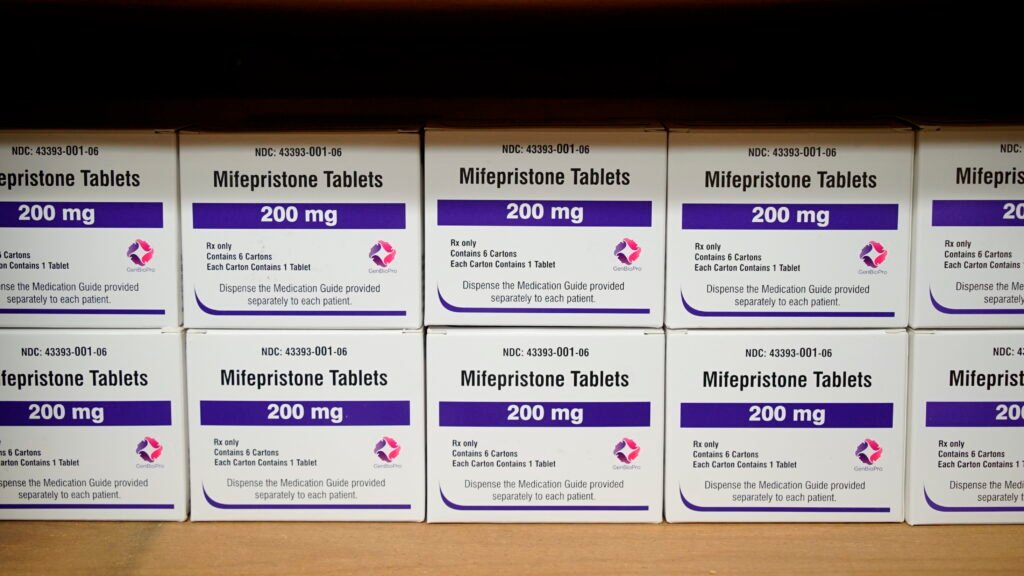
WASHINGTON – The Supreme Court on Thursday maintained women’s access to drugs used in the most common abortion method, rejecting lower courts’ restrictions while litigation continues.
The court order will allow women seeking abortions to continue obtaining the drug mifepristone through pharmacies or by mail, rather than visiting a doctor in person. Access is unlikely to be interrupted until at least next year, as the case progresses, including a possible appeal to the High Court.
The justices granted an emergency request by the manufacturers of mifepristone, which is appealing a federal appeals court ruling that would require women to see a doctor in person and stop mailing mifepristone. The federal Food and Drug Administration, which first approved mifepristone for abortion in 2000, stopped requiring in-person visits five years ago.
Anti-abortion groups frustrated with President Donald Trump’s administration are asking the FDA to move quickly on the review, which they hope will result in restrictions on mifepristone, including blocking its prescriptions through telemedicine platforms. The Republican administration says the work will take time.
Earlier this week, FDA Commissioner Marty McCulley resigned following months of criticism from President Trump’s political allies, including abortion opponents.

Former FDA leader and drug company speak out about mifepristone
Susan B. Anthony Pro-Life America and similar allies called on President Trump to fire McCulley, citing the slow pace of the mifepristone review.
The court is grappling with the latest abortion debate four years after a conservative majority overturned Roe v. Wade, effectively banning abortion altogether in more than a dozen states.
The case in the court stems from a lawsuit filed by the state of Louisiana to overturn Food and Drug Administration rules on how mifepristone is prescribed. The state argues that the policy undermines its ban there and calls into question the safety of the drug, which has been repeatedly called safe and effective by FDA scientists.
Lower courts concluded that Louisiana was likely to prevail, and a three-judge panel of the 5th Circuit Court of Appeals ruled that mail access and telehealth visits should be suspended while the case progresses.
This drug is most often used for abortions in combination with another drug, misoprostol. In 2023, the last year for which statistics are available, medication abortions accounted for nearly two-thirds of all abortions in the United States.
The current dispute is similar to one that went to court three years ago.
Later, lower courts also sought to restrict access to mifepristone in a lawsuit brought by anti-abortion doctors. They filed the lawsuit months after the court overturned Roe’s decision.
The Supreme Court blocked the Fifth Circuit’s decision from taking effect, with Justices Samuel Alito and Clarence Thomas dissenting. In 2024, the high court unanimously dismissed the doctors’ lawsuit on the grounds that they lacked the legal right or standing to sue.

Mifepristone court ruling makes drug development riskier for everyone
In the current case, mainstream medical groups, the pharmaceutical industry and Democratic lawmakers are focused on warning courts against restricting access to the drug. Pharmaceutical companies said the ruling against abortion opponents would upend the drug approval process.
The debate over the safety of mifepristone has been going on for more than 25 years. The FDA has eased many restrictions originally placed on the drug, including who can prescribe it, how it is compounded, and what types of safety complications must be reported.
Despite the decision, anti-abortion groups have filed a series of petitions and lawsuits against the agency, alleging that the agency is violating federal law by overlooking safety issues with the pill.
The Trump administration has remained unusually silent on the Supreme Court. Even though federal regulations were at issue, the court declined to submit a brief recommending what to do.
This incident puts the administration in a difficult situation. Although President Trump relies on the political support of anti-abortion groups, he has also seen poll questions and polls showing that Americans generally support abortion rights.
Both sides took the administration’s silence as tacit support for the appellate court’s ruling.
— Mark Sherman, Jeff Mulvihill, Matthew Perrone
Mulvihill reported from Haddonfield, New Jersey.
