


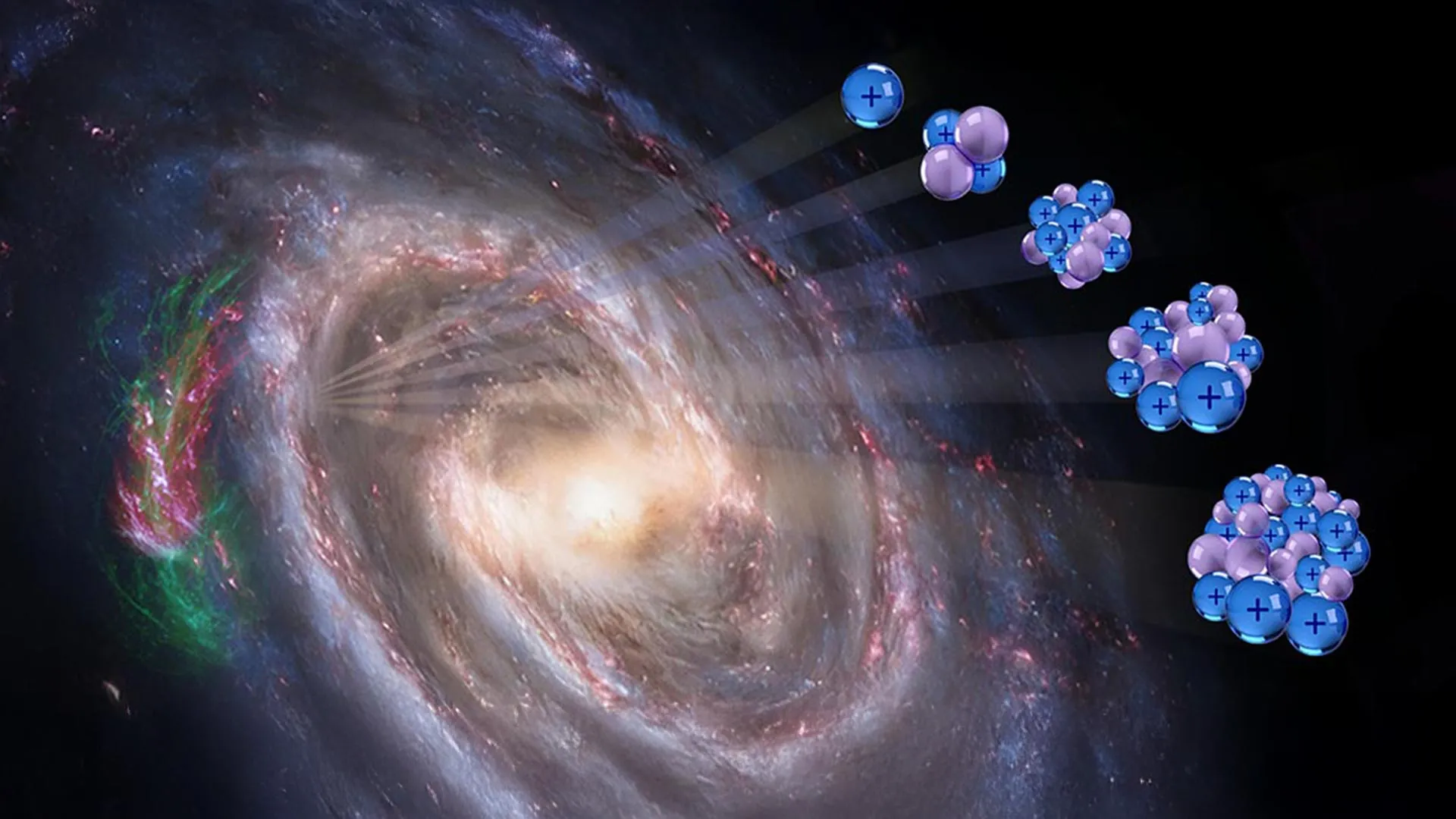
For more than 100 years, scientists have been trying to understand cosmic rays, incredibly powerful particles that travel through space with extreme energy. Despite decades of research, many questions about where they come from and how they are accelerated remain unanswered. Now, researchers working with the DAMPE (Dark Matter Particle Explorer) space telescope have discovered important new clues. Their findings are: naturea common feature shared by these mysterious particles has been uncovered, which could help scientists better understand their origins.
Cosmic rays are the highest energy particles ever observed in nature. They carry far more energy than the particles produced by even the most advanced accelerators on Earth. Scientists believe they were created by some of the most violent events in the universe, including supernova explosions, jets from black holes, and pulsars.
The DAMPE space telescope, launched in December 2015, was designed to investigate the properties of cosmic rays and explore possible connections with dark matter. The mission includes significant contributions from the Astrophysics Group of the Department of Nuclear and Particle Physics (DPNC) at the University of Geneva (UNIGE).
By examining the high-precision data collected by DAMPE, researchers discovered that there is a universal pattern in the energy spectrum of primary cosmic ray nuclei, from light protons to much heavier iron nuclei.
“Cosmic rays are mainly composed of protons, but also helium, carbon, oxygen, and iron nuclei,” explains Andriy Tikhonov, associate professor at UNIGE’s Faculty of Science DPNC and co-author of the study. Intermediate, from billions of electron volts to hundreds of billions of electron volts. And it’s as high as over 1000 billion electron volts. ”
Scientists discover common cosmic ray pattern
The study showed that for any type of nucleus studied, the number of particles begins to decline much faster after reaching a certain threshold. Scientists call this effect “spectral softening.”
Generally, high-energy cosmic rays become less likely to occur as their energy increases. However, DAMPE observations reveal that the drop becomes dramatically steeper once the stiffness exceeds about 15 TVs (teraelectron volts). Stiffness describes how strongly a particle’s path resists bending by a magnetic field.
Because this same feature appears in many different types of particles, this finding strongly supports theories that suggest that the acceleration and movement of cosmic rays through space is controlled by stiffness. At the same time, the data largely rule out competing explanations based on energy per nucleon (energy divided by the number of nucleons in the particle). According to the researchers, confidence in these alternative models reaches 99.999%.
AI and advanced detectors help accelerate discovery
Researchers in Geneva played a major role in this breakthrough. The research team developed an advanced artificial intelligence method to reconstruct particle events detected by the telescope. It also contributed important measurements on proton and helium fluxes and helped analyze carbon nuclear data.
Additionally, the Geneva Group led the development of one of DAMPE’s key instruments, the Silicon Tungsten Tracker (STK). This detector is essential for accurately tracking the path of particles and determining the charge of incoming cosmic rays.
This discovery represents an important advance in understanding how cosmic rays are produced and how they travel through galaxies. Scientists say the new results place severe limits on existing models of particle acceleration in astrophysical sources and improve our understanding of how energetic particles move through interstellar space.
