


key insights
- The U.S. Supreme Court heard oral arguments in Monsanto v. Darnell on Monday. The case focuses on the liability of pesticide manufacturers under state law for issuing warnings about their products that the Environmental Protection Agency does not require.
- Bayer, which acquired Monsanto in 2018, faces more than 100,000 lawsuits in state court alleging that glyphosate, the active ingredient in the herbicide Roundup, causes cancer. The company says the lawsuit threatens the supply of the most used herbicide in the United States.
- The justices are expected to issue their opinion by the end of June, but there is a possibility that there will not be a clear division between conservatives and liberals.
The U.S. Supreme Court heard oral arguments Monday in a case centered on whether companies that fail to warn about the potential dangers of pesticides are liable under state law when the federal government does not require such warnings.
The case, Monsanto v. Darnell, stems from a lawsuit filed in Missouri state court in 2019 by John Darnell, a gardener who claims that decades of exposure to the company’s glyphosate-based herbicide Roundup led to a type of cancer called non-Hodgkin’s lymphoma, and that the company should have warned him about the risks. Bayer acquired Monsanto in 2018 and assumed all of its debt.
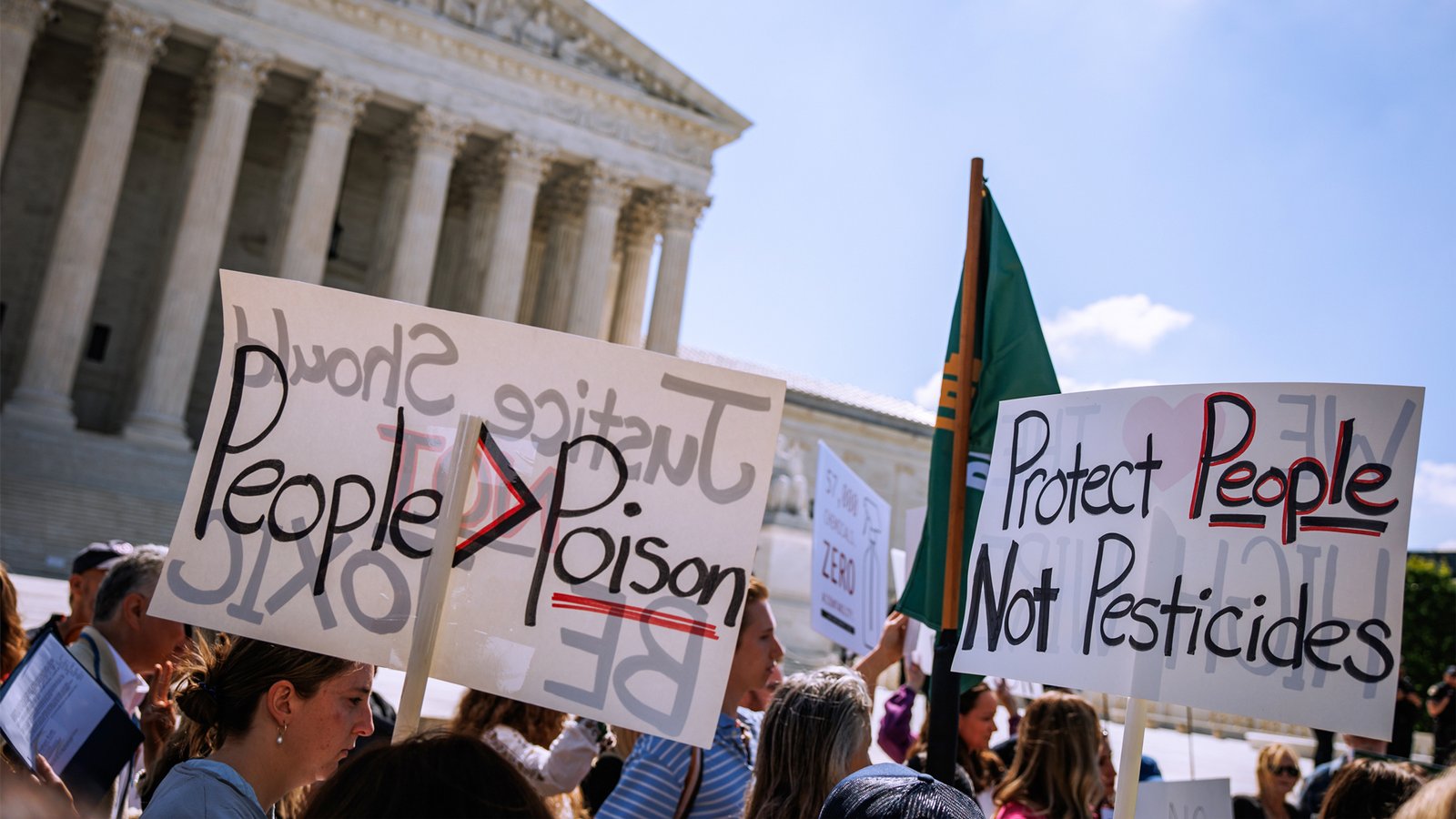
This case is not a partisan issue. Hundreds of protesters opposed to Bayer gathered outside the courthouse in what they called a “people versus poison” rally. The group included prominent Make America Healthy Again activists and influencers, as well as environmentalists, farmers, and members of Congress from both parties.
Some judges crossed ideological lines in their questioning. John Roberts and Neil Gorsuch joined Ketanji Brown Jackson in opposing Bayer, believing that states cannot go after pesticide manufacturers in the same way as the EPA. And Elena Kagan, along with Samuel Alito, questioned Darnell about whether the Supreme Court’s 2024 Roper-Bright v. Raimondo decision, which reversed the practice of leaving interpretation of ambiguous statutes to federal authorities, was really relevant to the case.
Debate over federal insecticide, fungicide, and rodenticide laws
Lawyers for both sides presented their arguments primarily in written briefs.
Paul Clement, a former attorney general in the George W.
Mr. Clement also argued that Mr. Darnell’s claims were “twice preempted.” First, he argued that this argument is “expressly” preempted by the text of FIFRA, which provides that “States may not impose, or in fact continue, any requirements for labeling or packaging in addition to or different from the requirements under this subchapter.” Second, he argued that the claim is “implicitly” preempted because it is impossible for Bayer to comply with both the Missouri jury’s cancer warning requirements and the EPA’s approved labeling without a cancer warning.
On behalf of the U.S. government, current Chief Deputy Solicitor General Sarah Harris also argued in court in support of Bayer’s position. “States can add penalties,” but they cannot “second-guess or compromise” the EPA’s pesticide registration process, she said.
Business and industry groups filed court briefs in support of Bayer. The same goes for Nebraska, Iowa, Missouri, where the incident occurred, and 12 other mostly red states.
For the plaintiffs, product liability attorney Ashley Keller of Keller Postman argued that even if a pesticide’s label was approved by the EPA at the time of registration, a pesticide can be “misbranded” under FIFRA if it does not include the required warnings. Mr. Keller also said that after the Roper-Bright decision, courts now require more evidence directly from the text of federal law than Bayer presented.
Keller further argued that while the original Missouri jury decision diverged from the EPA’s glyphosate registration decision, it did not diverge from FIFRA. “There is nothing in, under, or adjacent to FIFRA that would allow EPA to make a registration decision preemptively binding labeling requirements,” he said.
Environmental health, consumer and farmer advocacy groups filed court briefs in support of Darnell, as did a group of former EPA officials. Two separate groups in the state also filed court briefs in support of him. New Mexico and 17 other mostly blue states have filed court briefs, while Texas, Florida and Ohio have filed separate court briefs.
A “flood” of glyphosate lawsuits
Darnell’s lawsuit is one of more than 100,000 in the U.S. that hold Bayer liable under state law for failing to warn about possible cancer risks from exposure to Roundup.
Many of the complaints came from people who were using Roundup at home, and Bayer removed glyphosate from the consumer version. However, commercial agricultural versions still contain glyphosate. Glyphosate is the most common agricultural herbicide in the United States, used on most corn, cotton, soybeans, and sugar beets.
Bayer launched a multipronged effort to contain the lawsuit. In February, the company proposed a $7.25 billion class settlement that includes most of these claims. Shortly after, President Donald J. Trump signed an executive order promoting domestic production of elemental phosphorus and glyphosate-based herbicides. Lawmakers are currently working to pass a farm bill that includes a provision that would require uniform pesticide labels across the country.
CropLife America, an industry group representing pesticide manufacturers, highlighted the potential economic impact of the Roundup lawsuit in a court brief supporting Bayer (PDF). “The growing threat of such immense liability with so many pending lawsuits could easily drive economically important products from the market,” the report said.
Bayer said the plaintiffs began filing this “volume of litigation” after the World Health Organization’s International Agency for Research on Cancer (IARC) classified glyphosate as “probably carcinogenic to humans” in 2015.
The EPA and comparable regulators in the European Union and other countries have so far disagreed. However, in 2022, the U.S. Court of Appeals for the Ninth Circuit ordered the EPA to re-evaluate the safety of glyphosate, and the EPA is currently conducting that re-evaluation.
In the Darnell case, the first Missouri state court jury sided with IARC and Darnell and awarded $1.25 million in damages. Bayer appealed, and the case eventually reached the Supreme Court.
In a written statement on the matter, the company said the EPA has “thoroughly studied glyphosate and repeatedly concluded that it does not warrant a cancer warning.”
Pesticide label on line
The Supreme Court has already narrowed the scope of the issues Bayer wanted to consider in the case, but the justices’ final opinion “could be broader and far-reaching,” said Brent Wisner, a partner at Wisner Baum and a plaintiff’s attorney who won the first jury verdict in the nation in a Roundup-related cancer case in 2018.
If the court were to answer the relatively narrow labeling questions posed, it would rule in Bayer’s favor and “the failure to warn labeling claim would essentially no longer be viable,” Wisner said. A decision in Darnell’s favor means “nothing changes,” he said. “We’re back to where we are now,” he said, with state juries free to hold pesticide manufacturers accountable for failing to put warning labels on their products.
During oral arguments, lawyers representing Bayer and the U.S. government repeatedly raised an alternative to state court litigation: petitioning the EPA to cancel the pesticide’s registration altogether. Bridget Rollins, a staff attorney at the National Farm Law Center, said she would be interested to see whether more people would start petitioning the EPA this way if the court rules in Bayer’s favor.
“If the court rules in Bayer’s favor here, it would seem that revocation of this pesticide could emerge as another avenue for plaintiffs like Darnell to voice their concerns about pesticide safety,” she says. “I think maybe we’ll see more of that in the future.”
The justices are expected to issue an opinion on the case by the end of their current term in June.

Delgar Erdenesanaa is a policy and regulatory reporter covering pesticides, PFAS, and other chemicals in food, agriculture, and water.
Chemistry & Engineering News
ISSN 0009-2347
Copyright © 2026 American Chemical Society
