


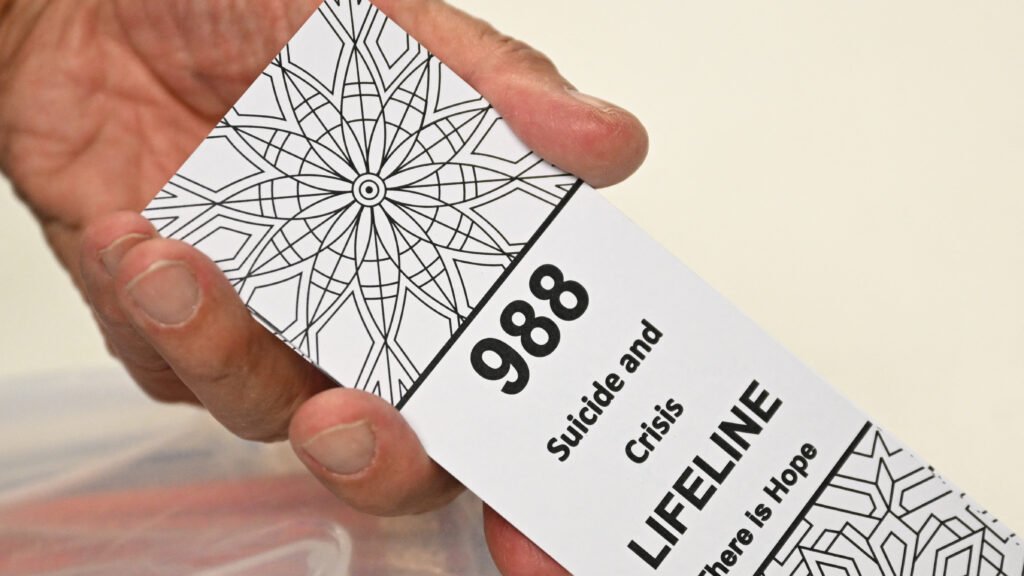
Death by suicide is an emergency for men. Although three times as many women as men report suicidal thoughts or attempts, men account for the majority of suicide deaths (up to 80%) in the United States. The reasons are high impulsivity, unreported fear of death, and, importantly, easy access to guns.
A new report from Crisis Text Line, a nonprofit organization that works with 988 Suicide & Crisis Lifeline to provide free and confidential text-based mental health support, sheds light on a different explanation. Men are far less likely to ask for help than women.
The organization found that of the 1.5 million messages it received in 2025, fewer than 20% of texters identified as exclusively male (this figure does not include texters who chose multiple gender identities). This is despite the fact that women are more likely than women to mention suicide in their messages, especially at a younger age. In 2025 data, the organization found that one in three conversations with boys under 14 mentioned suicide.
“The fact that boys and men are experiencing such high levels of distress and crisis, yet we’re not being reached, is something that’s really important to highlight. This is true for Crisis Textline, and more broadly for other helplines in this area,” said Tracy Costigan, Vice President of Impact Assessment and Storytelling at Crisis Textline and author of the report. “Boys and men are socialized to equate independence with strength and to see asking for help as weakness, which is exactly what conforms to traditional masculine norms.”
The new report, released Tuesday at a press conference hosted by the Parliamentary Mental Health Caucus, analyzes 71,000 conversations between men and boys between 2022 and 2024. This sample is not representative of men as a whole, as Crisis Text Line users tend to be younger, with two-thirds under 35 years of age, and self-selected to be more likely to seek help. But Costigan said the findings are consistent with documented help-seeking patterns among broader populations of boys and men, who are less likely than women to see a therapist or contact a helpline, and who frequently report having no one to talk to.

Study finds that increased calls to the 988 hotline are associated with fewer suicides among young people
“As a researcher who studies men’s mental health and help-seeking behavior, I’m not surprised,” said Michael Addis, a psychology professor at Clark University, about the low percentage of men reaching out to crisis lines. In his research and book, Invisible Men, about men’s reluctance to talk about their weaknesses, he identified several factors that make asking for help “a very difficult step” for men, including the stigma associated with being perceived as weak and cultural norms that promote independence.
The topic of masculinity is at the center of current political debate, and there are differing views on how it affects men’s mental health. On May 4, at the MAHA Institute Committee on Antidepressant Use, Adm. Brian Christine, assistant secretary of health and human services, said challenges to traditional masculinity are contributing to the men’s mental health crisis.
“This is a cultural issue, it’s a societal issue. We’ve created a culture where a lot of men feel like they’re on the outside looking in,” he said. “There’s a message in some spaces that masculinity itself is something to be despised, something to be criticized, something to be demonized, and we see the effects of that. We see boys falling behind in school, young men withdrawing from the workforce, and a quiet but growing sense of not being wanted.”
Addis and other scholars of masculinity disagree with this interpretation. “The answer is to reduce masculinity concerns, not increase them. Men’s masculinity does not need to be repaired to improve their mental health,” Addis said. “We need to teach them how to be more flexible in their understanding, or how to let go of the need to do it,” he says.
The report shows trends in the reasons for men’s unhappiness. For young men, relationship stress was the biggest concern, peaking in trouble among boys aged 14 to 17 and then decreasing with age, while loneliness and loneliness became more of a problem, peaking at age 65.
“Boys and men often talk about the importance of having social connections to support them in times of hardship,” Costigan says. “At the same time, we found that loneliness increases with age, while talk of relying on friends and social connections as a coping mechanism decreases with age. So we need to make sure we support older men to provide opportunities for social connections as well.”

Promising methods of suicide prevention start in the clinic
Addis said that while boys and men are discussing relationships and loneliness in the context of the crisis, mental health services are dispelling cultural stereotypes that “girls are relationship-oriented and boys are more autonomous; women are relationship-oriented and men are achievement-oriented.” Rather, men feel the importance of human relationships. “What’s happening is that for many of us, relationships aren’t unimportant; they’re extremely important. We don’t have the skills necessary to deal with relationship pain and keep the relationships around us healthy.”
“Young men really want social connections with other young men, they really want romantic relationships, they want to use words like love and friendship and caring, but over time they move away from that,” said Dominic Shattuck, a Johns Hopkins University researcher and men’s health researcher at the National Institute for Boys and Men.
Shattuck said the lesson is an evolutionary one. Boys need to be equipped with greater emotional literacy early in life so that they maintain the ability to build and nurture relationships as they grow older. “This report helps identify the coping mechanisms they already rely on, such as social connections, exercise and sports, creative outlets, mental health services, and time spent in nature,” Shattuck said. “This is important not only to scale up clinical care, but also to frame prevention around strengthening existing protective factors.” Not all spaces that look after the mental health of boys and men need to be formal, he added. “It could be a barber shop, it could be a sports club, it could be friends you hang out with.”
If you or someone you know may be considering suicide, contact the 988 Suicide and Crisis Lifeline: Call or text 988 or chat. 988lifeline.org. For TTY users: Use your preferred relay service or dial 711 then 988.
STAT’s reporting on health issues facing men and boys is supported by Rise Together. Rise Together is a donor-advised fund sponsored and managed by the National Philanthropic Trust and established by Richard Reeves, founding president of the American Association of Boys and Men. and by the Boston Foundation. Our financial supporters have no input into any decisions about our journalism.
