


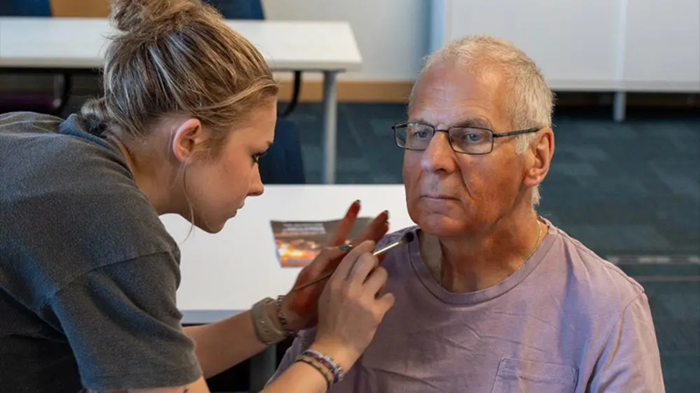
Southampton Solent University students are set to graduate having already secured two jobs in the ambulance service and providing trauma simulation training for the British Armed Forces.
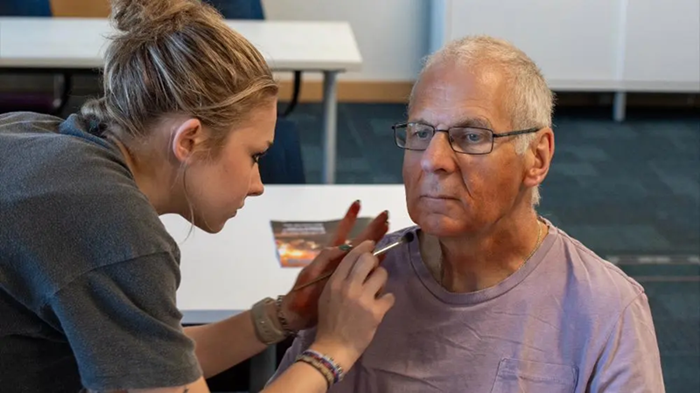
Image credit: Southampton Solent University
Final year BA (Hons) Prosthetics and Orthotics and Special Effects Design student Katie Upton has spent the past year building a career in one of the industry’s most niche and specialized fields.
Her specialty is moulage, which creates realistic simulated wounds and trauma for medical training. Although this is widely used in professional medical education, Katie discovered that it was practiced informally in many ambulance services in the UK.
“I contacted about 50 companies asking for work history.” she says. “This is such a niche field that we didn’t expect many people to respond, but we were very fortunate to receive responses from the South East Coast Ambulance Service, the London Ambulance Service, the Royal College of Surgeons and London’s major trauma hospitals.”
When it came to where to study, Katie says Sorrento stood out. The course’s focus on practice-led learning appealed to her, and as someone who grew up in London, the city campus felt familiar.
A module on professional applications in her second year made her think seriously about what kind of artist she wanted to be. She knew she was drawn to realism and gory, forensic endings, but had yet to find a field that could become a career in its own right.
This really inspired all of us to get into the industry. I was very quiet and lacked confidence in myself. But after getting some work experience, I realized that it’s not as scary as it seems. ”
Katie Upton, final year BA (Hons) student in Prosthetics and Special Effects Design, Southampton Solent University
She spent her second and third summers gaining on-the-job experience, teaching EMTs and doctors best practices, and participating in training days to demonstrate how professionally created wounds can impact the effectiveness of emergency simulations.
The emergency department she worked for noticed the difference and asked her to come back as a paid professional.
The military aspect of her career came about through a similar process of endeavor. She was initially told that security requirements made it impossible for her to take part in work experience, but a few months later she received a call offering her a paid role instead.
She traveled to a military base in Cambridge for training and has since become part of a team working on large-scale combat trauma simulations. Some of the actors she works with are amputees. Her job is to create prosthetic limbs and realistic injuries that help train military personnel to determine when and how medical intervention is needed.
“We make fake limbs. If someone’s entire arm is to be amputated, we make the entire arm.” she explains. “It makes it look like the edges are torn. Sometimes they’re out in the field for four or five hours.”
This work takes her to bases across the UK and overseas, with durations ranging from a day to a month.
For Katie, this piece also has personal meaning. Her mother was a director of midwifery and deputy head nurse in the NHS, and her father served in the army from the age of 16 to 27.
Solent’s Bachelor of Prosthetics and Special Effects Design (Hons) combines creative practice with professional application, preparing students for careers in film, television, theater and beyond.
Southampton Solent University is positioning itself at the forefront of a new higher education model that values students by putting employability, adaptability and real-world experience at the heart of every degree.
sauce:
Southampton Solent University
