


Sea level rise is one of the most obvious and most persistent effects of human-induced climate change. As the Earth’s temperature rises, the heat causes the oceans to expand and glaciers and ice sheets to melt, creating more seawater. Scientists say this process will be extremely difficult to stop and will continue into the distant future.
Now, an international climate research team says it has completely explained the causes behind global sea level rise over the past 60 years, resolving a long-standing problem that has complicated scientists’ understanding of one of the most serious threats of climate change.
Sea level rise is accelerating
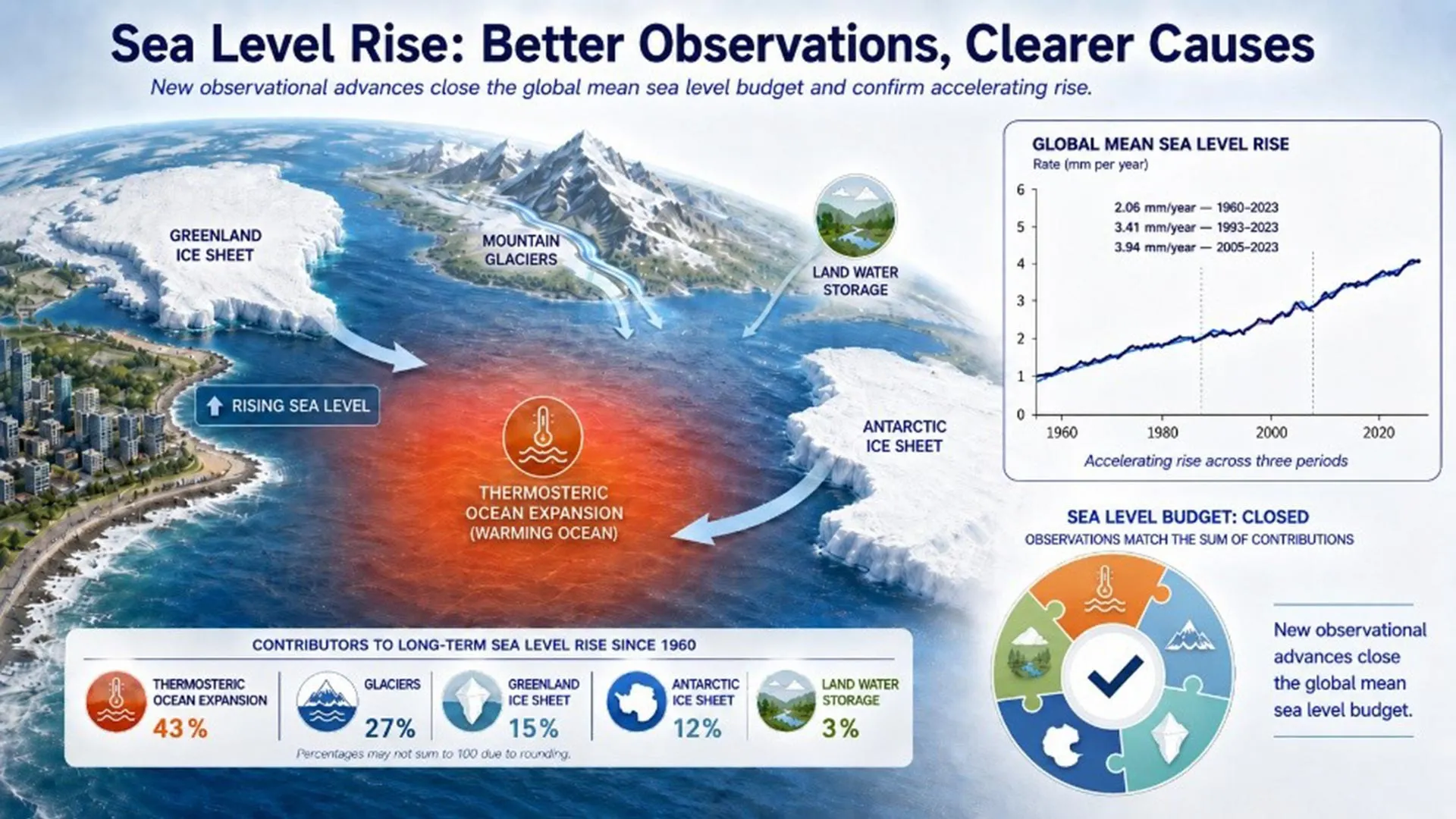
According to a new study published in scientific progressGlobal sea levels have risen at an average rate of 2.06 millimeters per year since 1960. However, the pace has increased dramatically in recent decades, reaching 3.94 millimeters per year between 2005 and 2023.
Researchers found ocean warming was the biggest culprit, accounting for 43% of the increase. As ocean water heats up, it expands and takes up more space, causing sea levels to rise around the world.
Ice melting is also an increasingly important factor. Mountain glaciers account for 27% of sea level rise since 1960, followed by the Greenland Ice Sheet for 15% and the Antarctic Ice Sheet for a further 12%. The remaining 3% is due to changes in land water storage.
The study also reveals why sea level rise has accelerated over time. Since 1960, ocean warming and decreased land water storage have played a major role. However, since 1993, the rapid melting of glaciers and ice sheets in Greenland and Antarctica has been a major factor in accelerating this trend.
Scientists warn that this pattern is likely to continue for decades to come.
Scientists unravel age-old measurement mystery
For years, researchers have been plagued by frustrating discrepancies between observed sea level rise and integrated estimates from known causes. Measurements from satellites and coastal tide gauges didn’t quite match calculations from ocean warming and ice melt.
New research appears to fill that gap.
“For years, there has been a frustrating gap between how much sea level rise is observed and how much it can be explained by individual causes. This study shows that with better instruments, processes and smarter analysis, we can close this knowledge gap. We can explain sea level rise with more confidence,” said John Abraham, professor of engineering at the University of St. Thomas. Co-author.
The research team was led by scientists from the Institute of Atmospheric Physics, Chinese Academy of Sciences. The collaboration also included researchers from Tulane University, NSF National Center for Atmospheric Research, the University of St. Thomas, and French scientific partners.
Scientists credit several technical and analytical improvements to resolve this discrepancy. These include updated revisions to satellite measurements that have been changing gradually since 2015, improvements in how coastal tide gauges measure land movement, and more accurate estimates of ice loss from Greenland and Antarctica.
Sea level rise is expected to continue for centuries
Researchers say the findings confirm an alarming reality about climate change. Even if greenhouse gas emissions eventually stabilize, sea level rise will not stop anytime soon.
The ocean slowly absorbs heat and continues to warm deep underground over long periods of time. At the same time, large ice sheets and glaciers continue to melt long after temperatures rise. Because of the inertia of this giant planet, scientists expect sea levels to continue rising for centuries.
