


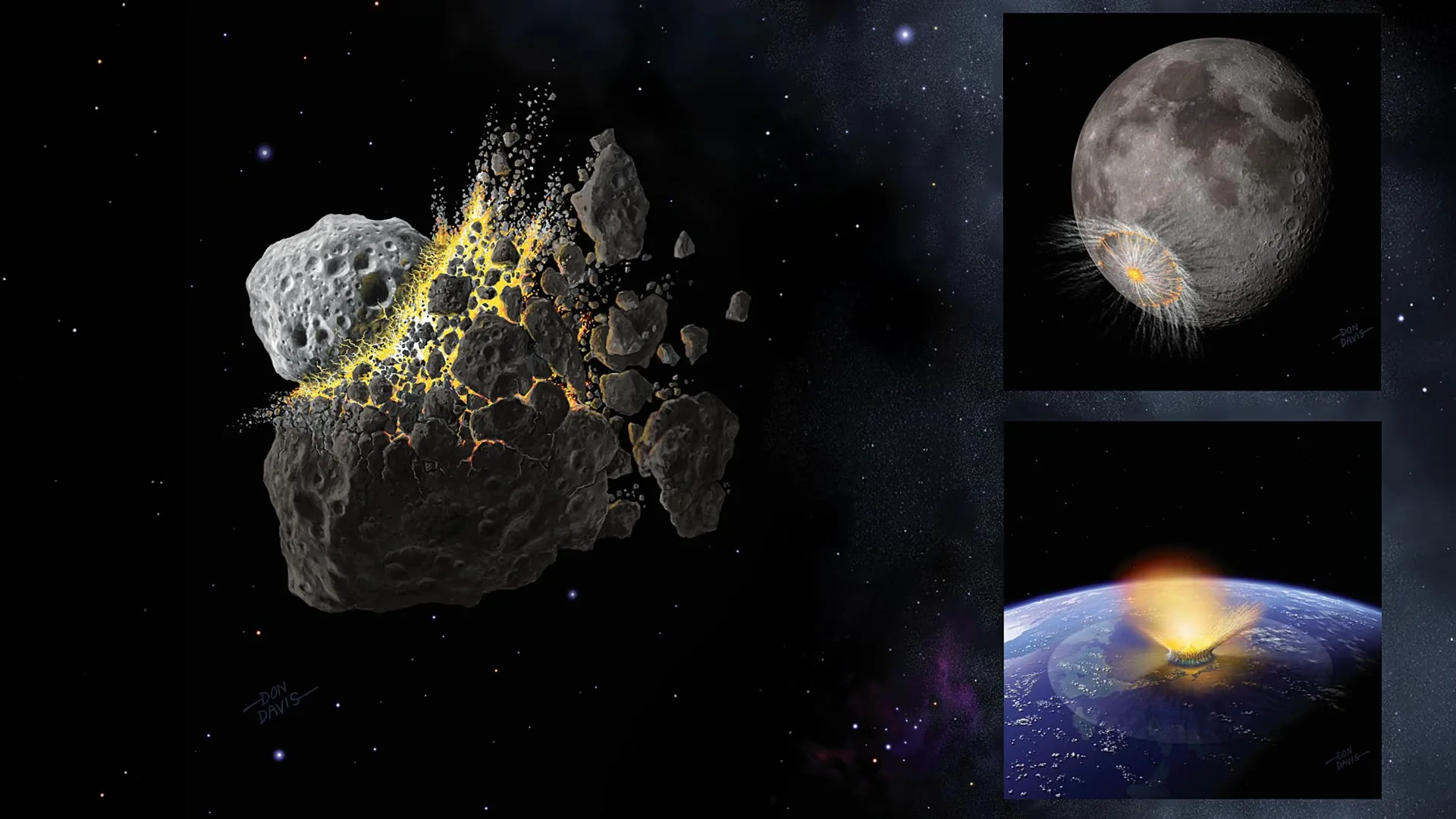
About 800 million years ago, a violent collision in the asteroid belt may have triggered a long wave of collisions in the inner solar system, according to research led by the Southwest Research Institute.
Researchers propose that the breakup of the parent body that formed the Eulalia asteroid family sent large amounts of debris flying toward Earth, the Moon, and Mars. If this relationship is correct, this event may have caused geological changes on several worlds and even influenced Earth’s climate and biosphere.
Ancient influences and history of life
“The role that impacts played in shaping the origin and evolution of life in the solar system is poorly understood,” said Dr. William Bottke, executive director of SwRI’s Solar System Science Exploration Division in Boulder, Colorado. He also directs the Center for Lunar Origins and Evolution (CLOE), a SwRI team at NASA’s Solar System Exploration Research Virtual Laboratory, and is lead author of the paper describing this research. “The moon’s cratered surface serves as a reminder of large-scale impacts in Earth’s past, but so far only the Chicxulub impact event 66 million years ago has been strongly linked to a specific impact on life, namely the mass extinction of dinosaurs.”
Chicxulub is a giant impact crater buried beneath Mexico’s Yucatan Peninsula. The asteroid impact that created it is widely associated with the extinction event that wiped out all nonavian dinosaurs and many other species.
Much older collisions are much more difficult to reconstruct. Because the Earth’s surface is constantly changing and recycling, there is little geological evidence from the impact more than 650 million years ago.
Volcanoes generate new rocks, plate tectonics reshapes continents and the ocean floor, and weathering gradually destroys exposed landforms. Together, these processes erase or fill in many ancient impact craters.
To investigate these lost chapters of Earth’s history, scientists can study asteroid showers, which are periods when debris from large collisions repeatedly slams into planets and moons in the solar system’s inner solar system.
“These rare events are caused by massive impacts in key locations in the asteroid belt, hitting entire worlds in the inner solar system,” Bottke said. “The evidence preserved on the moon’s stationary surface can therefore be used to infer what happened on Earth and Mars in ancient times.”
There are records of ancient collisions on the moon
Unlike Earth, the Moon has no active plate tectonics, flowing water, or a substantial atmosphere to rapidly erase old craters. Its surface thus serves as a more complete archive of ancient collisions.
Previous research suggests that there was a significant increase in large impacts on the Moon about 800 million years ago. That conclusion was based on the estimated age of the Moon’s main craters and the age of impact glass collected during the Apollo mission.
Impact glass forms when an impact generates enough heat to melt rocks. The molten material cools into glass, preserving chemical and chronological clues that scientists can use to estimate when the impact occurred.
While evidence from the Moon pointed to an impact spike, researchers needed to identify a realistic event in the asteroid belt that could have triggered the impact spike.
“Our space forensics team used impact and dynamical models to link these to the formation of the Eulalia asteroid family when a primitive carbonaceous chondrite-like object collided with another,” Bottke said. “The location of the parent asteroid was key; it collapsed on the brink of a 3:1 gravitational mean motion resonance with Jupiter.”
Carbonaceous chondrites are primitive carbon-rich meteorites that contain some of the oldest material formed in the solar system. Minerals and organic compounds containing water may also be included.
Jupiter’s gravity escape route
The orbital region described by Bottke is called the J3:1 resonance. In this configuration, the asteroid moves around the sun three times for every orbit of Jupiter.
Repeated gravitational nudges from Jupiter could gradually destabilize asteroids in this region. As a result, the resonance acts like an escape route from the main asteroid belt, pushing objects into elongated orbits that cross the planet’s path.
Many of the asteroids currently found near Earth are thought to have escaped from the asteroid belt through the J3:1 region.
According to the simulations, the location of Eulalia’s parent body made the breakup particularly significant. About half of the fragments entered the J3:1 resonance almost immediately.
Resonances then scattered fragments of this planet into the inner solar system, increasing the number of impacts on the Moon, Earth, Mars, and possibly other rocky worlds.
The bombardment did not end immediately. Over the next 100 million to 150 million years, an additional 25% of the debris gradually entered a resonant state due to the Yarkovsky effect.
The Yarkovsky effect is a subtle force caused by heat. Asteroids absorb sunlight and then emit that energy as infrared radiation. Because the heat is released unevenly, small extrusions occur that can slowly change the asteroid’s orbit over millions of years.
A barrage of fire spreads throughout the inner solar system
This modeling shows that the breakup of Eulalia can plausibly explain the increase in cratering on the Moon around 800 million years ago. It also suggests that the impact may have had broader effects throughout the interior of the solar system.
The Earth is much larger and has stronger gravity than the Moon, so it would have received much more impact. Researchers estimate that for every large object that hits the moon, about 20 objects of similar or larger size will hit Earth.
After that, most of the physical evidence of those collisions disappeared from the Earth’s surface. However, the timing of the bombardment coincided with a period of widespread cooling and major biological changes, raising the possibility that these effects had an impact on the global environment.
Although this study does not prove that the asteroid barrage caused these changes, this coincidence makes it an attractive target for future research.
“Given that the peak of this barrage coincided with a period of widespread cooling and major changes in the biosphere, it is tempting to suggest that the former produced the latter,” Bottke said. “On Mars, these impacts may cause significant seismic shaking and coincide with a surge in volcanic activity. Taken together, this shows how certain catastrophic impacts in the main belt may have had far-reaching effects on the history of terrestrial planets.”
