

Close Menu

    Subscribe to Updates

    Get the latest creative news from FooBar about art, design and business.

    What's Hot

    Musicians show a small but steady advantage in sustained attention from childhood to adulthood

    May 14, 2026

    Supreme Court upholds access to mifepristone while litigation continues

    May 14, 2026

    Making instant judgments about dating apps can hurt your sense of worth as a partner.

    May 14, 2026
    Facebook X (Twitter) Instagram
    Facebook X (Twitter) Instagram
    Health Magazine
    • Home
    • Environmental Health
    • Health Technology
    • Medical Research
    • Mental Health
    • Nutrition Science
    • Pharma
    • Public Health
    • Discover
      • Daily Health Tips
      • Financial Health & Stability
      • Holistic Health & Wellness
      • Mental Health
      • Nutrition & Dietary Trends
      • Professional & Personal Growth
    • Our Mission
    Health Magazine
    Home » News » Scientists use breakthrough single-atom catalyst to turn CO2 into fuel
    Nutrition Science

    Scientists use breakthrough single-atom catalyst to turn CO2 into fuel

    healthadminBy healthadminMarch 20, 2026No Comments4 Mins Read
    Scientists use breakthrough single-atom catalyst to turn CO2 into fuel
    Share
    Facebook Twitter Reddit Telegram Pinterest Email


    Every chemical reaction must overcome an energy hurdle before it can occur. For a substance to start a reaction, it first needs an input of energy. In some cases, this barrier can be small, like lighting a match. However, many industrial processes require much more energy, increasing costs.

    To make reactions easier and more efficient, chemists rely on substances called catalysts. These “reaction helpers” reduce the energy required. The most effective catalysts often contain metals, including rare and expensive metals.

    A revolutionary catalyst that converts CO2 into methanol

    Researchers at ETH Zurich are currently making significant progress in designing catalysts. Their new system significantly reduces the energy required to produce methanol (alcohol) from carbon dioxide and hydrogen.

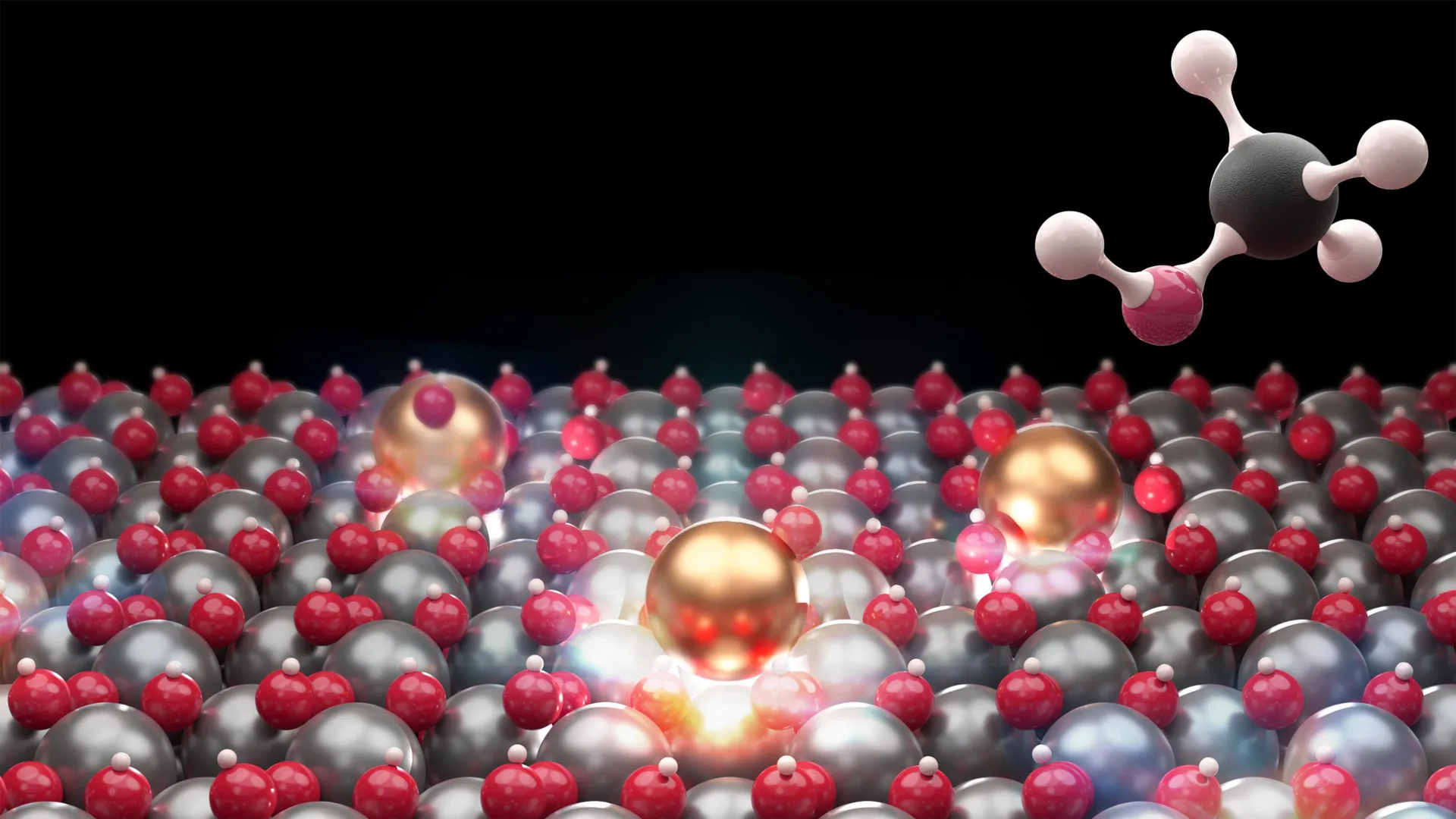
    The team also made an unusually efficient use of the metal indium. In this catalyst, each individual indium atom acts as its own active site. This is a significant change from the traditional approach of grouping metals as particles.

    Another important benefit is increased accuracy. Up until now, catalyst development has often relied on trial and error. This new design allows scientists to better observe and understand the reactions occurring on the surface, opening the door to more planned and optimized catalyst development.

    The role of methanol in sustainable chemistry

    “Methanol is the Swiss Army knife of chemistry, a universal precursor for the production of a wide range of chemicals and materials, including plastics,” says Javier Pérez Ramírez, professor of catalysis at ETH Zurich.

    Methanol is essential for the production of fuels and materials, and its role is increasing in the transition away from fossil fuels. Methanol production can be climate-neutral if the hydrogen and energy used in the process come from renewable sources.

    This approach also offers new ways to utilize CO2. Instead of releasing it into the atmosphere, it can be captured and turned into valuable raw materials.

    Single-atom catalyst maximizes efficiency

    “Our new catalyst has a monoatomic structure, in which isolated active metal atoms are fixed on the surface of a specially developed support material,” explains Pérez Ramirez.

    In traditional catalysts, metals are typically broken down into small particles that can contain hundreds or thousands of atoms. Many of these atoms do not directly participate in the reaction, making the process less efficient.

    Single-atom catalysts offer a more efficient alternative. Using metals at the level of individual atoms allows scientists to make better use of rare and expensive elements. In some cases, this can even make the use of precious metals practical in industrial applications.

    Working with isolated atoms can also change the behavior of catalysts. “Indium has already been used in this catalyst for more than 10 years,” says Pérez Ramírez. “Our study shows that the use of isolated indium atoms on hafnium oxide enables more efficient CO2-based methanol synthesis than indium in the form of nanoparticles containing a large number of atoms.”

    Engineering stable single-atom catalysts

    To precisely place individual indium atoms on the surface of hafnium oxide, the ETH team developed several new synthetic methods in collaboration with other research groups. A key element was to design a support material that maintains stability while maintaining atomic reactivity.

    One method involves burning the starting material in a flame at temperatures of 2,000 to 3,000 °C, followed by rapid cooling. Under these conditions, the indium atoms remain on the surface and are firmly embedded.

    The resulting catalyst is highly durable. The researchers showed that these single-atom systems can withstand harsh conditions such as high temperatures and pressures. This is important because producing methanol from CO2 and hydrogen typically requires temperatures of up to 300°C and pressures of up to 50 times normal atmospheric pressure levels.

    Clearer insight into reaction mechanisms

    Traditional catalysts made from nanoparticles have long been difficult to study. Although the reaction occurs on the surface atoms, much of the measured signal comes from atoms inside the particle that are not involved in the reaction. This makes it difficult to interpret what is actually happening.

    Using single-atom catalysts alleviates this problem. Because only isolated atoms are present, scientists can analyze reaction mechanisms with fewer interferences, providing clearer insight.

    Pérez Ramírez has been working on improving CO2-based methanol production since 2010, working closely with industry. He also holds several patents in this field. According to him, the success of this new catalyst was made possible by the strong collaboration of the entire Swiss research community: “Without this interdisciplinary expertise, the development of the methanol catalyst and the detailed analysis of its mechanism would not have been possible.”


    Source link

    Visited 19 times, 1 visit(s) today
    Share. Facebook Twitter Pinterest LinkedIn Telegram Reddit Email
    Previous ArticleLB Bohle at Interphex 2026
    Next Article Carbon removal hub stalls as DOE audit drags on
    healthadmin

    Related Posts

    After 100 years, scientists finally uncover the hidden laws behind cosmic rays

    May 14, 2026

    Huge ‘stealth’ magma surge triggers thousands of earthquakes beneath Atlantic island

    May 14, 2026

    Scientists say taking a daily multivitamin may slow aging

    May 14, 2026

    Giant squid discovery reveals hidden deep-sea world off the coast of Australia

    May 14, 2026

    Organic molecules discovered in 66-million-year-old dinosaur bones shake up paleontology

    May 14, 2026

    Scientists discover strange way CO2 cools parts of Earth’s atmosphere

    May 14, 2026
    Add A Comment

    Comments are closed.

    Categories

    • Daily Health Tips
    • Discover
    • Environmental Health
    • Exercise & Fitness
    • Featured
    • Featured Videos
    • Financial Health & Stability
    • Fitness
    • Fitness Updates
    • Health
    • Health Technology
    • Healthy Aging
    • Healthy Living
    • Holistic Healing
    • Holistic Health & Wellness
    • Medical Research
    • Medical Research & Insights
    • Mental Health
    • Mental Wellness
    • Natural Remedies
    • New Workouts
    • Nutrition
    • Nutrition & Dietary Trends
    • Nutrition & Superfoods
    • Nutrition Science
    • Pharma
    • Preventive Healthcare
    • Professional & Personal Growth
    • Public Health
    • Public Health & Awareness
    • Selected
    • Sleep & Recovery
    • Top Programs
    • Weight Management
    • Workouts
    Popular Posts
    • 1773313737_bacteria_-_Sebastian_Kaulitzki_46826fb7971649bfaca04a9b4cef3309-620x480.jpgHow Sino Biological ProPure™ redefines ultra-low… March 12, 2026
    • the-pros-and-cons-of-paleo-dietsThe Pros and Cons of Paleo Diets: What Science Really Says April 16, 2025
    • pexels-david-bartus-442116The food industry needs to act now to cut greenhouse… January 2, 2022
    • 1773729862_TagImage-3347-458389964760995353448-620x480.jpgDespite safety concerns, parents underestimate the… March 17, 2026
    • Improve Mental Health10 Science-Backed Practices to Improve Mental Health… March 11, 2025
    • 1773209206_futuristic_techno_design_on_background_of_supercomputer_data_center_-_Image_-_Timofeev_Vladimir_M1_4.jpegMulti-agent AI systems outperform single models… March 11, 2026

    Demo
    Stay In Touch
    • Facebook
    • Twitter
    • Pinterest
    • Instagram
    • YouTube
    • Vimeo
    Don't Miss

    Musicians show a small but steady advantage in sustained attention from childhood to adulthood

    By healthadminMay 14, 2026

    Learning a musical instrument may strengthen your attention and alertness from childhood to adulthood, according…

    Supreme Court upholds access to mifepristone while litigation continues

    May 14, 2026

    Making instant judgments about dating apps can hurt your sense of worth as a partner.

    May 14, 2026

    Eli Lilly contributes $50 million to UNICEF’s childhood health initiatives

    May 14, 2026

    Subscribe to Updates

    Get the latest creative news from SmartMag about art & design.

    HealthxMagazine
    HealthxMagazine

    At HealthX Magazine, we are dedicated to empowering entrepreneurs, doctors, chiropractors, healthcare professionals, personal trainers, executives, thought leaders, and anyone striving for optimal health.

    Our Picks

    Eli Lilly contributes $50 million to UNICEF’s childhood health initiatives

    May 14, 2026

    Epic, Cleveland Clinic joins CMS preclearance effort

    May 14, 2026

    After 100 years, scientists finally uncover the hidden laws behind cosmic rays

    May 14, 2026
    New Comments
      Facebook X (Twitter) Instagram Pinterest
      • Home
      • Privacy Policy
      • Our Mission
      © 2026 ThemeSphere. Designed by ThemeSphere.

      Type above and press Enter to search. Press Esc to cancel.